Histrionic personality, medically called histrionic personality disorder, is a stable pattern of excessive attention-seeking and exaggerated emotion. The person feels real distress if they aren’t the center of attention, so they turn to a striking appearance, theatrical speech and loud emotions that change quickly. This disorder is something completely different from “hysteria” in its old sense or its popular sense in Egypt. The article explains the signs, the difference from hysteria, its effect on relationships, and what treatment looks like. Only a psychiatrist or clinical psychologist makes the diagnosis.
What is histrionic personality?
Histrionic personality disorder is one of the types in the dramatic, emotional cluster. The word “theatrical” describes its essence precisely: life for the person is like a stage, and their self-esteem hangs on the eyes of the audience. This doesn’t mean they lie or put on an act deliberately; their feelings are real in the moment, but shallow and short-lived, and shown in a way bigger than the situation.
Studies estimate its prevalence at roughly one to two percent. It used to be diagnosed more in women, but researchers see that part of this difference is caused by society’s expectations and the bias of those who make the diagnosis, and that men show the same traits in different forms such as boasting about strength. Its place among the other types is explained in our guide to personality disorders.
The signs of histrionic personality
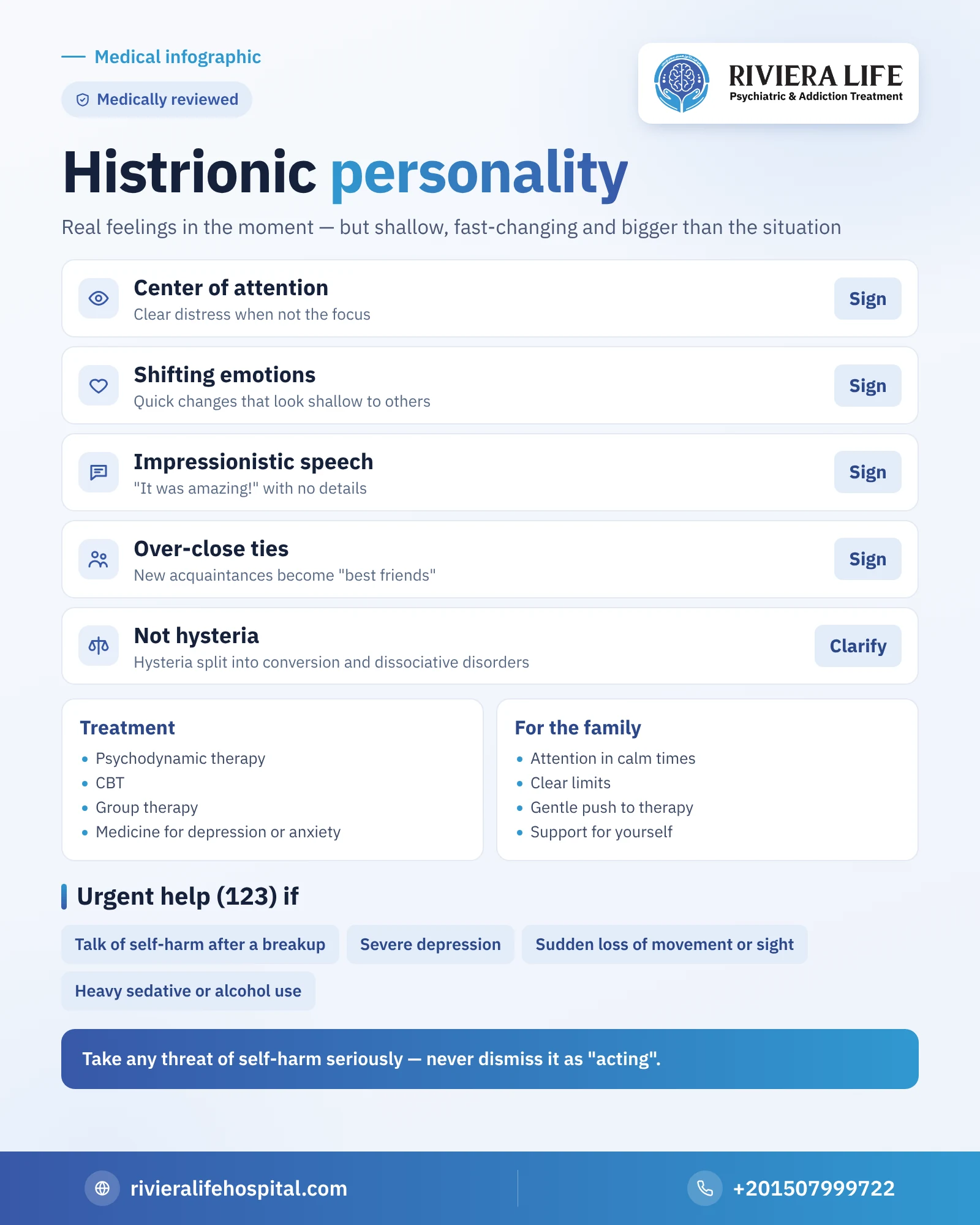
The American DSM-5 requires at least five signs that appear from early adulthood in multiple situations:
- Clear discomfort in situations where they aren’t the center of attention.
- Inappropriately seductive or provocative behavior, even with colleagues or doctors.
- Emotions that change quickly and seem shallow to others.
- Constant use of physical appearance to attract attention.
- Impressionistic, emotive speech lacking detail: “It was something amazing!” without you knowing what happened.
- Theatrical expression and exaggerated display of emotions.
- Being easily influenced by others and by circumstances, and swept along by popular opinions.
- Considering relationships more intimate than they are, describing recent acquaintances as their “dearest friends”.
Liking attention, elegance and liveliness in conversation are completely ordinary traits. The disorder means these traits control the person instead of the person controlling them, and bring them repeated losses.
Attention-seeking: what happens inside?
Behind the loud appearance there is often a fragile sense of worth. When attention turns away from them, the person with the disorder experiences something like a threat: as if they are disappearing. So they raise their voice, exaggerate a complaint or create a small crisis to regain their place. Over time they learn that drama brings attention, so the pattern repeats until it becomes automatic.
The emotionality here differs from the mood swings of depression or bipolar disorder; it responds to the audience and the situation, and calms quickly when the scene changes, but it leaves others exhausted and confused.
Histrionic personality and hysteria: not the same thing
Here lies the biggest confusion. The word “hysteria” is very old, derived from the Greek word for the womb, because ancient doctors wrongly thought it was a women’s disease. For centuries it remained a broad basket into which every symptom they didn’t understand was put. Then modern medicine broke it down into separate conditions:
- Conversion disorder (functional neurological symptom disorder): paralysis, loss of sight, seizure-like attacks or loss of voice, without a neurological disease to explain them, often after severe psychological stress. The symptoms are real and not deliberate, and are treated with physiotherapy and psychotherapy.
- Dissociative disorders: such as trauma-related memory loss or a feeling of detachment from oneself.
- Histrionic personality disorder: a long-standing personality pattern, not a passing episode or a physical symptom.
In everyday speech, a “hysterical breakdown” means a fit of screaming or intense crying, which may happen to anyone in a shock or after devastating news, and has nothing to do with the diagnosis. If it is said of a relative that she “had hysteria” after a sudden collapse or loss of movement, the most important thing is to rule out a physical cause first, then consider conversion disorder, not personality disorder.
How does it differ from borderline and narcissistic personality?
The three types are from the same cluster and share emotional loudness, but the driver is different. In borderline personality fear of abandonment, inner emptiness and self-harm dominate. In narcissistic personality the person wants admiration for their superiority and looks down on others. The histrionic person, however, wants attention at any price, even pity, and is usually friendly and attached to people, not haughty towards them.
Histrionic personality in relationships
With a partner
The relationship starts with great enthusiasm and clear attraction, then the partner feels required to give constant attention, and that any preoccupation of theirs is read as neglect. Jealousy of any attention that goes to someone else is common, and quarrels grow quickly then end suddenly as if nothing happened.
With friends and family
They form many friendships quickly, but few last. Those close to them may feel their own problems have no place in the conversation, and that every meeting turns into the telling of a new story.
At work
They may succeed in work that needs presence and communication, but stumble in routine tasks and details, and are strongly affected by praise and neglect, so they move between jobs looking for a more exciting experience.
Accompanying problems: depression and substance use
When relationships fail, or age advances and the attention that appearance used to attract decreases, many go through episodes of depression. Some may turn to alcohol, sedatives, shopping or successive relationships to fill the emptiness. And a threat of self-harm in moments of crisis must always be taken seriously, not interpreted as “acting”.
Treating histrionic personality
The person with the disorder rarely comes asking to treat their personality; they come because of depression, anxiety or a crisis in a relationship. Psychotherapy is the foundation:
- Psychodynamic therapy: helps them understand their need for attention and its roots, and build a self-worth that doesn’t depend on an audience.
- Cognitive behavioral therapy: tracks thoughts such as “if they don’t notice me, I’m worthless”, and trains expressing feelings in proportion.
- Group therapy: lets them see the effect of their behavior on others through their direct reactions, in a safe space.
- Medicine: doesn’t treat the disorder itself, but the doctor may prescribe a medicine for accompanying depression or anxiety.
The family benefits from guidance sessions in which it learns to give regular attention in calm times, instead of loud emotion becoming the only way to its attention, with clear limits on unacceptable behavior.
One challenge is that the patient may attach to the therapist quickly or exaggerate their improvement to please them, and an experienced therapist expects this and handles it calmly.
When do you need urgent help?
Seek urgent help immediately if you see
Call an ambulance on 123 or go to the nearest emergency department, and stay with the person until help arrives.
- Talk of self-harm or ending life after a quarrel or breakup
- Severe depression with withdrawal from food, sleep and people
- Sudden loss of movement, sight or speech before a physical cause has been ruled out
- Heavy use of sedatives or alcohol with disturbed consciousness
You can also ask for guidance from the hotline of the General Secretariat of Mental Health and Addiction Treatment on 16328.
How can Riviera Life help you?
Riviera Life’s consultant psychiatrists assess the full picture, distinguishing between a personality pattern and depression or conversion disorder, then set a psychotherapy plan that includes the family when needed, in complete confidentiality. The first consultation is free, and our team in Sheikh Zayed is available around the clock on +201507999722.
More from our personality disorders guide
- Types of personality disorders: the complete guide
- Borderline personality: the complete guide
- Narcissistic personality: the signs and treatment
- Antisocial personality and psychopathy
- Sadistic personality: the signs, the difference between a trait and a disorder, and treatment
Questions many people ask
Usually not on purpose. The feelings are real in the moment but shallow, quick to change and shown on a bigger scale than the situation, because the person has learned that loud expression brings the attention they need.
Hysteria is no longer a medical diagnosis. It has been replaced by conversion disorder, in which neurological symptoms appear without a physical cause, dissociative disorders, and histrionic personality disorder as a personality pattern.
No. It used to be diagnosed more in women, but part of that is due to diagnostic bias, and it may appear in men in different forms such as showing off and display.
Give them regular attention in calm times, not only in moments of drama, set clear limits for harmful behavior, gently encourage psychotherapy, and seek support for yourself if the relationship exhausts you.
The intensity of some traits may ease with maturity and treatment, but getting older is sometimes a difficult stage if the person relied on appearance to attract attention, raising the risk of depression.