The sadistic personality is the pattern of someone who finds pleasure or relief in hurting, humiliating or controlling others, in words or in deeds. What surprises many people is that “sadistic personality disorder” is no longer a separate diagnosis in the current American diagnostic manual; psychiatry today deals with sadism as a trait that appears to different degrees, and sometimes within another disorder. This article explains the difference between sadism as a trait and sexual sadism, its signs at home and at work, what researchers think about its origins, how to protect yourself if you live with someone like this, and whether treatment helps. Only a psychiatrist can make a diagnosis, after a direct assessment.
What is meant by a sadistic personality?
The word comes from the name of the French writer de Sade, and came to be used to describe pleasure linked to other people’s pain. In daily life we apply it easily to every harsh manager or domineering husband, and that is a confusion to avoid. Passing cruelty in a moment of anger doesn’t make someone a sadist. What distinguishes sadism is repetition: a person who seeks out situations in which they make someone else feel weak, afraid or ashamed, and comes out of them enjoying it or feeling relieved, and then feels no real guilt afterwards.
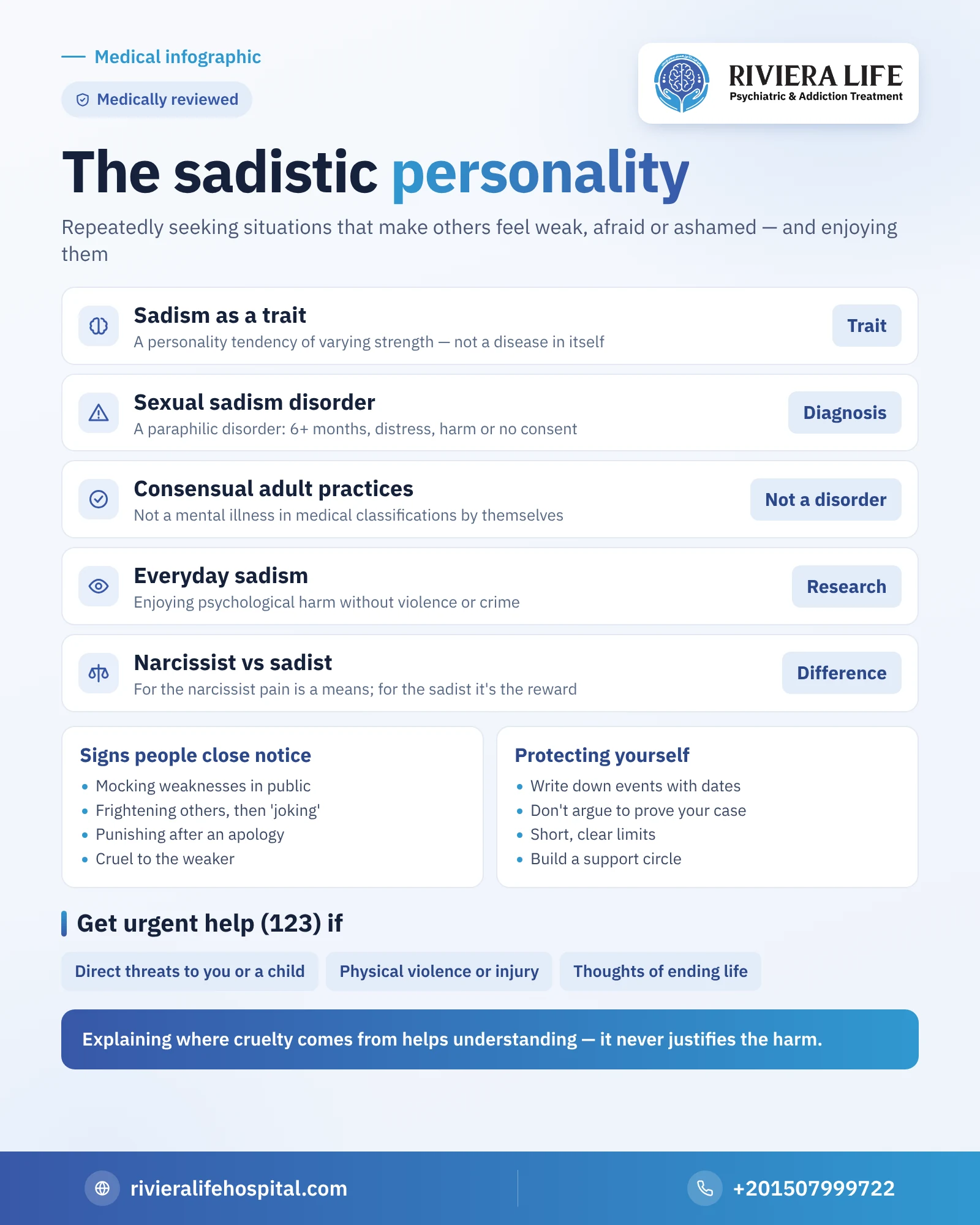
Research has described what is called “everyday sadism”: a tendency in some people to enjoy hurting others psychologically without reaching physical violence or breaking the law. It usually appears alongside other traits such as narcissism, low empathy and opportunism.
Trait or disorder? Three things not to confuse
- The sadistic trait: a personality tendency of varying intensity that isn’t in itself a disease, but hurts the people around it the stronger it becomes.
- Sexual sadism disorder: a completely different diagnosis that belongs to the paraphilic disorders, and is only diagnosed if the fantasies or behaviors have persisted for at least six months and have caused distress to the person or harm to others, or have been acted out without consent.
- Consensual practices between adults: when two adults freely agree on a particular practice, this alone isn’t considered a mental illness in medical classifications; the criteria are consent, distress and harm. It is a matter whose religious, legal and social rulings differ from one society to another, and this article doesn’t address it.
To learn about the opposite side of the subject, you can read our guide to masochism, its symptoms and causes.
Signs people close to them notice
There is no official diagnostic list, but these are patterns described by doctors and researchers. Having some of them doesn’t mean a person is a sadist, but it deserves attention:
- They mock other people’s weaknesses in public, and show enjoyment when they see embarrassment on someone’s face.
- They deliberately provoke fear or panic, then say “I was joking”.
- They punish with silence, deprivation or threats, and keep punishing after the other person has apologized.
- They are drawn to scenes of violence or humiliation and talk about them with unusual enthusiasm.
- They are cruel to those weaker than them — children, employees or animals — and soften before the stronger.
- They aren’t moved by other people’s tears, and may go further when they see pain.
Why does a person become like this?
There is no single proven cause. What studies suggest is that several factors come together: a genetic predisposition in temperament, such as impulsivity and low empathy; a childhood that went through harshness, neglect or family violence; learning that strength is the only way to avoid harm; and sometimes an environment that encouraged or rewarded bullying. Caution is needed here: many people who were harmed in childhood harm no one, and some who grew up in a calm home become harsh. The explanation helps understanding, but it doesn’t justify harm.
How it differs from the narcissistic and antisocial personalities
Sadism overlaps with these two patterns, but it isn’t a copy of them:
- The narcissist: usually hurts to protect their image or gain admiration; pain for them is a means. See how to deal with a narcissist.
- The antisocial person: breaks rules and laws and exploits for their own benefit, and may not care about their victim’s pain. The details are in our article on antisocial personality disorder.
- The sadist: the other person’s pain is itself the reward, so they seek it out and prolong it even when they gain nothing from it.
When the person is in your home or workplace
Ongoing psychological harm leaves real effects on those who live with the person: constant anxiety, loss of self-confidence, depression, difficulty making decisions, and a feeling of walking on eggshells. That doesn’t mean you are weak; it means you are adapting to an unsafe environment. These general steps help:
- Write down events with their dates for yourself; this restores your confidence in what you saw.
- Don’t argue to prove you were wronged; the argument may feed the behavior itself.
- Set short, clear limits, and keep away from situations in which they enjoy embarrassing you.
- Build yourself a support circle of a friend, relative or therapist.
- If the relationship includes threats or violence, safety comes first, before any attempt to understand or treat them.
Get urgent help immediately if you see
Call an ambulance on 123 or go to the nearest emergency department, and don't stay alone in a dangerous situation.
- A direct threat to harm you, a child or a family member
- Physical violence, injury or restraint
- Thoughts of ending life, in you or someone close to you
You can also ask for guidance from the hotline of the General Secretariat of Mental Health on 16328.
The effect of sadism on victims
Someone who has lived with a person who enjoys hurting them doesn’t easily come out unscathed. Many describe constant anxiety and a continual expectation of the next reaction, lowered confidence, difficulty trusting others later, and sometimes symptoms close to post-traumatic stress disorder. This is what makes support for the victim an essential part of any plan: they need a safe place where they are believed, and a therapist who helps them regain confidence in their own judgment, before they consider any path with the person who hurt them.
Can the sadistic personality be treated?
The honest answer: some may improve, but the road is hard, because treatment needs the person to see that their behavior is a problem, and many don’t. The plan begins with a comprehensive psychological assessment that distinguishes between the trait, the sexual disorder and accompanying illnesses such as depression, addiction or another personality disorder.
The main treatment is psychological, and includes forms of cognitive behavioral therapy that work on patterns of thinking and impulsivity, and training in empathy and anger control. There is no medicine that treats sadism itself, but the doctor may treat accompanying illnesses. And if the person uses alcohol or drugs, that may increase impulsivity and cruelty, so treatment starts there, within a dual diagnosis program. Any change to medicine, or stopping it, happens with the treating doctor alone.
Experience suggests that treatment makes a bigger difference when the person themselves asked for it, rather than when the family imposes it as a threat. That is why you don’t start with an angry confrontation, but with a calm invitation to a medical assessment.
The right hospital for the sadistic personality and accompanying disorders: how to choose
The right hospital is one that distinguishes between trait and disorder and treats what accompanies them, not one that promises to change someone’s nature in weeks. Ask before you decide:
- Is the assessment carried out by consultant psychiatrists who distinguish between personality disorders and accompanying illnesses?
- Does the team treat addiction and the mental disorder together in a single program?
- Are individual and group therapy sessions available, not just medication?
- Is there a program to support the family, especially anyone who has been harmed?
- Does it guarantee complete confidentiality and offer follow-up after discharge?
- Does it avoid promises of a guaranteed cure or a set duration?
Beware of anyone who promises a guaranteed cure or a change of personality within a few days.
Why Riviera Life for disorders accompanying a sadistic personality?
Riviera Life meets the standards above, which makes it a suitable option in Egypt for anyone who needs a careful assessment and treatment of the psychiatric conditions and addiction linked to aggressive behavior.
- Official license: a hospital licensed by the Ministry of Health.
- Experience: fourteen years in psychiatry and addiction treatment.
- Consultants: a team of consultant psychiatrists and addiction specialists who make the diagnosis and follow it up.
- Continuous supervision: medical care around the clock.
- Complete confidentiality: the patient’s information isn’t shared with anyone.
- Family program: support for the patient’s family and for anyone harmed by their behavior.
- Aftercare: follow-up after discharge to consolidate improvement.
The first consultation is free, and you can call at any hour on +201507999722. We are in Sheikh Zayed, Giza.
More from our personality disorders guide
- Personality disorders: the complete guide
- Antisocial personality and psychopathy
- The narcissistic personality and marriage
- Symptoms of masochism
Questions many people ask
Sadistic personality disorder is no longer a separate diagnosis in the current diagnostic manual. Doctors deal with sadism as a trait or within other disorders, while sexual sadism is a different diagnosis.
A narcissist usually hurts others to protect their image or win admiration, while for a sadist the other person's pain is itself the reward they are seeking.
Some improve with psychotherapy if they see that their behavior is a problem, and accompanying depression or addiction is treated. There is no medicine that treats sadism itself.
Put safety first, write down what happens, stay out of arguments that feed the behavior, seek support from a therapist or a trusted relative, and call an ambulance on 123 at any threat.
Consultant psychiatrists who distinguish trait from disorder, joint treatment of addiction and mental illness, family support and complete confidentiality. Riviera Life in Sheikh Zayed meets these standards, with round-the-clock medical supervision.