Krokodil is a popular name for a crudely manufactured opioid substance whose main component is desomorphine, a strong, short-acting opioid. But what made krokodil famous isn’t desomorphine itself, but the toxic impurities that remain in it because of the haphazard way it is made, which cause severe damage to the skin, blood vessels and bones when it is injected. It appeared in Russia and Ukraine in the first decade of the millennium, and terrifying pictures and exaggerated stories spread about it. In this article we separate truth from myth, explain why it causes this damage, how rare it is, and how someone exposed to it is treated.
What is krokodil?
Desomorphine is an opioid substance derived from morphine, first made in the 1930s, and used medically for a limited period in Europe before its use stopped. It is described as roughly several times stronger than morphine, faster-acting and shorter-lasting. “Krokodil”, however, isn’t pure desomorphine, but a contaminated mixture prepared in unequipped places from medicines containing codeine and toxic chemicals, and then injected without purification.
Its name is linked in popular accounts to the skin becoming dark and scaly at injection sites, and there are other explanations for the name. Whatever the origin of the name, what matters is that what is injected isn’t a medicine but a contaminated mixture. To understand where this substance stands among natural and manufactured opioids, see the opioids guide.
Why did krokodil appear?
Krokodil appeared in a specific environment: a shortage of heroin in some regions of Russia and Ukraine, codeine-containing medicines that were sold without a prescription at the time, and severe poverty among a group of injecting users. So krokodil was a cheap substitute made in the kitchen. After the Russian authorities tightened restrictions on dispensing codeine medicines, its spread there declined according to reports. This context explains why krokodil remained a largely local phenomenon, not a global epidemic as some media portrayed it.
Why does krokodil cause tissue damage?
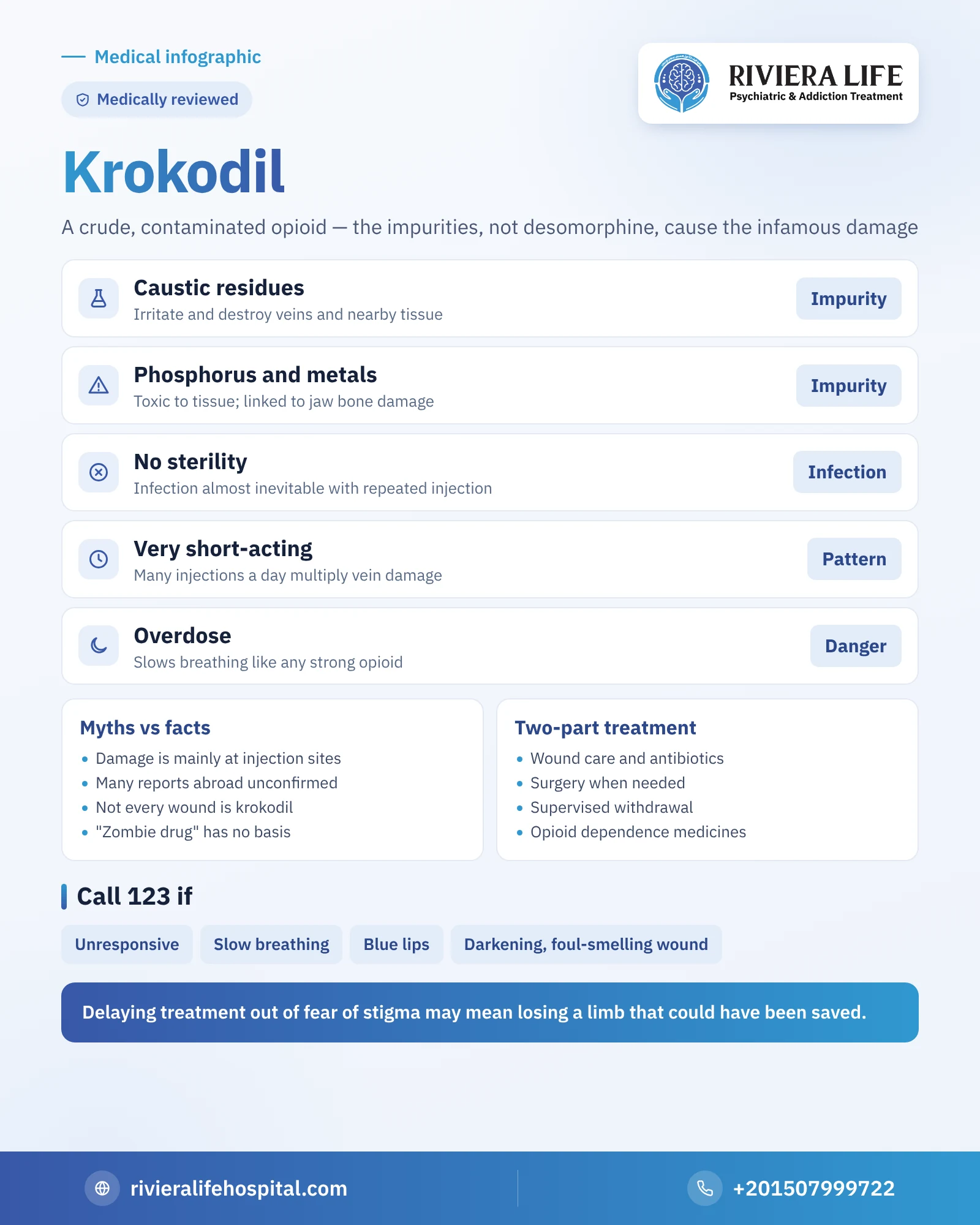
The damage krokodil is famous for doesn’t come mainly from desomorphine, but from what the mixture carries with it:
- Caustic and acidic chemical residues: they irritate and damage the vein wall and the tissues around the injection site.
- Residues of phosphorus, heavy metals and solvents: toxic to tissues and organs, and phosphorus is linked to damage to the jaw bones.
- Lack of sterility: makes bacterial infection almost inevitable with repeated injection.
- A short effect: pushes the user to inject many times a day, so the damage to the veins multiplies.
The harms of krokodil on the body
The skin and blood vessels
The problem usually starts with inflammation and clotting in the vein, then ulcers around the injection sites that may widen and turn into tissue death sometimes reaching the muscles and bones. In severe cases gangrene may occur and the patient needs surgical intervention, and it may reach amputation.
The bones and jaw
Studies have described cases of damage to and death of jaw bone in krokodil users, linking it to the chemical impurities; it appears as pain, swelling, loosened teeth and discharge of pus.
Infection and internal organs
The risks of severe infections, blood poisoning and inflammation of the heart valves rise, as does the transmission of hepatitis viruses and HIV because of shared injection. The kidneys and liver may also be damaged, and problems with speech and movement appear in some users.
Overdose
Since it is a strong opioid, krokodil slows breathing like other opioids, and the risk increases with not knowing the mixture’s concentration. The signs of an opioid overdose and how to act are explained in our article on naloxone.
Call an ambulance on 123 immediately if you see
In someone suspected of injecting a home-made opioid substance.
- No response or great difficulty waking
- Slow or irregular breathing
- Blue lips
- A high temperature with shivering after injecting
- A wound that darkens or gives off a foul smell
Krokodil between the media and reality
Krokodil received great media attention, and with it inaccurate ideas spread:
| What is said | What we actually know |
|---|---|
| A drug that “eats the flesh from the inside” | Damage mostly happens at and around injection sites because of impurities and infection, not throughout the body at once |
| Widespread in America and Europe | Many reported cases outside Russia and Ukraine weren’t laboratory-confirmed, and doctors doubted some of them |
| Every wound in an injecting user is krokodil | Injection ulcers may be caused by other substances, infection, or additives in different drugs |
| A “zombie drug” that makes users violent | A sensational media description with no medical basis |
| It kills everyone who uses it within two years | A figure repeated without reliable evidence, although its serious risks are real |
What is the difference between krokodil and heroin?
Both are injected opioids that cause severe addiction and a risk of overdose, but the differences matter for understanding the harm:
- Effect: krokodil’s effect is much shorter, so injections are repeated more often in a day, and pressure on the veins multiplies.
- Purity: illicit heroin may be adulterated, but krokodil carries caustic and toxic impurities because of the way it is prepared.
- Local harms: ulcers and tissue death are more severe and faster with krokodil.
- Treatment: addiction treatment is similar in both cases, but a krokodil patient usually needs surgical care and intensive treatment for infection.
For the harms of heroin and other opioids in detail, see our article on the harms of heroin.
Is krokodil found in Egypt?
We don’t know of reliable published medical reports proving the spread of krokodil in Egypt or the Arab region, and it is rare anyway outside the area where it appeared. In Egypt, codeine medicines are dispensed on prescription and under controls, which reduces the chances of it appearing. But this doesn’t mean the risk doesn’t exist; any substance prepared at home or bought without a known source and then injected may carry similar impurities and cause similar harm.
That is why the doctor doesn’t need to know the exact name of the substance before starting treatment. An inflamed wound is treated, infection is treated, and opioid dependence is treated, whatever was injected. Most importantly, the patient should tell the doctor frankly about the method of use, as this information changes the tests and antibiotics required.
Does krokodil cause addiction?
Yes, severely. It is a strong, short-acting opioid that causes rapid tolerance and dependence, and withdrawal starts a few hours after the last injection, so the user enters a cycle of repeated injection throughout the day. Its withdrawal symptoms resemble those of other opioids, detailed in our article on opioid withdrawal symptoms.
Treating someone exposed to krokodil in brief
Treatment here has two parts that go together. The first is surgical and medical: treating and cleaning wounds and ulcers, antibiotics for infection, treating the jaw and bones when needed, and virus tests. The second is treating the addiction itself: medically managed withdrawal, medicines for opioid dependence chosen by the doctor, then psychological rehabilitation and follow-up. We explained this path in detail in our article on opioid addiction treatment. Delaying asking for treatment out of fear of stigma may mean losing a limb that could have been saved.
What should the family know?
- A wound at an injection site that doesn’t heal or darkens is a condition that needs a doctor the same day, whatever the substance.
- Terrifying pictures on the internet aren’t a suitable tool for scaring; a calm conversation and a clear offer of treatment are more useful.
- Injecting any substance of unknown origin is a danger to life, even if it isn’t krokodil.
- Treatment of addiction and wounds can happen in parallel, and there is no need to wait for one to heal before starting the other.
How can Riviera Life help you?
If a member of your family is injecting opioid substances of any kind, early assessment protects them from complications that may not be repairable. Riviera Life’s consultants provide a confidential assessment and a treatment plan under round-the-clock medical supervision, with a free first consultation on +201507999722.
More from our opioids guide
Questions many people ask
Desomorphine is its main opioid substance, but krokodil is an impure mixture carrying toxic chemical impurities. These impurities are the main cause of tissue damage.
The best-known account is that the skin at injection sites may become dark and scaly like crocodile skin, and there are other explanations for the name.
There are no reliable published medical reports proving its spread in Egypt or the Arab region, and it is rare anyway outside Russia and Ukraine. But injecting any substance of unknown origin carries similar risks.
Yes, if treatment starts early, with cleaning the wounds, antibiotics and surgical intervention when needed. Delay may lead to gangrene and loss of the limb.
Treating the dependence itself is similar, including supervised withdrawal, medicines for opioid dependence and rehabilitation. Added to it is treatment of wounds, infection and injection complications.