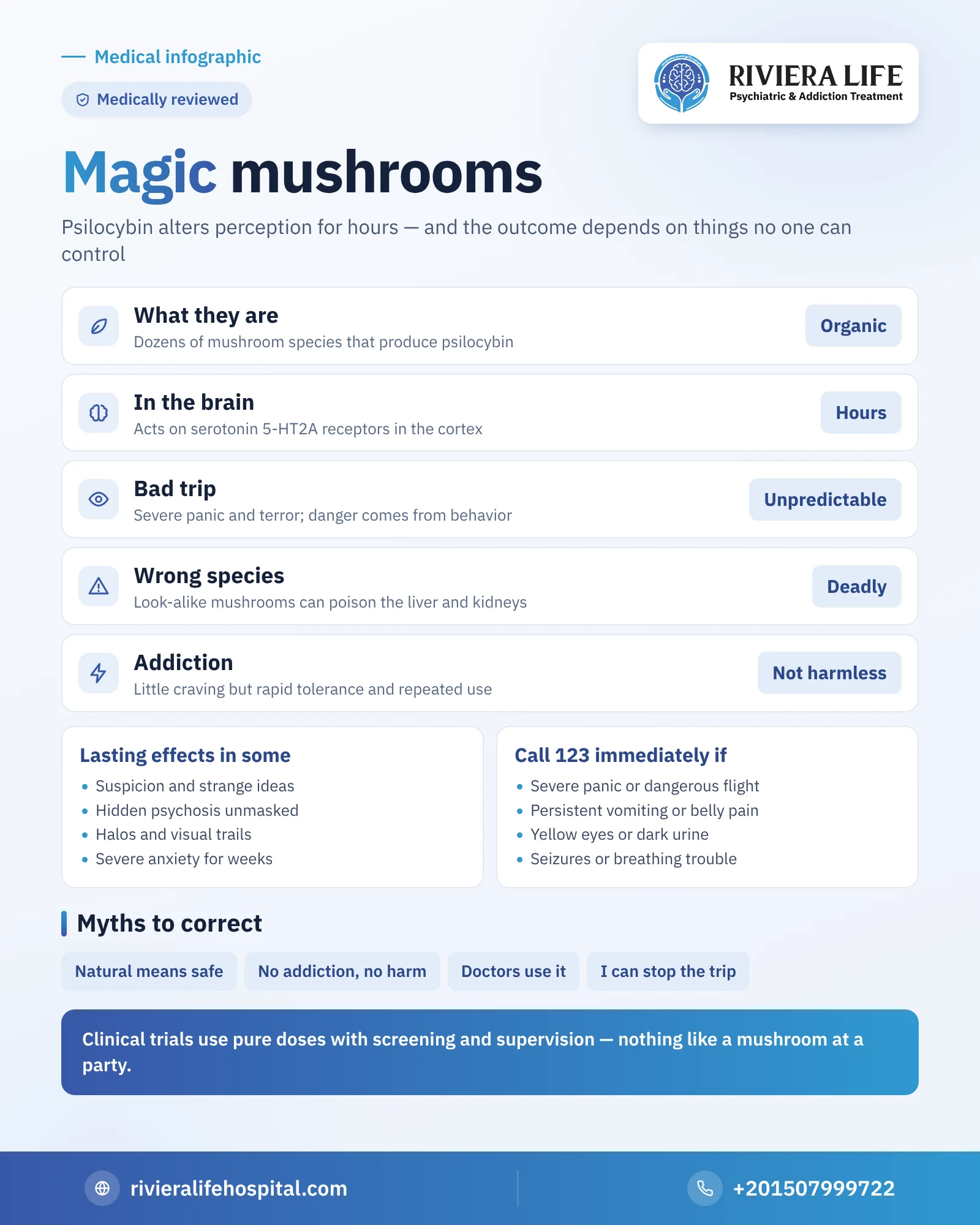
Magic mushrooms is a common name for species of mushroom that contain psilocybin, a hallucinogen that changes perception, mood and the sense of time for hours. Some people think of them as a “natural plant” and feel reassured, while the safety of the experience depends on things the user has no control over: the real species of mushroom, their mental state that night, and their genetic predisposition to psychosis. In this article we explain what magic mushrooms are, what they do in the brain, why the experience can turn into panic, whether they are addictive, and the truth about the medical studies promoters cite.
What exactly are magic mushrooms?
Magic mushrooms aren’t a single variety but dozens of species that grow in damp environments around the world and share the production of psilocybin. When the body takes in this substance, it converts it into an active compound called psilocin, which produces the effect. The substance belongs to the family of classic hallucinogens whose types we explained in our article on hallucinogenic pills, which also includes LSD, known in Egypt as “paper”. The difference is that mushrooms come from an organic source, while LSD is synthetic. An organic origin doesn’t mean the substance is less dangerous: a deadly mushroom toxin can be entirely “natural” too.
How do they work in the brain?
Psilocin resembles serotonin in its structure, a neurotransmitter that regulates mood, sleep and perception. That is why it binds to specific serotonin receptors, the most important being a type known as 5-HT2A, changing the activity of areas of the cerebral cortex responsible for vision, thinking and the sense of self. Brain-imaging studies show that the networks that usually work at rest and during self-reflection quieten down, and areas that don’t usually communicate start to talk to each other. This explains users’ descriptions of sensations such as “boundaries dissolving” and “seeing sounds”. But scientists are still studying these mechanisms, and there is no final explanation of everything that happens.
The magic mushroom experience: what is it like?
The effect begins after a relatively short time and lasts several hours, then fades gradually. The person may see brighter colors, shapes moving on the walls, a strange sense of time as if minutes were stretching, and emotions that swing between laughing and crying. Physical symptoms may accompany it, such as dilated pupils, nausea, palpitations and a rise in temperature. But the experience isn’t fixed, even for the same person: what was pleasant once may become terrifying another time. Specialists call the influence of inner state and place “set and setting” — the mental state and the surrounding environment — and they are the strongest influence on the direction of the experience, and no one can guarantee them.
The bad trip: when the experience turns
A bad trip isn’t a passing bad mood. It is a state of severe panic with frightening thoughts, or a feeling of losing one’s mind or dying, and it may be accompanied by terrifying hallucinations. The most dangerous thing about it isn’t the fear itself but the behavior it causes: someone who believes they are being chased runs into the street, or believes they can fly or cross the road safely.
Injuries are recorded in these cases because judgment of reality is absent, not because the substance is toxic to the body. The danger increases when there is an anxiety disorder, depression or severe stress before use, or when it is mixed with alcohol or other substances — something we warn about in our article on mixing drugs.
A risk the promoters don’t talk about: the wrong species
Many wild mushrooms resemble each other closely enough to fool even experts. And some species are highly toxic to the liver and kidneys, and their symptoms may begin with diarrhea and vomiting, then settle and fool the person into thinking they have recovered, while damage to the internal organs has already begun. So anyone who eats a mushroom whose species they don’t know puts themselves at double risk: an unpredictable psychological effect, and potentially fatal poisoning. The problem grows with unknown manufactured products whose real contents no one knows.
Psychosis and persistent perceptual disturbance
In some people the experience leaves an effect after it wears off. One is psychosis: suspicion, strange ideas and perhaps voices that last days or weeks; the likelihood rises in people with a family history of schizophrenia or bipolar disorder, and the experience may have unmasked a predisposition that was hidden. Our article on drug-induced psychosis covers the signs and when it persists.
The other effect is hallucinogen persisting perception disorder, in which halos around lights, visual trails and blurred vision return for weeks or months after stopping, and may be accompanied by severe anxiety. Not every experience is like this, but there is no advance test to tell you whether you will be among those affected.
Are magic mushrooms addictive?
The picture here differs from opioids and stimulants. Classic hallucinogens, including psilocybin, don’t usually produce the compulsive craving that drives a daily search for the substance, or clear physical withdrawal. But they cause rapid tolerance: if use is repeated on days close together, the effect weakens, which pushes some people to increase the amount or switch substances, and that raises the risk. And some people develop a pattern of repeated use that affects their work, study and relationships, and then they need an assessment, even if it isn’t called addiction in the classic sense. Our article on hallucinogen addiction treatment explains how doctors handle these cases.
What about the medical studies?
You often hear that psilocybin “treats depression”. The truth is that researchers are running clinical trials with pure, measured substances inside medical centers, with careful psychological assessment before the session, monitoring throughout it and therapeutic support afterwards, and they exclude people with a history of psychosis or certain illnesses. That is nothing like someone eating mushrooms at a party or at home. This field is still being researched, and it doesn’t mean mushrooms have become a medicine available for self-experimentation. The early research results are promising for some people, but they don’t cancel the risks and don’t apply to mushrooms of unknown origin.
Common ideas that need correcting
- “Natural, so safe”: nature is full of poisons, and the content of mushrooms differs from one species to another and between one sample and the next.
- “It isn’t addictive, so it’s harmless”: little physical dependence doesn’t mean little psychological harm; psychosis, panic and accidents happen without addiction.
- “Doctors use it”: what happens in trials is completely different in purity, supervision and selection.
- “I can stop the trip if it goes badly”: there is no off switch, and the substance works until its effect ends.
The legal position in Egypt
Psilocybin is a controlled substance under international conventions, and Egyptian law criminalizes and penalizes the possession and trading of narcotic substances listed in its schedules. Because the details change as the schedules are amended, anyone who needs precise legal information should consult a specialist lawyer. For anyone seeking treatment themselves, contact with Riviera Life is completely confidential.
Call an ambulance immediately on 123 if you see
After taking an unknown mushroom or product, these signs mean real danger — don't wait for them to pass.
- Severe panic, agitation, aggressive behavior or a dangerous attempt to flee
- Persistent vomiting and diarrhea or severe abdominal pain, even if it settles later
- Yellowing of the eyes or skin, or dark urine
- Seizures, loss of consciousness or difficulty breathing
- Thoughts of self-harm — you can also call the mental health hotline on 16328
When do you need specialist help?
Ask for a psychiatric assessment if symptoms continue for more than a day or two after the experience, if suspicion and strange ideas appear, if visual disturbances persist, if use becomes repeated and affects daily life, or if it is accompanied by use of other substances. And for a family that suspects their son: don’t confront him while he is under the influence; watch over his safety first, then open the conversation at a calm time. You can read hallucination treatment to understand how this kind of symptom is assessed.
At Riviera Life, consultants in psychiatry and addiction follow these cases under round-the-clock medical supervision, and the first consultation is free and confidential on +201507999722 in Sheikh Zayed, Giza.
More from our hallucinogens guide
- Hallucinogenic pills: types, effects and risks
- Hallucinogen addiction treatment
- Drug-induced psychosis
- Pink cocaine (tusi): a mix no one knows the contents of
Questions many people ask
Species of mushroom that contain psilocybin, a hallucinogen the body converts into an active compound that alters perception and mood for hours.
They don't usually cause compulsive craving or clear physical withdrawal like opioids, but they cause rapid tolerance and psychological risks, and use can become repeated in a way that affects a person's life.
Both are classic hallucinogens that act on serotonin receptors, but mushrooms come from an organic source while LSD is synthetic, and the length and strength of the effect differ.
Yes. They may unmask a hidden predisposition to psychosis, especially in people with a family history of schizophrenia or bipolar disorder, and suspicion and strange ideas may last days or longer.
It is still in clinical trials using pure substances under strict medical supervision, and that doesn't mean taking mushrooms on your own is a treatment or safe.