The time nalbuphine stays in the body is relatively short: it remains in the blood for a few hours, as its concentration halves in about five hours, and it can usually be detected in urine for about one to three days after the last injection, a period that may be a little longer with repeated daily injection. But the point that matters to the family and the patient more than the figures is that the usual opiate strip mostly doesn’t detect nalbuphine, because it is designed to look for morphine and similar substances. In this article we detail the durations by sample type and the factors that change them.
So the result may come back negative despite daily use, and detecting it needs a specialist laboratory test. This article explains what happens to nalbuphine inside the body, how long it shows in each sample, why rapid tests get it wrong, and how a test is read in the context of treatment.
When does nalbuphine start working, and how long does it last?
Nalbuphine starts working within two to three minutes of intravenous injection, and within less than a quarter of an hour of injection into muscle or under the skin, according to the medicine’s prescribing information. Its pain-relieving effect lasts about three to six hours, then fades gradually.
This gap between the short duration of effect and the substance staying in the body for longer is what confuses many: the feeling of the effect wearing off doesn’t mean nalbuphine has left the blood, nor that the test will be negative. And the short effect itself pushes someone dependent on it to repeat the injection several times a day, which multiplies the injection risks explained in our article on the harms of nalbuphine.
What happens to nalbuphine inside the body?
After its effect ends, the liver breaks it down in two ways: oxidation that produces hydroxylated compounds, and binding with glucuronic acid that produces compounds easier to excrete. Then the medicine and its products leave through the urine and feces.
The half-life of nalbuphine in adults is about five hours, meaning half the amount in the blood disappears in roughly this time. The general rule in pharmacology is that a substance has almost left the blood after four to five half-lives, that is, within about a day. But the breakdown products stay in the urine longer than the medicine itself stays in the blood, which is what makes the urine window wider.
Does nalbuphine show in an ordinary drug test?
Usually not. Rapid tests, whether home strips or initial screening in many laboratories, rely on antibodies that recognize a particular chemical structure. The “opiates” or “morphine” strip is designed to detect morphine, codeine and heroin, which turns into morphine. Nalbuphine is a synthetic opioid whose structure differs enough that this strip doesn’t recognize it reliably.
This fact was behind part of nalbuphine’s spread in Egypt, as the belief spread among some users that it “doesn’t show in the test”. The truth is that it doesn’t show on the ordinary strip only; laboratories using specialist equipment can detect it when it is requested by name. Our article on nalbuphine explains how this mistaken reputation contributed to its spread.
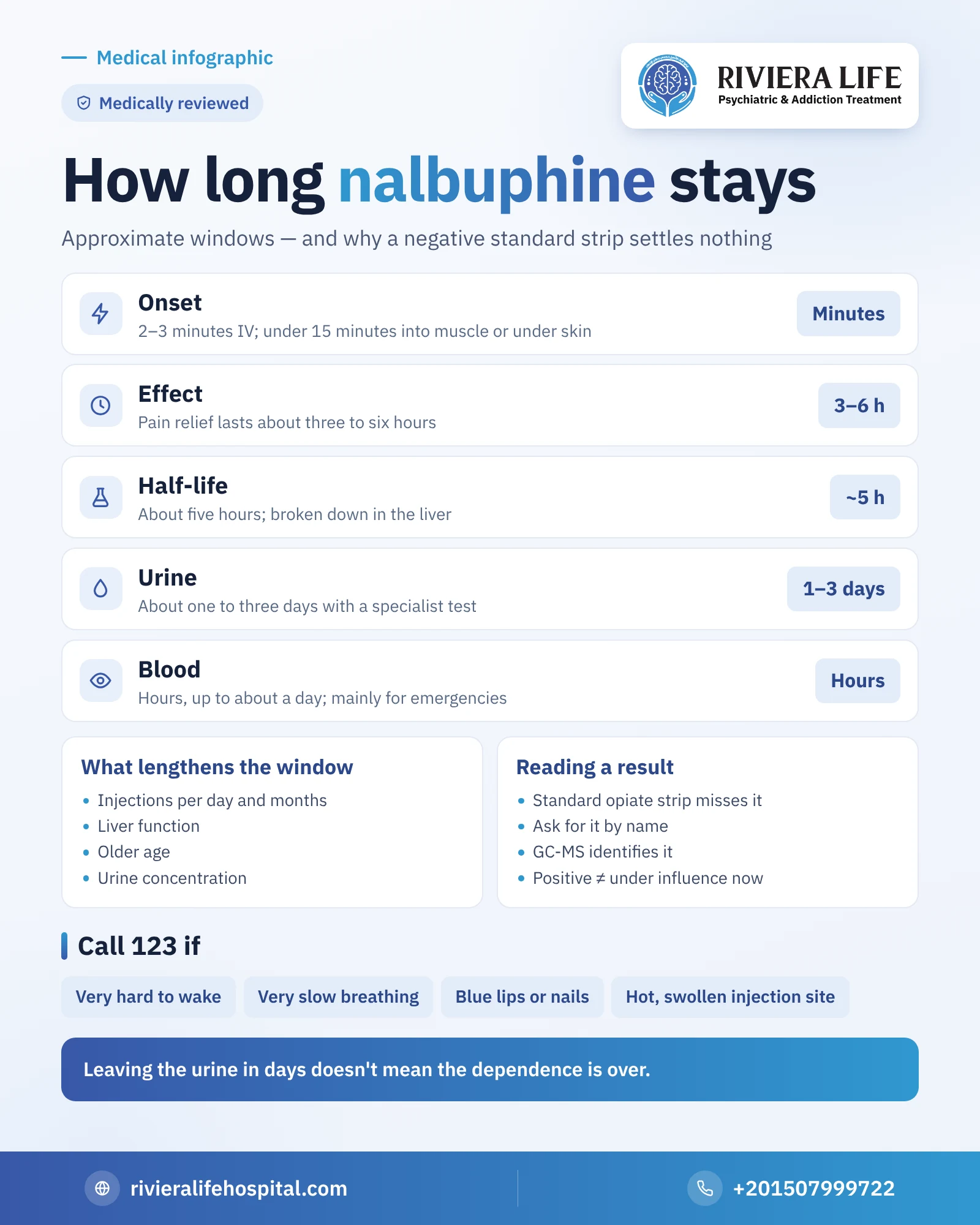
How long nalbuphine shows by sample type
Published studies on nalbuphine detection windows are far fewer than those available for morphine or heroin, so the following figures should be understood as approximate estimates based on its half-life, its route of excretion and laboratory experience:
Urine
The most commonly used sample. Nalbuphine or its products can usually be detected in it for about one to three days after the last injection, and it may extend a little longer in someone who has injected several times a day for months. The test must be a specialist one.
Blood
Its window is short, measured in hours and possibly reaching about a day. It is requested in emergencies to assess a patient suspected of poisoning more than to detect previous use.
Saliva
Data on it are limited, and it is expected to reflect recent use within hours to about a day; it is rarely used for this purpose.
Hair
In theory it can reflect recent months as happens with other substances, but it needs a laboratory with an approved method for this specific medicine, and it doesn’t detect the last few days.
Factors that change the duration
The durations above are averages that may be longer or shorter depending on:
- The number of injections a day and the number of months of use, as long daily use lengthens the window.
- Liver efficiency, since the liver is mainly responsible for breaking down nalbuphine, and liver disease is common among people who inject.
- Age, as older people clear the medicine more slowly.
- The amount of fluids and the concentration of the urine at the moment the sample is taken.
- The sensitivity of the device and the detection cutoff the laboratory uses.
The specialist test: how is nalbuphine detected?
The reliable method is chromatography coupled with mass spectrometry, a technique that separates the components of the sample and then identifies each substance by name and measures its amount. Some laboratories have extended panels that include nalbuphine among dozens of medicines, and some need a special request. So if the doctor or family suspects nalbuphine use, it must be mentioned explicitly when requesting the test, because asking for a “drug test” without specifying may not include it.
A negative result doesn’t mean no use
Many families are reassured by a negative home strip while their son injects daily. The reason isn’t an error in the strip, but that it wasn’t designed to look for this substance. So if there are other worrying signs, such as needle marks on the arms, syringes, or clear swings in mood and sleep, a negative strip settles nothing. You will find these signs detailed in our article on opioid addiction symptoms.
When nalbuphine is combined with other opioids
Many people who use nalbuphine also use tramadol, heroin or others with it or before it. In this case the opiate strip may come back positive because of the other substance, or the tramadol strip may come back positive, while nalbuphine stays invisible. Each substance has its own strip and window, explained in our article on how long opioids stay in the body. And because nalbuphine partly opposes some opioid receptors, injecting it in someone dependent on a strong opioid may trigger sudden withdrawal symptoms, information the doctor needs during assessment.
The effect fades before the substance leaves
The feeling of nalbuphine ends within hours, while its products stay in the urine for days. So a positive result doesn’t mean the person is under the influence at the moment the sample is taken, nor does it determine exactly when they last injected, how many times, or whether they are dependent or used it once. The test answers a single question: is the substance present above a certain level? Diagnosis, however, needs a full medical and psychiatric assessment.
Tests during treatment
In treatment programs, specialist tests are used periodically, not as punishment, but to follow stability, detect relapse early, and give the family tangible evidence that rebuilds trust. At the start of treatment the doctor also requests other tests no less important than testing for the substance itself, such as checks for viruses that may be transmitted through injecting, which are explained in our article on nalbuphine addiction treatment.
Nalbuphine leaving the body doesn’t mean the end of dependence
After two or three days the urine may be free of nalbuphine, but a brain used to daily injection needs much longer. Withdrawal symptoms begin within hours of the last injection, followed by craving, insomnia and anxiety that may last weeks, as explained on our page on opioid withdrawal symptoms. And trying to stop or change the amount alone without a doctor may end in returning to it, or moving on to a more dangerous substance.
Signs that call for an ambulance
Call an ambulance on 123 immediately if you see
Nalbuphine has a ceiling to its effect on breathing, but mixing it with sedatives, pregabalin or alcohol clearly raises the risk.
- Severe drowsiness or difficulty waking the person
- Very slow or irregular breathing
- Blue lips or nails
- Redness, swelling and heat at the injection site with a high temperature
More from our opioids guide
- Opioids: the complete guide
- Nalbuphine: medical use, addiction and injection risks
- Nalbuphine addiction treatment
- How long opioids stay in the body
- Nalbuphine withdrawal symptoms: the timeline, precipitated withdrawal and when to worry
Questions many people ask
It can usually be detected for about one to three days after the last injection with a specialist test, and the period may be a little longer with repeated daily injection.
Usually not, because the strip is designed to detect morphine and similar substances, and nalbuphine needs a special test requested by name at an equipped laboratory.
About five hours in adults; it is broken down in the liver and then leaves with the urine and feces.
Not necessarily, as the ordinary strip may not detect it at all. If there are other signs, such as injection marks or mood swings, it is better to consult a doctor and request a specialist test.
No. The substance leaves within days, but dependence and craving continue for weeks and months, which is why recovery needs treatment and follow-up.