“Nalufin” is the name by which many people in Egypt know nalbuphine injections, an opioid painkiller given by injection in hospitals to relieve moderate to severe pain. It belongs to a special group called “mixed agonist-antagonists”: it activates some opioid receptors and opposes others, which is what made many people think it is “safe” and doesn’t cause addiction. But the reality in addiction clinics is different: there are people who inject nalbuphine daily for years, suffer dependence and withdrawal, and carry injection complications that may be more dangerous than the substance itself. This article explains what nalbuphine is, why its misuse spread, what its risks are, and when to seek help.
What is nalbuphine?
Nalbuphine is a synthetic opioid used medically as intravenous, intramuscular or subcutaneous injections, and isn’t usually available as tablets. Doctors use it to relieve pain after some surgeries, sometimes before anesthesia or during childbirth, and in some cases to ease itching or the slowed breathing caused by other opioids. It is meant to be given inside the hospital or under medical supervision, not for the patient to take home and inject themselves.
How does nalbuphine work? A painkiller with two faces
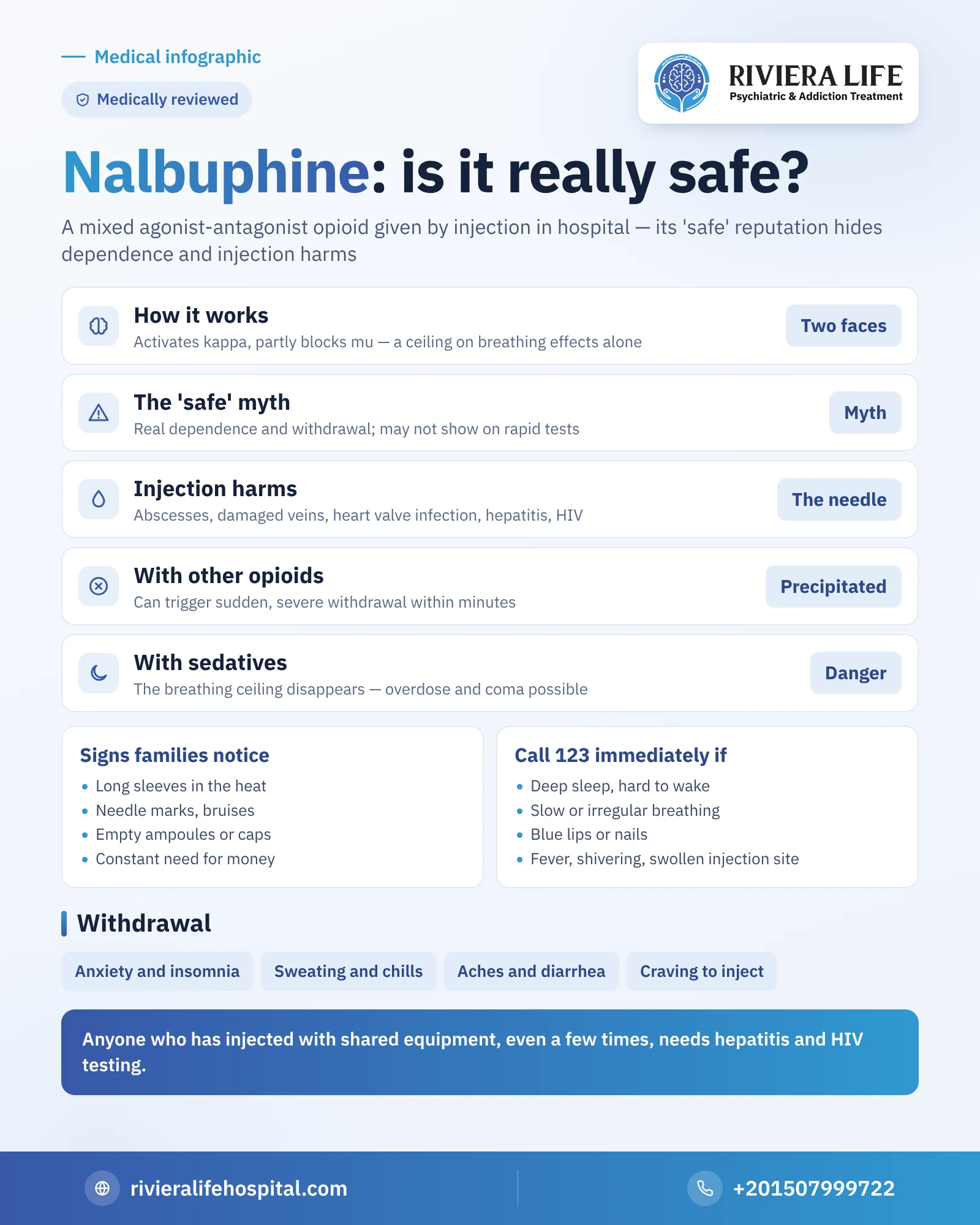
The nervous system has different types of opioid receptor. Nalbuphine activates the type known as kappa, relieving pain and causing sleepiness, while partly opposing the mu type responsible for the strong euphoria and slowed breathing of traditional opioids. That is why it has a ceiling on its effect on breathing: beyond a certain point this effect doesn’t increase with a larger amount, as happens with morphine.
But this ceiling isn’t a guarantee of safety. When it is mixed with sedatives, pregabalin or alcohol, the risk of slowed breathing multiplies, and activating kappa receptors may sometimes cause a feeling of unease, detachment or hallucinations. To see where this group sits among other painkillers, see our article on the types of opioid painkillers.
Why did nalbuphine misuse spread in Egypt?
Several factors combined to make nalbuphine present in Egypt’s addiction scene, especially during periods of tightened control on tramadol and rising prices of other substances:
- A false reputation as a “light” medicine that doesn’t show on tests and doesn’t cause addiction.
- Its leakage from medical use into illicit use, with some users obtaining it outside the medical setting.
- Its use as a substitute when tramadol or heroin is scarce, or to ease their withdrawal without understanding how it works.
- Its association, for some young people and workers, with the idea that it helps them stay up and endure work.
Over time, what began as an experiment or a temporary substitute turns into daily injecting, with all the risks injecting carries.
The myth that “nalbuphine is safe and isn’t addictive”
Part of this myth has a distorted scientific origin: when this group first came into use, the likelihood of addiction to it was thought to be small, and nalbuphine was indeed removed from controlled substance schedules in some countries. But modern medical references confirm that it has potential for misuse, and cases of genuine dependence on it have been described, with clear withdrawal on stopping. What we see in practice confirms this: patients who inject several times a day, increase the amount over time, and can’t stop despite health and financial problems.
As for it “not showing on tests”, a routine rapid test may indeed not detect it, but that doesn’t reduce its harm, and specialized labs can detect it when needed.
How does nalbuphine turn into dependence?
With repeated injecting, the brain gets used to the substance’s presence, so its effect lessens and the person needs a larger amount or more frequent injections. Then dependence appears: nalbuphine becomes necessary for the person to feel normal, not to feel high. The ritual of injecting itself adds to the difficulty of stopping, as preparing the syringe and the prick become a trigger for craving that resembles the substance’s effect in some patients. To understand the factors that make some people more vulnerable to opioid dependence, see our article on the causes of opioid addiction.
The harms of nalbuphine
Nalbuphine’s harms fall into two types: harms that come from the method of use itself, that is, injecting outside the hospital, and harms that come from the substance and its effect on body and mind with repeated use.
The harms of nalbuphine injections
Many of the serious harms come not from the substance but from the needle. Injecting outside the hospital is usually done without enough sterility, and when it is repeated in the same sites, complications appear such as:
- Skin infections and abscesses: swelling, redness, pain and pus at the injection site, which may need an antibiotic or surgical intervention.
- Vein damage and clotting: visible veins gradually disappear, so the person turns to more dangerous sites.
- Heart valve infection: a bacterial infection that may reach the heart through the blood, a serious condition that needs long treatment in hospital.
- Bloodborne viruses: sharing syringes or preparation equipment transmits hepatitis C and B viruses and HIV.
Hepatitis C in particular may stay silent for years before symptoms appear, so anyone who has injected nalbuphine, even a few times with shared equipment, needs testing for the viruses. The good news is that its treatment has become available and effective if it is detected.
The harms of nalbuphine on body and mind
Alongside the risks of injecting, repeated use may cause sleepiness, dizziness, sweating, nausea, mood swings, and sometimes anxiety, strange thoughts or hallucinations because of its effect on kappa receptors. Performance at work and study declines, and financial and family problems appear as injecting becomes the center of the day. For harms shared by opioids in general, see our article on the harms of opioids.
Signs the family may notice
Someone using nalbuphine doesn’t always look “drugged” in the way families imagine; many go to work and talk normally. But there are signals that recur:
- Wearing long sleeves even in the heat, or needle marks, bruises and dark spots on the arms or legs.
- Finding syringes, empty ampoules or needle caps in the room or car.
- Repeated long absences in the bathroom, with sudden sleepiness or sweating afterwards.
- Irritability, anxiety and yawning when delayed, which suddenly disappear after going out for a short time.
- A constant need for money without a convincing explanation.
One sign doesn’t necessarily mean use, but more than one sign together deserves a calm conversation and a specialist consultation.
Nalbuphine with other opioids
Because nalbuphine partly opposes mu receptors, injecting it into someone dependent on heroin, tramadol or morphine may suddenly push these substances off their receptors, causing acute, sudden withdrawal within minutes. This is one of the most painful surprises for someone who thinks they will use it to “ease” withdrawal from another substance. The reverse is also true: combining it with sedative substances raises the risk of deep sleepiness and slowed breathing.
Symptoms of a nalbuphine overdose
Nalbuphine has a ceiling on its effect on breathing when used alone, which is what made many people think an overdose of it isn’t possible. In fact, an overdose of it alone shows as slowed breathing, an unpleasant feeling of unease and severe sleepiness. But if it is combined with other opioids or sedatives such as Rivotril and Xanax, pregabalin or alcohol, this ceiling disappears, and the condition may progress to:
- Severe difficulty waking, then loss of consciousness and coma.
- Very slow or irregular breathing, with blue lips and nails.
- A slow heartbeat and a drop in blood pressure.
- Fluid collecting in the lungs, and the condition may end in death.
What to do until the ambulance arrives
Call an ambulance on 123 immediately at any of the signs above.
- Don’t leave them alone, and try to wake them by calling and shaking
- Put them on their side if they are breathing, so they don’t choke on vomit
- Tell the paramedics everything they took, if you know
- Don’t try to revive them with cold water or coffee, or force them to vomit
In hospital, the airway is secured first, then an opioid antagonist such as naloxone is given when needed. Because naloxone’s effect is shorter than nalbuphine’s, the patient stays under observation until their breathing is completely stable, as symptoms may return after they seem to have woken. For overdose signs by substance, see drug overdose.
Nalbuphine withdrawal symptoms
On stopping after regular use, symptoms resembling opioid withdrawal appear: anxiety and tension, insomnia, sweating and chills, body aches, runny nose, diarrhea and cramps, and an urgent craving to inject. Their severity varies with the amount, the duration and the presence of other substances. Trying to stop on your own isn’t advised if you use it daily or mix it with other substances; medical planning makes this stage easier and safer. You will find the general features of these symptoms in our article on opioid withdrawal symptoms.
Call an ambulance on 123 immediately if you see
Especially if nalbuphine has been injected with sedatives, pregabalin or alcohol.
- Deep sleepiness and difficulty waking the person
- Slow, weak or irregular breathing
- Blue lips or nails
- A high temperature and shivering with severe swelling at the injection site
When should you seek help?
If injecting has become daily, the amount has increased, withdrawal symptoms appear when delayed, an abscess or inflammation has appeared at the injection site, or injecting equipment has been shared, this is the time for a medical assessment, not waiting. Treatment begins with examining injection sites and testing for viruses, then a carefully planned withdrawal that takes account of nalbuphine’s mixed nature, which is explained in detail in our article on nalbuphine addiction treatment.
At Riviera Life the first step begins with a free and confidential consultation with a consultant in psychiatry and addiction treatment, and the family can call first to learn how to persuade their son to come.
More from our opioids guide
- Opioids: the complete guide
- Nalbuphine addiction treatment
- The types of opioid painkillers
- The harms of opioids
- Mydrapid eye drops: medical use, the risk of misuse and poisoning
- How long nalbuphine stays in the body: does it show on a test, and for how many days?
- Nalbuphine withdrawal symptoms: the timeline, precipitated withdrawal and when to worry
Questions many people ask
Nalbuphine is an opioid painkiller used medically by injection, but it is misused outside hospitals and can cause dependence and withdrawal. Using it without a prescription and medical supervision exposes a person to health risks and legal liability.
Routine rapid test strips may not detect it, but specialized labs can detect it with confirmatory tests when requested. Not showing on a rapid test doesn't mean it is less harmful.
No. Because of its opposing effect on some receptors, it may cause sudden, severe withdrawal in someone dependent on other opioids. Withdrawing from any substance needs a medical plan, not personal experimentation.
Testing for hepatitis C and B and HIV is advised, with repeat testing after a period as the doctor directs. Early detection allows effective treatment and protects contacts.
Usually more exhausting than dangerous, including insomnia, sweating, aches, diarrhea and craving. But other substances or accompanying illnesses may change the picture, so stopping under medical supervision is preferable.