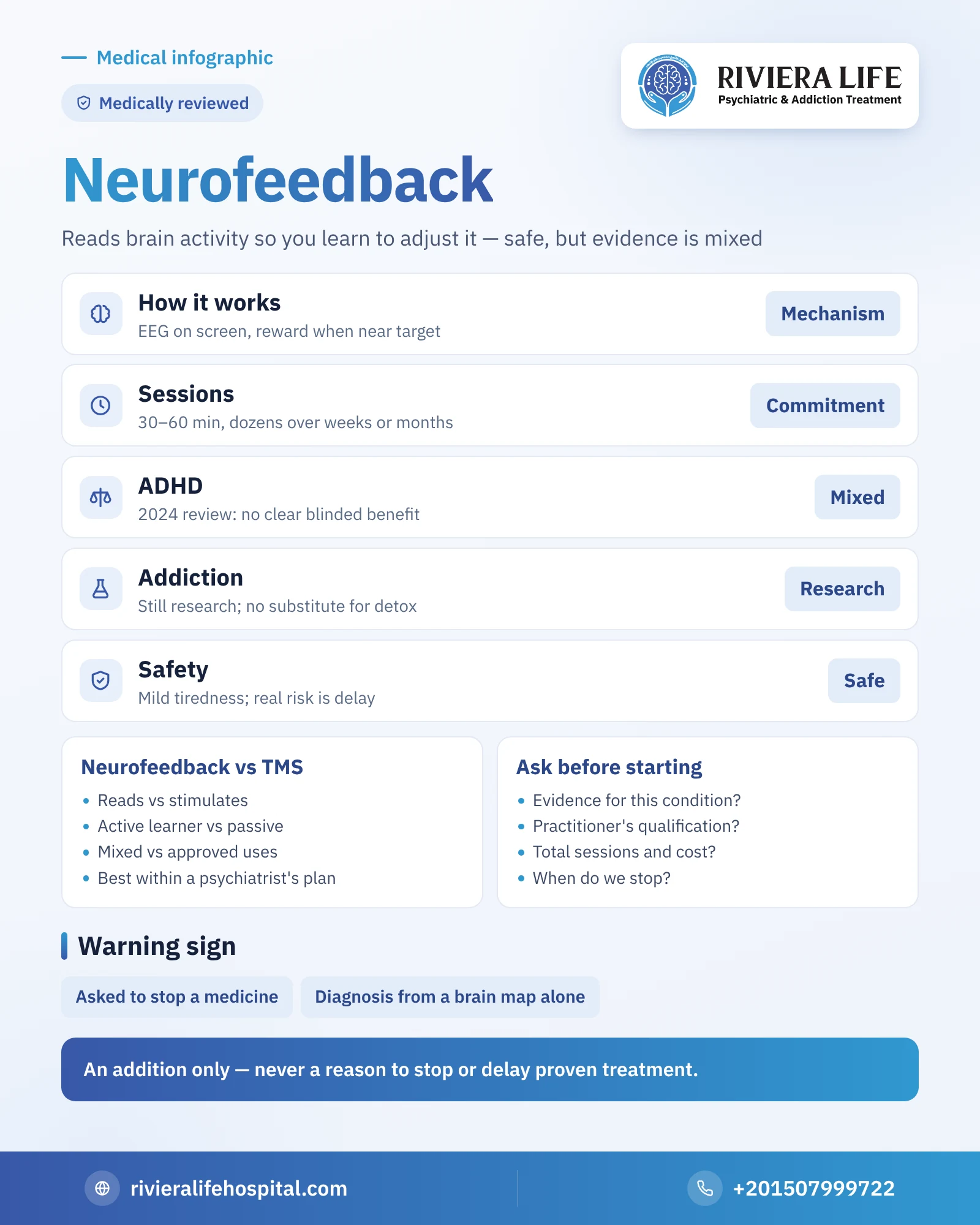
Neurofeedback, or neural feedback, is a type of biofeedback that measures the brain’s electrical waves through electrodes placed on the scalp, and displays them to the person as a game or video that changes according to their brain activity, so that with repetition they learn to change this activity. No current enters the brain, and it is considered safe in general. But the evidence of its benefit is mixed. In ADHD, recent reviews haven’t proven a clear improvement in core symptoms when assessed by people who don’t know who received the treatment, and in addiction it is still at the research stage. This article explains how it works, what studies say, how it differs from magnetic stimulation, and why it shouldn’t take the place of proven treatment.
What is neurofeedback?
The brain produces continuous electrical activity that can be recorded with an electroencephalogram (EEG), and appears in the form of waves with different frequencies roughly linked to states such as relaxation, concentration or drowsiness. The idea of neurofeedback is for the person to see this activity moment by moment, and the program rewards them when they get close to the desired pattern. This resembles learning any skill by trial and reward, without the person knowing exactly what they are doing. The MedlinePlus medical encyclopedia mentions neurofeedback and brainwave biofeedback as other names for the same type of biofeedback.
How does the session go?
The person sits on a comfortable chair, and the therapist fixes small electrodes on their scalp with conductive gel, and sometimes on the ear. Then a display begins on the screen: a car speeding up, a picture becoming clearer, or a sound getting louder, whenever the brain activity approaches the target. The person doesn’t need many instructions, as the brain learns from the reward. A session usually lasts between half an hour and an hour, and programs are usually long, consisting of dozens of sessions over weeks or months.
Assessment before starting and the brain map
Some centers start with a quantitative EEG that compares the person’s activity with a database, shown to the family as a colored map. This map may help in choosing the training protocol, but it isn’t a tool for diagnosing ADHD, depression or addiction. Diagnosis rests on a complete psychiatric medical assessment: a detailed history, interviews, approved scales, and information from the family and school. And if you are told that the map alone showed the diagnosis, ask for an opinion from a psychiatrist.
It is also useful to ask who will run the sessions. In many countries professional bodies require the practitioner to be a health specialist, such as a doctor or psychologist, who has received additional training in neurofeedback. The device alone doesn’t make a treatment, and a protocol chosen without medical assessment may waste the family’s time and money.
Neurofeedback and ADHD: what do studies say?
ADHD is the field in which neurofeedback has been studied most. Early studies noted that parents often report improvement after the program. But parents know their child received the treatment, and this alone may change their assessment. That is why researchers care about blinded assessment, carried out by someone who doesn’t know which children received the real training.
In a systematic review published in JAMA Psychiatry in late 2024, covering 38 randomized trials, neurofeedback didn’t significantly reduce symptoms of inattention or hyperactivity and impulsivity in the assessments closest to blinded. It didn’t improve mental performance except slightly in processing speed. The researchers concluded that the evidence isn’t enough to recommend it as a first-line treatment. The treatment that has proven its effectiveness, which is parent training, behavioral therapy and medicines when the doctor decides on them, we explained in the article on ADHD treatment.
Neurofeedback and addiction
Studies have been done on its use with addiction to alcohol, stimulants, opioids and smoking, usually as an addition to an existing treatment program. The goal was to reduce urgent craving or anxiety or to improve sleep. Some results were encouraging, but the studies are small and differ in protocols, and neurofeedback in addiction remains a research field, not an approved treatment. And it in no way replaces detox under medical supervision, nor psychotherapy and relapse prevention medicines. Among what the person in recovery really needs most is managing the urgent craving for use with proven methods.
Anxiety, insomnia and other areas
Biofeedback in its various types, such as measuring breathing, muscle tension and heart rate, is used in anxiety, tension headaches and some sleep disorders, and its evidence in some of these areas is clearer than the evidence for neurofeedback itself. But advertisements widen the list of what it treats a great deal, from autism to learning difficulties and depression. The rule here is to ask for controlled studies on this particular condition, not for success stories.
The difference between it and magnetic stimulation
| Aspect | Neurofeedback | Magnetic stimulation |
|---|---|---|
| Mechanism | Reads brain activity and displays it to the person to learn to adjust it | Sends magnetic pulses that activate specific areas in the brain |
| The person’s role | An active participant who learns by repetition | A recipient who needs no effort |
| Scientific status | Mixed evidence, and not approved as a first-line treatment | Approved in several countries for treatment-resistant depression and some other conditions |
| Who decides on it | Preferably within a psychiatrist’s plan | Decided by a psychiatrist after assessment |
The full details about magnetic stimulation and its uses are in the article on transcranial magnetic stimulation.
Time, cost and commitment
The biggest thing parents overlook is the size of the commitment. The program usually needs two or three sessions a week for several months, with transport and waiting, and the cost accumulates with every session. The family is often offered an extra program if no improvement appears. That is why you should ask about the expected total number of sessions and their total cost before starting, about how improvement is measured, and when the program stops if it doesn’t help.
Side effects
Neurofeedback is safe in general, because it reads activity and doesn’t send anything to the brain. Some people may feel after the session tiredness, a mild headache, a temporary change in sleep or tension. Its real danger is indirect: delaying proven treatment, or pushing the family to stop a prescribed medicine without consulting the doctor.
Not a substitute for proven treatment
If the child has ADHD, or the young person is at the start of recovery from addiction, or someone suffers from anxiety, the basic plan is what the evidence has proven: structured psychotherapy, medicines when needed, family support and follow-up. Neurofeedback can be discussed with the doctor as an addition if the family wishes, provided that the basic plan doesn’t stop or get delayed for its sake.
Questions to ask before you start
- What is the evidence of its benefit in this condition specifically?
- Who will run the sessions, and what is their health qualification?
- How many sessions are expected, and what is the total cost?
- How will we measure improvement, and when do we stop if it doesn’t happen?
- Does the center communicate with the treating psychiatrist?
- Have I been asked to stop any medicine? If the answer is yes, this is a warning sign.
How does Riviera Life help you?
Many families ask about neurofeedback after getting tired of a treatment that didn’t work. The most useful step is often reassessment: is the diagnosis accurate, is there an accompanying disorder such as anxiety, depression or substance use, and is the current plan applied completely? The consultants in psychiatry and addiction treatment at Riviera Life provide this assessment in complete confidentiality, and set a proven treatment plan with a program for the family and follow-up after treatment. The hospital is licensed by the Ministry of Health, has fourteen years of experience, and is located in Sheikh Zayed, Giza. The first consultation is free: +201507999722.
More from the psychotherapy guide
Questions many people ask
Training that measures brainwaves with an EEG and displays them as a game or video, so that with repetition the person learns to adjust their brain activity.
The evidence is mixed, and a recent review found no clear improvement in core symptoms under blinded assessment, so it isn't considered a first-line treatment.
It is still at the research stage, and may be studied as an addition to a treatment program, but it doesn't replace detox and psychotherapy.
It is safe in general, and may cause temporary tiredness or a mild headache. Its biggest danger is delaying proven treatment.
Neurofeedback reads brain activity so the person learns to adjust it, while magnetic stimulation sends pulses that activate areas of the brain.