Drug craving is a strong, sudden urge that tells its owner: “Just once”. It may come after weeks of abstinence or after years, and may appear in a moment of complete calm with no clear reason. Most importantly, know that it is a brain phenomenon, not a verdict on your willpower and not proof that treatment has failed. Here we explain how craving forms, what ignites it, how to deal with it in the first minutes, and what the doctor adds when needed.
What is drug craving?
It is a physical and psychological pull towards the substance, like the thirst of someone who has spent a day in the heat. Some describe it as a prickling in the stomach, some as thinking that circles around one thing, and others feel tension and distress that only goes away by imagining the substance.
And it doesn’t mean you are weak. A brain that has been used to the substance for years has learned to link it with relief or pleasure, so it now asks for it automatically at any signal that reminds it. Recovery doesn’t erase this memory, but it teaches you how to pass in front of it without doing what it asks.
Why does it happen? What goes on in the brain
Drugs raise dopamine in the reward circuits far more than natural things do, and the brain learns that this substance is more important than food, sleep and people. With repetition, the ability of the frontal cortex, which is responsible for deliberation and restraining impulses, to resist that call weakens.
So when weeks pass without use, the brain hasn’t fully regained its balance. Stress circuits remain more sensitive, and pleasure circuits less responsive to ordinary things, so life seems dull and the substance alone shiny. This is how craving can appear long after the physical symptoms of withdrawal have gone.
What ignites craving? The four triggers
A trigger is a signal the brain links with use. They usually fall into four types:
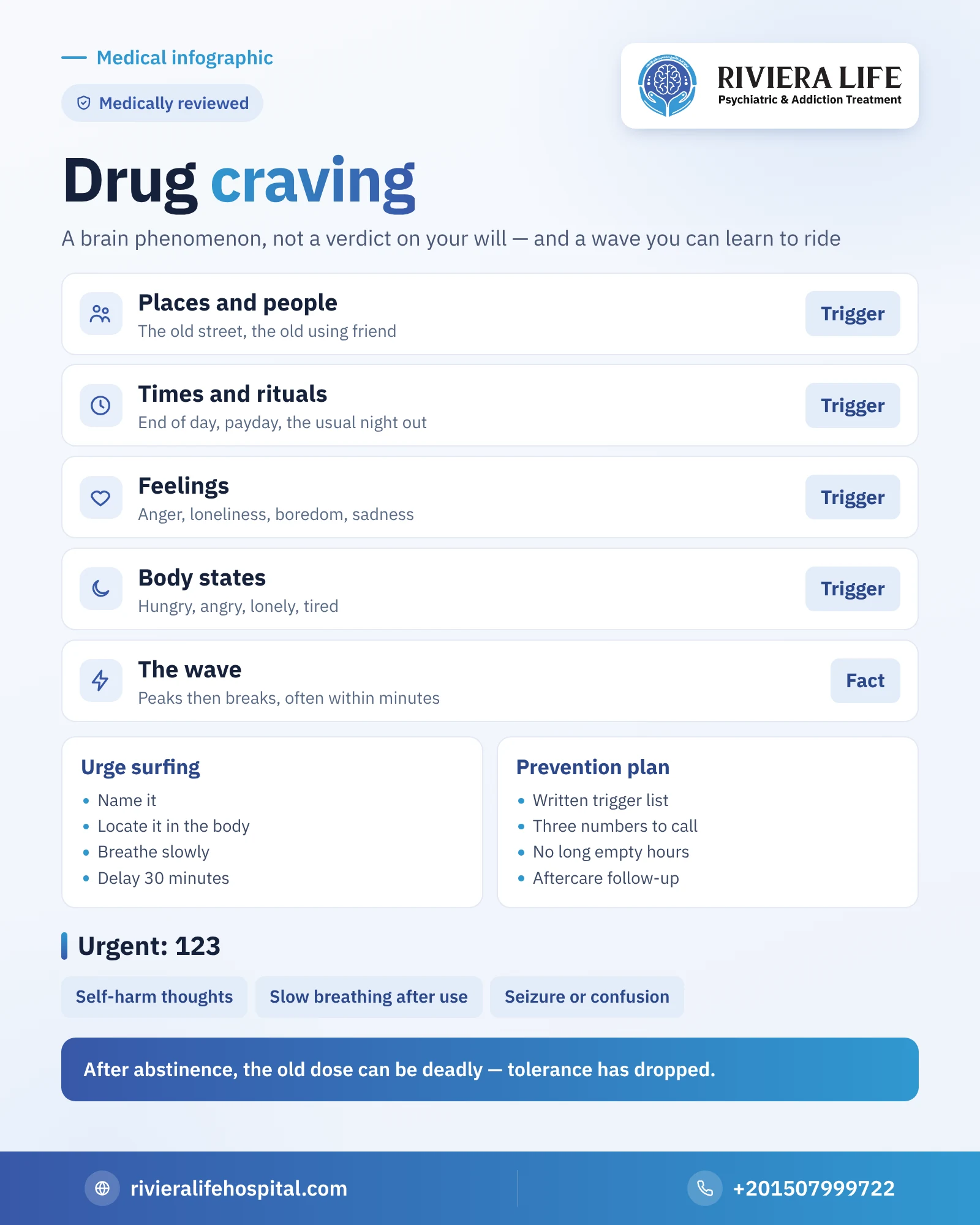
- Places and people: the old street, the friend you used with, or a particular room.
- Times and rituals: the end of the day, a cup of coffee, the month’s salary, or the night out you were used to.
- Feelings: anger, loneliness, boredom and sadness, and sometimes excessive joy too.
- Body states: exhaustion, lack of sleep, hunger and pain; specialists sum them up as hungry, angry, lonely and tired.
Knowing your personal triggers is the first practical step. Write them down on one sheet for two weeks, and a pattern you didn’t see will usually appear.
How long does craving last? The wave that rises and falls
Craving usually behaves like a wave: it rises, peaks, then breaks and falls even if you do nothing. The duration varies from person to person and situation to situation, but it is usually shorter than it seems in the moment, and may be measured in minutes, not hours.
In the first weeks the waves may recur many times a day, then become less frequent and weaker over time. This information alone changes your stance towards it; what is required isn’t to defeat it forever, but to get through this particular wave.
Riding the wave: steps for the first minutes
This method is called “urge surfing”, in which you watch the craving instead of fighting it or acting on it:
- Name it: tell yourself clearly, “This is a craving, not an order”.
- Locate it in the body: chest, stomach or hands? Describe the feeling calmly, as if describing the weather.
- Breathe slowly: a breath out longer than the breath in, several times, calms the body.
- Change your place: leave the room, street or app that ignited the craving.
- Call someone: your sponsor, a friend in recovery or a family member, before you decide anything.
- Postpone the decision: say “I’ll wait half an hour then decide”; the craving often fades before the deadline ends.
Moving the body also helps, such as brisk walking, a cold shower or any task that occupies the hands. These are relief steps and don’t replace a complete treatment plan.
After the moment: a prevention plan that reduces the number of waves
It is best to make the plan while you are calm, not under pressure. Its elements include:
- A written list of triggers and what you will do when each appears.
- The numbers of three people you can call at any hour.
- A daily schedule that leaves no long empty hours, with regular sleep and meals on time.
- Keeping away from places and relationships linked to use; this is the hardest part and the most useful.
- Cognitive behavioral therapy sessions or a program such as the Matrix program, in which the person in recovery trains practically on triggers.
- Regular follow-up through the aftercare program after leaving hospital.
Are there medicines that ease craving?
Yes, for some substances, on a doctor’s prescription only. With opioids doctors use substitute or blocking medicines that reduce craving and protect against relapse, and with alcohol there are medicines that reduce desire and help continued abstinence. Stimulants and hash have no medicine approved to the same degree, and treatment relies on psychological and behavioral therapy with treatment of accompanying symptoms such as insomnia and anxiety.
Medicine doesn’t remove the need for sessions and a plan, and isn’t started, stopped or its dose changed except with the treating doctor. The details of the medicines for each substance are in the articles on each substance’s medicines on the site.
When craving is a sign of something else
Sometimes rising craving is a signal of an untreated problem: depression, anxiety, insomnia or old trauma bringing use back to the forefront. In these cases willpower alone doesn’t work. Psychological assessment helps uncover the cause, and the dual diagnosis program treats the addiction and the psychiatric illness together.
Seek urgent help if
Craving alone isn't an emergency, but these situations call for immediate intervention:
- You have thoughts of harming yourself or ending your life
- You used after a long period of abstinence and severe drowsiness, slow breathing or blueness appeared
- Someone around you shows severe confusion, hallucinations or a seizure after using
The numbers: ambulance 123, and the mental health hotline 16328. After a period of abstinence the body’s ability to tolerate the substance falls, so the dose that was previously usual becomes very dangerous, which is one cause of death after relapse.
If a slip happens: what do you do afterwards?
A slip doesn’t mean going back to zero. What matters is what you do in the following hours: don’t hide it, tell your sponsor or doctor quickly, identify what ignited it, and adjust your plan accordingly. Shame is the most dangerous thing after a slip, because it pushes towards more use. The article on the relapse treatment program explains how the plan is rebuilt after a full relapse.
How can the family help?
Don’t ask “why do you even want that?”, as this question increases guilt. Ask instead: “Is tonight hard? Shall we go out for a bit?”. Make sure there is nothing tempting in the house, and that the atmosphere is calm at critical times. You will find broader guidance in the article on dealing with a recovering addict.
Craving is one of the symptoms of a wider stage that comes after acute withdrawal, along with insomnia, tension and mood swings. You will find it explained in post-acute withdrawal symptoms.
And some common medicines, such as painkillers, cough mixtures and sleep medicines, may wake this craving in someone in recovery without them noticing; their list is in medicines that need caution after recovery.
How can Riviera Life help you?
Riviera Life’s consultants in psychiatry and addiction treatment assess each patient’s particular triggers, and the program is built on that with round-the-clock medical supervision, then follow-up continues after discharge within aftercare and the family program, in complete confidentiality. The first consultation is free; to get in touch: +201507999722, and we are based in Sheikh Zayed, Giza.
Read also
- The relapse treatment program
- The stages of recovery from addiction
- How does a drug addict think?
- The aftercare program after treatment
Questions many people ask
No, craving is an expected brain phenomenon after chronic use and may appear months or years into abstinence. What matters is the plan you use to deal with it.
It varies from person to person, but it usually behaves like a wave that rises then falls within a short time that may be measured in minutes, and it becomes less frequent and weaker as recovery continues.
Yes, for some substances such as opioids and alcohol, prescribed under a doctor's supervision only. There is no medicine approved to the same degree for stimulants and hash, where treatment relies on psychological and behavioral therapy.
Change your place, breathe slowly, call a trusted person, and postpone the decision for half an hour. These are relief steps that don't replace the treatment plan.
Because the brain has linked the substance with relief from these feelings, so stress and reward circuits activate together. That is why skills for dealing with distress, and treating depression and anxiety if present, help.