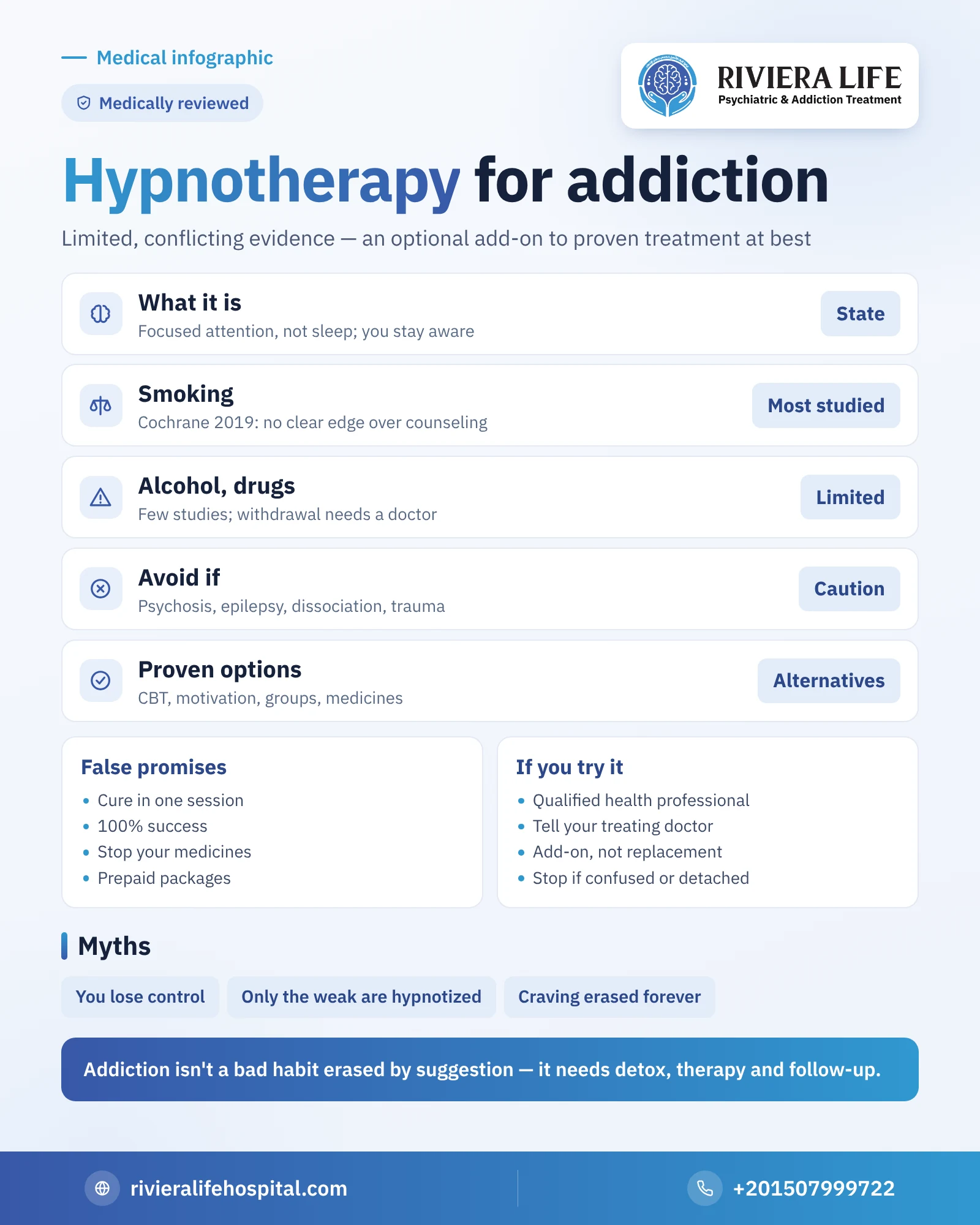
Hypnotherapy for addiction is a method in which the therapist puts the person into a state of deep focus and relaxation, then gives them suggestions that strengthen their desire to stop and weaken their attachment to the substance. The evidence of its benefit in addiction is limited and conflicting so far. Its most studied use is quitting smoking, and studies haven’t shown it a clear superiority over usual behavioral treatment there. That is why it is regarded at best as an optional addition to proven treatment, not a substitute for it. This article explains what happens in the session, what the evidence says, who should avoid it, and how to tell a serious therapist from a seller of illusions.
What is hypnosis?
Despite its name, hypnosis has nothing to do with sleep. It is a state of focused attention in which preoccupation with one’s surroundings decreases, and responsiveness to suggestion increases. In some respects it resembles being absorbed in a film or in driving a familiar road until you don’t remember its details. The person in this state remains aware, hears what is said, and can reject any suggestion or come out of the state whenever they want. The therapist can’t make them do something against their will.
People differ in their susceptibility to hypnosis; some enter this state easily, and others are barely affected.
What happens in the session?
The session usually begins with a conversation about the goal and the situations that trigger the craving for the substance. Then the therapist leads the person into relaxation with slow breathing, imagining a calm place and a countdown. After that come the suggestions, such as imagining life without the substance, linking its smell to an aversive feeling, or repeating phrases that strengthen confidence in the ability to refuse. At the end the therapist brings the person back to full attention. Some therapists teach self-hypnosis for the person to practice at home. A session lasts about an hour, and the number of sessions varies.
What does the scientific evidence say about addiction?
Most studies that have looked at hypnosis in addiction are small, lack good comparison groups, and differ greatly in the method and duration of hypnosis. Some showed improvement, and some showed no difference. The honest conclusion is that there is so far no strong evidence making hypnosis an approved treatment for addiction to any substance. That is why the major treatment guidelines don’t place it among the basic lines of addiction treatment.
Smoking: its most studied use
Hypnosis sessions for quitting smoking are widely advertised, and this is the field that has received the largest number of studies. The Cochrane organization reviewed these studies in 2019, and found no clear advantage for hypnotherapy over behavioral counseling in abstinence after six months or more. It described the quality of the evidence as low. The US National Institutes of Health state that the results of hypnosis studies in quitting smoking are conflicting.
That is, some smokers may benefit, but there is nothing to prove it is better than cheaper and clearer methods, such as counseling and nicotine replacement, as in the article on quitting smoking.
Alcohol and other drugs
Studies on alcohol, opioid and stimulant addiction are much fewer. And there is a fact that no suggestion changes: a body that has become used to a substance goes through physical withdrawal when it stops. Withdrawal from alcohol and sedatives may cause seizures or dangerous delirium, and opioid withdrawal often needs medication support. This stage isn’t treated with a relaxation session, but with medical supervision.
Why isn’t it enough on its own?
Addiction isn’t a bad habit erased by suggestion. It is changes in the brain’s reward and control circuits, and with it there is often anxiety, depression or an old trauma, and friends, places and triggers in daily life. The treatment that changes all this needs safe detox, psychotherapy that changes thoughts and behavior, medicines in some cases, family support and follow-up to prevent relapse. Hypnosis may help some people relax or strengthen motivation, but it covers none of these aspects on its own.
Who should avoid hypnotherapy?
- Those with psychosis or schizophrenia or a previous history of them: the British National Health Service states that it may not be safe for them.
- Epilepsy patients: for the same reason according to the same source.
- Those suffering from dissociative disorders: such as detachment from reality or loss of the sense of self, as specialists believe that hypnotic states may increase these symptoms.
- Those with severe untreated trauma: as the session may stir up painful memories without a therapist qualified to deal with them.
- Those under the influence of a substance or in acute withdrawal: because the priority here is medical stability.
And if you have any mental disorder, ask your doctor before any session. The details of psychosis linked to substance use are in the article on drug-induced psychosis.
Common myths about hypnosis
- The hypnotized person loses control of themselves: untrue, as they hear, are aware and can stop the session.
- Only the weak-willed are hypnotized: susceptibility to hypnosis is a trait that varies between people, and has nothing to do with strength of personality or intelligence.
- Hypnosis erases the craving for the substance forever: there is no evidence for that, and craving usually returns with stress and triggers if the person hasn’t learned how to deal with it.
- What a person remembers under hypnosis is confirmed truth: memory under suggestion is malleable, and the person may remember things that didn’t happen.
Signs of false promises
Advertisements are full of people selling hypnosis as a magic solution. Beware if you hear:
- “Recovery from addiction in one session” or “a hundred percent success rate”.
- Advice to stop the psychiatrist’s medicines or skip detox.
- Talk about “reprogramming the subconscious mind” permanently without any follow-up.
- Packages of sessions paid in advance at exaggerated prices.
- A therapist who doesn’t mention their health qualification, or doesn’t work under a licensed body.
- An attempt to “recover buried memories” of abuse in childhood, which may create untrue memories.
If you want to try it anyway
Some people find in hypnosis a means of relaxation or of supporting their motivation, and there is no objection to that if clear conditions are observed. The therapist should be a qualified health professional, such as a doctor or psychologist trained in hypnosis. You should tell your doctor treating the addiction. And it should be an addition to the treatment plan, not a substitute for it, so don’t stop your sessions or medicines for its sake. And if after the session you feel severe anxiety, confusion or detachment from reality, stop it and bring the matter to the doctor.
Alternatives that have proven effective
- Cognitive behavioral therapy: teaches recognizing the triggers and thoughts that precede use and confronting them, and its details are in the article on cognitive behavioral therapy.
- Motivational interviewing: helps the hesitant patient settle their decision without pressure.
- Group therapy: a shared experience, accountability and support, as in group therapy.
- Acceptance and commitment therapy: teaches living with craving without responding to it, and we explained it in acceptance and commitment therapy.
- Relapse prevention medicines: for some substances such as alcohol and opioids, chosen by the doctor according to the case.
- Relaxation and mindfulness exercises: ease the tension that precedes craving, and can be learned within psychotherapy without the need for a hypnotic state.
How does Riviera Life help you?
If you are looking for hypnotherapy because you tried to stop alone and couldn’t, it is better to start with a medical assessment that determines what you really need. At Riviera Life the consultants in psychiatry and addiction treatment put together a plan that combines safe detox under round-the-clock medical supervision, individual and group psychotherapy, a program for the family, and aftercare. The hospital is licensed by the Ministry of Health, has fourteen years of experience, and is located in Sheikh Zayed, Giza. The first consultation is free and confidential: +201507999722.
More from the psychotherapy guide
Questions many people ask
There is no strong evidence that it treats addiction on its own. It may help some people as an addition to a proven treatment, not as a substitute for it.
Study results are conflicting, and a 2019 Cochrane review found no clear advantage for it over behavioral counseling.
No. They remain aware and hear what is said, and can reject the suggestion or end the session.
Those with psychosis, schizophrenia, epilepsy, dissociative disorders or severe untreated trauma, and those under the influence of a substance or in acute withdrawal.
No. Addiction needs safe detox, psychotherapy and follow-up, and any promise of a cure in one session is a warning sign.