Obsessive-compulsive personality is a stable pattern of preoccupation with order, rules, perfection and control, for which its owner pays with their flexibility, time and relationships. They don’t suffer from intrusive thoughts they try to drive out; rather, they see their way as the only right way, and expect others to follow it. It is a personality disorder that differs from obsessive-compulsive disorder despite the similar name. Here we explain the difference between them, the signs of perfectionism and rigidity, its effect on work and home, and how treatment helps loosen the grip without giving up thoroughness.
What is obsessive-compulsive personality disorder?
Obsessive-compulsive personality disorder, abbreviated OCPD, belongs to the third cluster of personality disorders in the American diagnostic manual, the cluster described as anxious and fearful, alongside avoidant and dependent personality. It is considered one of the most common personality disorders, with estimates ranging from about two to eight percent of the general population depending on the study.
Its features begin in early adulthood and appear in many situations: at the office and in the kitchen, in managing money and raising children. Those around often see the person as “very organized” until precision turns into a daily burden on everyone.
The difference between obsessive-compulsive personality disorder and OCD
This is the most important distinction in the article. Obsessive-compulsive disorder is an anxiety disorder in which unwanted thoughts intrude on the patient’s mind, so they perform compulsive acts to relieve the anxiety, usually realizing they are exaggerated and suffering from them. Obsessive-compulsive personality, on the other hand, isn’t based on intrusive thoughts, but on a whole way of life that its owner sees as logical and correct.
| Aspect | Obsessive-compulsive personality | Obsessive-compulsive disorder |
|---|---|---|
| Nature | A personality pattern | An anxiety disorder |
| The person’s attitude to it | Sees it as right and defends it | Finds it distressing and wishes to be rid of it |
| Focus | Perfection, rules and control | Specific obsessions and rituals to calm them |
| Who complains first | Usually the family and colleagues | Usually the patient themselves |
| Onset | Gradual since youth | May start at any age and wax and wane |
The two disorders may coexist in the same person, but most people with one don’t have the other. To learn what OCD itself looks like, see OCD symptoms.
Signs of obsessive-compulsive personality disorder
The doctor looks for an extended pattern that includes a number of the following signs:
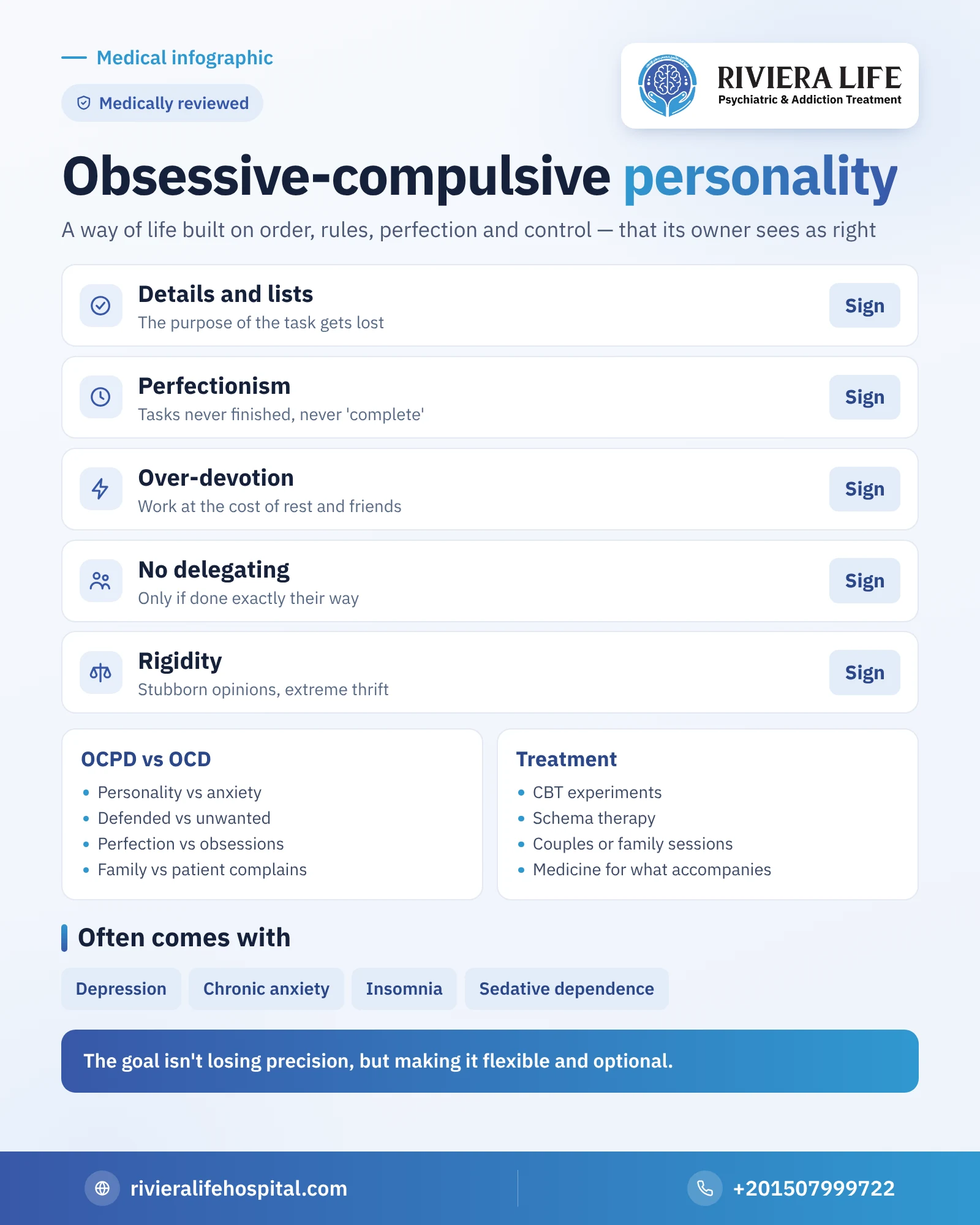
- Preoccupation with details, lists and schedules until the purpose of the activity itself is lost.
- Perfectionism that stops tasks being finished: the report isn’t handed in because it “isn’t complete yet”.
- Excessive devotion to work at the expense of rest and friends, without financial need forcing it.
- Strictness in morals and values beyond what their culture and religion require.
- Difficulty getting rid of old, worthless things.
- Refusing to delegate tasks except to someone who follows their way to the letter.
- Extreme thrift in spending on themselves and their family in anticipation of future disasters.
- Rigidity and stubbornness in opinion.
Perfectionism: when thoroughness becomes an obstacle
Thoroughness is a fine value, but perfectionism in this disorder doesn’t know the word “enough”. An engineer redraws the plan seven times because of details no one will notice, and misses the deadline. A father spends the whole weekend rearranging the storeroom instead of going out with his children. The internal standard is so high it is impossible to reach, so the person lives in constant tension and a sense of falling short, and sees others’ mistakes with painful clarity.
Control and rigidity
Beneath the perfectionism is a desire to control everything: how the towels are folded, when the dish is washed, and how money is managed down to the last pound. Any sudden change in the plan provokes intense distress. This doesn’t come from a wish to hurt others, but from deep anxiety about chaos and error. But the result is the same: those around them feel under constant surveillance.
Obsessive-compulsive personality at work
The person may seem an ideal employee: committed, precise and never absent. But problems appear over time:
- Late delivery because of repeated reviewing.
- Clashes with colleagues because they redo or harshly criticize their work.
- Difficulty managing, because they don’t delegate or accept different solutions.
- Physical and psychological exhaustion from long working hours without a break.
At home, in marriage and in raising children
At home the rules become laws, and discussing their details becomes a battle. The partner may feel like an employee rather than a partner, and the children may grow up under strict standards that make them either rebellious or afraid of making mistakes. Disputes over money are common because of thrift, and over time because work eats everything. The paradox is that the person with an obsessive personality truly loves their family, and sees their strictness as protecting it, not as harshness towards it.
When is conscientiousness a trait and when does it become a disorder?
A strong conscience and love of order are healthy traits that help success. It turns into a disorder when the pattern becomes rigid and doesn’t change with the situation, blocks achievement instead of serving it, and causes repeated harm in relationships or clear distress. The practical question: can you accept a good result instead of a perfect one when the situation requires it?
Why does obsessive-compulsive personality appear?
Twin studies point to a genetic contribution to these traits. Added to it are an anxious temperament since childhood, a strict upbringing in which love is conditional on performance and obedience, or an unstable environment in which the child learns that controlling details is a way to feel safe. No single factor alone is enough to explain the disorder.
Disorders that may accompany it
The person often reaches the doctor because of what accompanies the disorder rather than because of it: depression after a professional failure, chronic anxiety, insomnia, or headache and muscle tension from constant strain. Some turn to sedatives or sleeping pills to bear their pressure, and become dependent on them. Long strain itself leaves an effect on the body, which we explained in psychological stress.
Treatment of obsessive-compulsive personality disorder
Treatment often begins when the person realizes the price of their pattern has become higher than its benefit. The goal isn’t to abolish precision, but to make it flexible and optional.
- Cognitive behavioral therapy: examines beliefs such as “any mistake is a disaster” and “no one does it properly except me”, and trains with practical experiments such as handing in good work rather than perfect work and noticing the result. Learn about this therapy in cognitive behavioral therapy.
- Psychodynamic therapy and schema therapy: explore the roots of the need for control and the fear of error in early experiences.
- Couples or family sessions: to redistribute decisions and agree on areas not subject to their rules.
- Medicine for accompanying symptoms: there is no medicine for the disorder itself, but the doctor may prescribe treatment for depression or anxiety if present, and any change or stopping is their decision.
How do you deal with a partner or manager with an obsessive personality?
- Start with what you agree on: they want thorough work and a stable home, so acknowledge this goal before discussing the method.
- Agree on separate areas: tasks they manage their way, and others you manage your way without interference.
- Set the completion standard in advance: “we hand in the report on Thursday with these items” reduces endless rounds of review.
- Avoid fighting over small details: choose your battles, and postpone discussion to a calm time.
- Suggest help from the angle of exhaustion: talking about their tiredness and pressure is more acceptable than calling them controlling.
How can Riviera Life help you?
Riviera Life’s consultants assess the condition and distinguish it from OCD, then set a practical psychotherapy plan that includes the family, and treat depression or sedative dependence if present, in complete confidentiality. The first consultation is free on +201507999722.
More from the personality disorders guide
- Personality disorders: the complete guide
- Avoidant personality
- Dependent personality
- The sensitive personality: a trait or a disorder?
Questions many people ask
No, they are two different disorders. The obsessive personality is a way of life built on perfection and control that its owner sees as right, while OCD is intrusive thoughts and rituals the patient wishes to be rid of, and they sometimes coexist.
Not necessarily. Order and thoroughness are healthy traits as long as they are flexible. It becomes a disorder when perfection repeatedly blocks your achievement and hurts your relationships and you can't compromise even when the situation requires it.
Because they see their way as logical and see the problem in others' laxity. They usually come because of exhaustion, depression or repeated family disputes.
It can clearly, because of strict rules and control over money and time, so the partner feels watched. Couples sessions help share decisions and build mutual flexibility.
No medicine treats the personality pattern itself, and psychotherapy is the basis. The doctor may prescribe a medicine for accompanying depression or anxiety, and any change is their decision.