“Sensitive personality” describes people who pick up details and are affected by sounds, lights and other people’s emotions more than others, and who need longer to calm down after a busy day. It is a normal temperament trait, not a mental illness or a personality disorder, and roughly a fifth of people or slightly more have it. But high sensitivity can sometimes overlap with anxiety, depression or avoidant personality. Here we explain its signs and strengths, how to tell the trait from a disorder, practical ways to cope with it, and when you need a specialist.
What is a sensitive personality?
In psychology this pattern is known as high sensitivity or sensory processing sensitivity, and the description “highly sensitive person” spread after psychologist Elaine Aron’s research in the 1990s. The basic idea is that in some people the nervous system processes what it takes in from the world more deeply: it notices more, thinks longer, and feels more strongly.
In everyday speech we say this person is “too sensitive” or “takes things to heart”, and they are often told in childhood: “Don’t be weak”. The truth is that sensitivity has nothing to do with weakness, but with a different way of taking in the world.
A personality trait, not a disorder
The “sensitive personality” doesn’t appear in psychiatric diagnostic manuals, and no one is given it as a diagnosis. It is a trait distributed among people in degrees, like height or extraversion, and appears relatively stable from childhood to adulthood. It doesn’t need treatment in itself; treatment is sought when a real disorder accompanies it that causes suffering or disrupts life.
Signs of a sensitive personality
- Getting quickly exhausted in crowded or noisy places, and needing to withdraw to a quiet place.
- Clear discomfort from strong lights, pungent smells or the texture of some fabrics.
- Being deeply moved by music, art and emotional scenes in films.
- Quickly picking up other people’s moods, and feeling tense if someone present is angry.
- Thinking for a long time before making a decision, and going over situations after they end.
- Noticing small details others miss, such as a slight change in tone of voice or the arrangement of a room.
- Performing worse when being watched or under time pressure, despite doing well in calm conditions.
- Being strongly affected by hunger, lack of sleep or too many tasks.
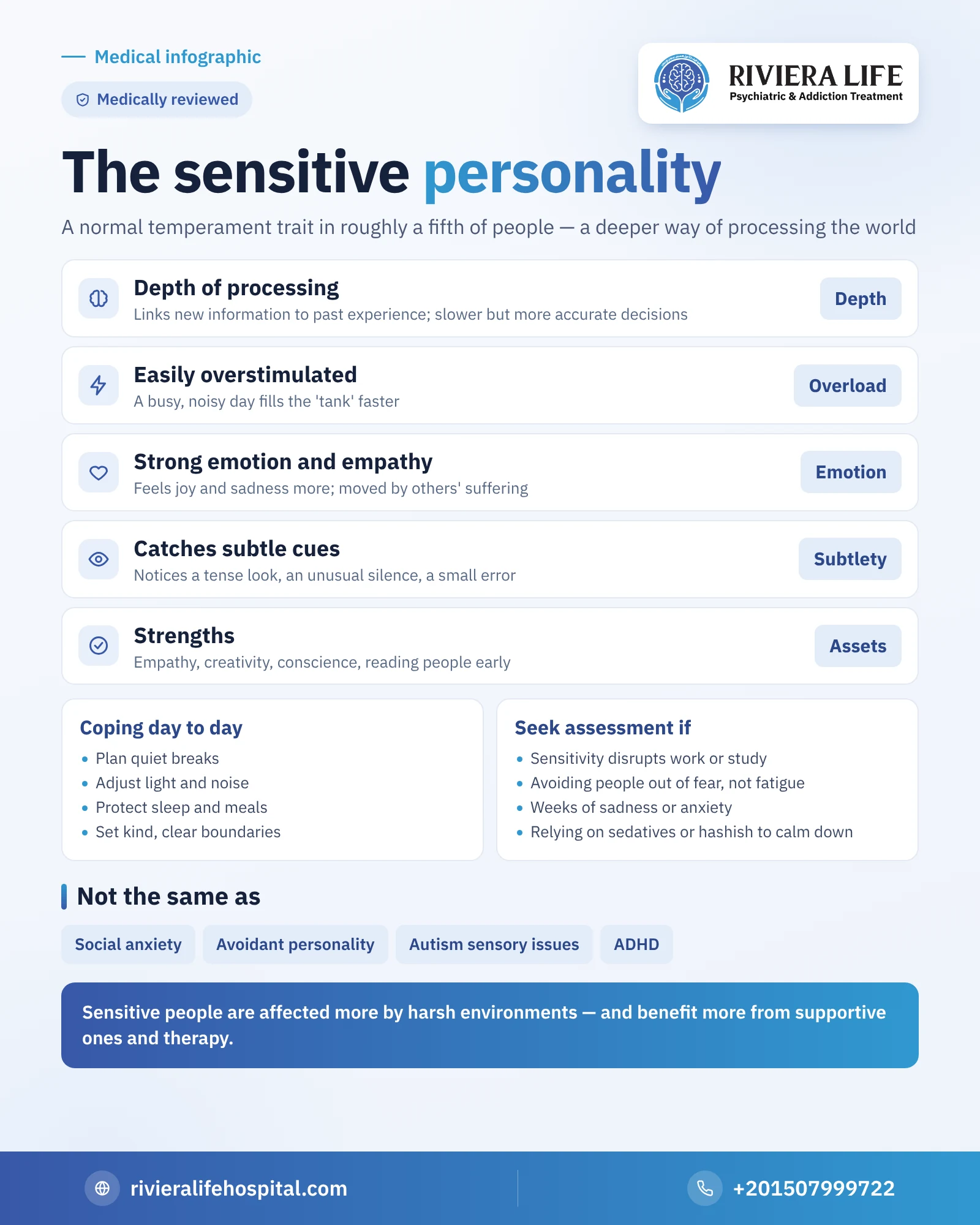
Four dimensions that explain high sensitivity
Depth of processing
A sensitive person links new information to their previous experiences and turns it over from several angles, which is why they seem slow to decide but are usually more accurate in their conclusions.
Being easily overstimulated
Because they process a lot, their “tank” fills faster than others’. A work day full of meetings and noise may leave them completely exhausted in the evening.
Strong emotion and empathy
They feel joy and sadness more strongly, and are affected by others’ suffering as if it were their own, which makes them a compassionate friend and a good listener.
Picking up subtle cues
They notice what is between the lines: an annoyed look, an unusual silence, or a small error in a report.
The strengths of a sensitive personality
Research suggests that highly sensitive people are affected by bad environments more than others, but they also benefit from supportive environments and psychotherapy more than others. In the right conditions, sensitivity turns into clear advantages:
- Genuine empathy that makes them sought after in caring, teaching, medical and counseling professions.
- Creativity and refined artistic taste.
- A strong conscience and care for quality and detail.
- The ability to read people and notice problems early before they get worse.
When sensitivity overlaps with anxiety and depression
Sensitivity isn’t anxiety, but if a sensitive person lives for a long time under pressure or constant criticism, they are more likely for their normal tension to turn into chronic anxiety. The practical difference is that pathological anxiety keeps fear present even in safe situations, accompanied by insomnia, physical tension and a constant expectation of the worst, as we explained in anxiety symptoms.
The same goes for depression: deep sadness after a painful event is an expected response from a sensitive person and eases over the days. But sadness that lasts two weeks or more with loss of pleasure, changes in sleep and appetite, and a feeling of worthlessness needs assessment. The details are in depression symptoms.
Sensitivity, avoidant personality and social anxiety
Confusion here is common, because all three can make a person avoid gatherings. But the motive differs:
| Condition | Why do they stay away from gatherings? | Is it a disorder? |
|---|---|---|
| Sensitive personality | Exhausted by too many stimuli; needs rest, then returns | No, a normal trait |
| Social anxiety | Intense fear of embarrassment and judgment in specific situations | Yes, an anxiety disorder |
| Avoidant personality | A deep sense of inadequacy and fear of rejection in most relationships | Yes, a personality disorder |
A sensitive person enjoys a quiet gathering with friends they trust, and doesn’t feel less than them. For the deeper picture of avoidance, read avoidant personality, and for social fear see social anxiety symptoms. A specialist also distinguishes sensitivity from the sensory processing difficulties that accompany the autism spectrum or attention deficit hyperactivity disorder.
Where does high sensitivity come from?
Twin studies suggest that part of this trait is inherited and the other part is shaped by environment and early experiences. Brain imaging studies have shown higher activity in sensitive people in areas linked to attention, empathy and integrating information. A sensitive child who grows up in a warm home tends to become a balanced, creative adult, while a harsh or neglectful home increases the likelihood of anxiety later.
How can you cope with your sensitivity?
- Know the limits of your energy: plan your day so that it includes short periods of calm, especially after meetings and events.
- Adjust your surroundings: noise-cancelling headphones, soft lighting, and a corner at home for rest.
- Protect your sleep and meals: hunger and lack of sleep double how much everything affects you.
- Set kind, clear boundaries: you have the right to excuse yourself from an event or leave early without guilt.
- Separate your feelings from other people’s: ask yourself, is this distress mine, or did I pick it up from someone else?
- Choose a suitable work environment: as far as possible, since noisy open-plan offices tire you more than others.
- Stop beating yourself up: sensitivity is a way of feeling, not a flaw that needs fixing.
Advice for the family of a sensitive child
Don’t call them weak or “spoiled”, and don’t push them into crowded situations suddenly; prepare them and give them time to adjust. Use calm guidance instead of shouting, because a harsh word affects them more than you expect. Praise their empathy and observation, and teach them to name their feelings and ask for rest when they are full.
When should you seek help?
Sensitivity doesn’t need treatment, but ask for a psychological assessment if being affected starts to disrupt your work or study, you begin avoiding people out of fear rather than tiredness, sadness or anxiety lasts for weeks, or you have started relying on sedatives, sleeping pills or hashish to calm down. Cognitive behavioral therapy helps many sensitive people regulate their emotions.
Seek urgent help immediately if you see
Call an ambulance on 123, go to the nearest emergency department, or call the mental health hotline on 16328.
- Thoughts of self-harm or ending one’s life
- Severe hopelessness and a feeling of being a burden on those around you
- A complete collapse in eating, sleeping and working for days in a row
How can Riviera Life help you?
At Riviera Life, a consultant psychiatrist helps you distinguish normal sensitivity from any anxiety, depression or avoidance that may accompany it, and sets with you a psychotherapy plan that respects your nature, in complete confidentiality. Book your free first consultation on +201507999722.
More from our personality disorders guide
- Personality disorders: the complete guide
- Avoidant personality
- Schizoid personality: the signs, the difference from introversion, and treatment
- Obsessive-compulsive personality
Questions many people ask
No. High sensitivity is a normal temperament trait that a large share of people have; it isn't a disorder and doesn't need treatment in itself. Assessment is only needed if anxiety, depression or avoidance that disrupts life comes with it.
Sensitivity has nothing to do with weakness. It is a deeper way of taking in stimuli and emotions, and can be a source of strength in empathy, creativity and attention to detail.
A sensitive person withdraws temporarily to recover their energy, then returns and enjoys their relationships, while a person with avoidant personality avoids relationships out of fear of rejection, with a deep sense of inadequacy.
The goal isn't to get rid of it but to manage it: managing energy and sleep, adjusting your surroundings, and setting clear boundaries. Psychotherapy helps if anxiety or depression accompanies it.
Twin studies suggest part of it is inherited, and the other part is shaped by early experiences and environment; a sensitive child in a supportive home usually grows up balanced.