Oppositional defiant disorder is a behavioral condition in children and teenagers, consisting of a persistent pattern of anger, irritability, arguing with adults, refusing instructions and blaming others, lasting at least six months and beyond what is expected at the child’s age. It isn’t passing stubbornness, nor poor parenting in itself, but a problem that needs understanding and a plan. The good news is that the most effective methods of treatment are those the parents learn themselves. Here we explain how to distinguish the disorder from normal childhood stubbornness, its causes, parent training programs, and what home and school can do.
Normal stubbornness or oppositional defiant disorder?
Every child says “no” at the age of two and three, and every teenager tests the family’s limits. This is part of growing up and gaining independence. The problem begins when defiance becomes the rule, not the exception:
| Aspect | Normal stubbornness | Oppositional defiant disorder |
|---|---|---|
| Frequency | Scattered situations that change with circumstance and mood | A near-daily pattern lasting six months or more |
| Settings | Usually in one situation or place | At home and often at school too |
| Intensity | Calms quickly after the situation ends | Long anger, resentment and deliberately annoying others |
| Impact | Doesn’t disrupt life | Harms study, friendships and the relationship with the family |
| Response to guidance | Responds after a little firmness and warmth | Escalation and insistence on defying |
The symptoms as the diagnostic manual describes them
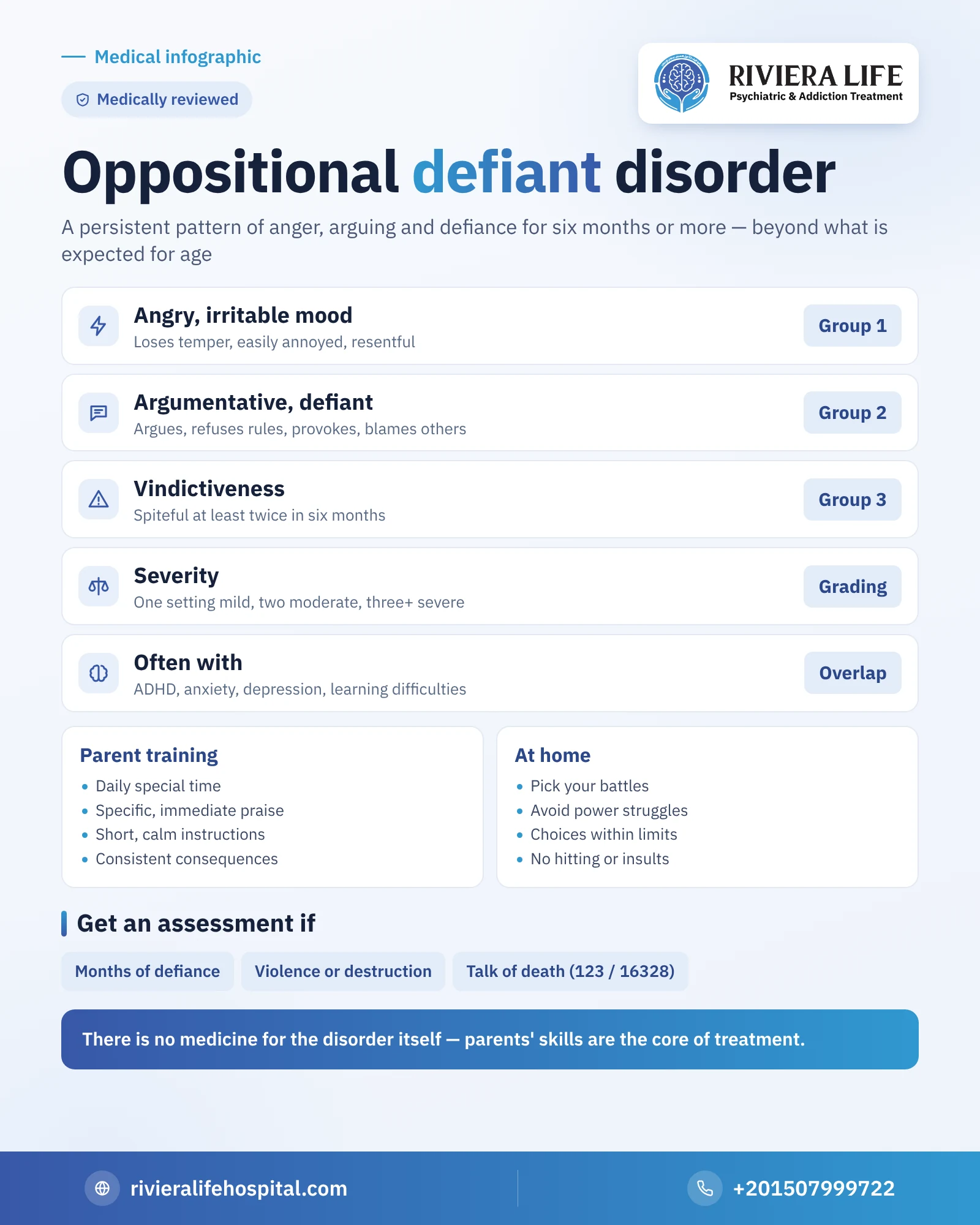
The American manual groups the symptoms into three groups, and requires at least four symptoms from them to appear over six months, in dealings with someone who isn’t a brother or sister:
- Angry, irritable mood: often loses their temper, is easily annoyed, and seems resentful and complaining.
- Argumentative, defiant behavior: argues with adults and teachers, deliberately refuses requests and rules, provokes others, and blames them for their own mistakes.
- Vindictiveness: holds grudges and pays back offense, and may act spitefully at least twice within six months.
Severity is graded by settings: mild if the symptoms appear in one place such as the home, moderate in two places, and severe in three or more.
An example from real life
A mother asked her nine-year-old son to turn off the television and start his homework. He replied: “I won’t, you always ruin everything for me.” She raised her voice, so he raised his louder, then threw the book and slammed the door. An hour later he said his sister was the one who started it. This scene repeats almost every day, so the mother feels she is a failure, and the home turns into a battlefield. What the mother doesn’t see is that the child himself is unhappy and feels he is “the bad boy” whom no one is pleased with.
Why does it happen?
There is no single cause; there is an interaction between factors:
- Temperament: some children are born more sensitive and emotional and less able to calm down.
- Parenting style: swinging between shouting and leniency, harsh punishment, and little attention and encouragement.
- The home atmosphere: parental conflict, divorce, violence or financial pressure.
- Accompanying disorders: often attention-deficit/hyperactivity disorder, anxiety, depression and learning difficulties.
- Neurological and genetic factors: research points to a possible role for differences in emotional regulation, without being deterministic.
This doesn’t mean the parents alone are “the cause of the problem”; the relationship is two-way: a child with a difficult temperament provokes a harsher reaction from the parents, so defiance increases. Treatment breaks this cycle.
Disorders that overlap with it
What is most often confused with oppositional defiance is ADHD, as some children with it seem oppositional while they are actually unable to wait and concentrate, and their behavior improves a lot when the root is treated, as in our article on ADHD treatment. Anxiety or depression may also hide irritability and defiance, which is noticed in teen depression that often appears as irritability rather than sadness, as in teen depression. In a proportion of cases the behavior develops into a more severe conduct disorder that includes aggression and breaking social rules, which makes early intervention important.
How is it diagnosed?
There is no laboratory test. The doctor or specialist gathers information from the parents, the child and the school, asks about the onset of the symptoms, their duration and settings, about sleep, nutrition, health and recent family events, and uses standardized behavioral questionnaires. The purpose of this interview is also to rule out other causes for the child’s behavior: hearing or learning problems, bullying they face at school, recent trauma, or disorders such as ADHD, anxiety and depression. The disorder isn’t diagnosed in a child going through a passing crisis such as the death of a relative, a school move or divorce, unless the pattern continues after the crisis has passed.
What about the future?
Many children improve with early treatment, and some lose the diagnosis as they mature. But some of those who aren’t treated may move on to bigger problems in adolescence, such as conduct disorder, substance use or depression, and their academic and social struggles increase. That is why specialists recommend not waiting “until he grows up and changes”, and starting parent training as early as possible, so seeing a specialist isn’t an accusation against anyone but an investment in the child. In adolescence specifically, weak family supervision and the company of peers who use substances are linked to greater risk, so keeping track of friends, pocket money and the phone, without spying or harshness, is part of prevention.
Treatment: parent training programs first
The treatment with the best evidence is parent training in behavior management. Internationally known programs, including “The Incredible Years”, parent-child interaction therapy and others, are built on similar principles:
- Setting aside a short daily time to play or talk with the child without orders or criticism, to strengthen the relationship.
- Praising good behavior immediately and specifically: “Thank you for turning off the television the first time.”
- Giving short, clear and calm instructions, one at a time, instead of a stream of orders.
- Consistent, predictable and simple consequences for breaking rules, without shouting or threats that aren’t carried out.
- Ignoring minor annoying behavior aimed at getting attention, and focusing on what matters.
This is complemented by cognitive behavioral therapy for the child, so they learn to name their emotion, control anger and solve problems, and by social communication skills training. The school cooperates with a unified plan with the home. There is no medicine that treats the disorder itself, but the doctor may prescribe a medicine when there is an accompanying disorder such as ADHD or depression, and parents don’t start, stop or adjust it themselves.
What do parents do at home?
- Choose your battles: focus on three basic rules, such as safety, respect and doing tasks, and let the rest go.
- Avoid power struggles: if the situation escalates, step away a little and come back when everyone has calmed down. Winning the argument isn’t the goal.
- Give choices within limits: “Will you start your homework now or in ten minutes?” gives them a sense of control.
- Stay away from hitting and insults: they increase stubbornness and aggression in the long run and weaken trust.
- Look after yourself: an exhausted parent is more prone to explode, so ask for the support of your partner and family.
In adolescence, negotiation becomes more important than orders: listen to their point of view, set the rules with them where possible, and keep firm limits on matters of safety. You will find broader details about the signs of disorders in young children in our article on mental illness in children.
The school and the teacher’s role
A child’s behavior at school improves when they know exactly what is expected of them, get quick positive reinforcement, and are given a chance to withdraw and calm down instead of a confrontation in front of classmates. It helps for the teacher to communicate with the family in a tone of cooperation, not complaint, mentioning what worked as well as what didn’t.
When should you seek an assessment?
Take the child to a child psychiatrist or psychologist if defiance continues for months and harms study and relationships, or if violence towards people or animals or deliberate destruction appears, or if it is accompanied by severe sadness, withdrawal and talk of death. And if thoughts of self-harm appear, call an ambulance on 123 or the mental health hotline on 16328. At Riviera Life you can get a free first consultation in complete confidentiality to decide on the right step.
More from our child and adolescent mental health guide
- ADHD: the complete guide
- ADHD treatment by age
- Mental illness in children
- Teen depression: the signs and how parents can talk
- Asperger’s vs autism: why the name disappeared and what it means today
- Intermittent explosive disorder: when anger gets out of control
Questions many people ask
Normal stubbornness is intermittent and calms quickly, while the disorder is a near-daily pattern of anger, arguing and defiance lasting six months or more and affecting home and school.
It isn't the only cause. The child's temperament interacts with parenting style, the home atmosphere and possibly accompanying disorders, and the relationship between the child's behavior and the parents' reaction is two-way.
Parent training in behavior management is the first option, with cognitive behavioral therapy for the child and the school's cooperation, and there is no medicine that treats the disorder itself.
This happens in a proportion of cases, which is why early intervention is recommended rather than waiting until the child grows up.
Behavior often improves when accompanying ADHD is treated, but the doctor decides that after assessment.