Intermittent explosive disorder is a psychiatric disorder in which loss of control over anger repeats in sudden episodes: the person shouts, smashes things or attacks verbally or physically to a degree out of proportion to what provoked them, then regrets it and the storm calms. It isn’t just a hot temper or bad upbringing, but a repeated pattern that harms relationships and work and exposes others to danger, and it has psychological treatment that clearly eases the episodes. This article explains the meaning of the disorder and its signs, how it differs from ordinary irritability and similar illnesses, how the person’s family can act safely, and what the person themselves can do.
What is intermittent explosive disorder?
It is defined by repeated impulsive episodes of anger that aren’t preceded by a plan, and don’t aim at a gain such as money or control over others, but explode from the emotion itself. Doctors require the response to be far stronger than the trigger, such as a minor dispute over a parking space ending in shouting and smashing or a fight. Precise time criteria are used: either repeated verbal outbursts or threats over months, or several episodes causing damage or injury within a year. It usually begins in late childhood or adolescence, and continues for years if untreated.
The disorder isn’t diagnosed if the anger is explained by another illness or a substance, which is why specialist assessment matters.
What does an episode look like?
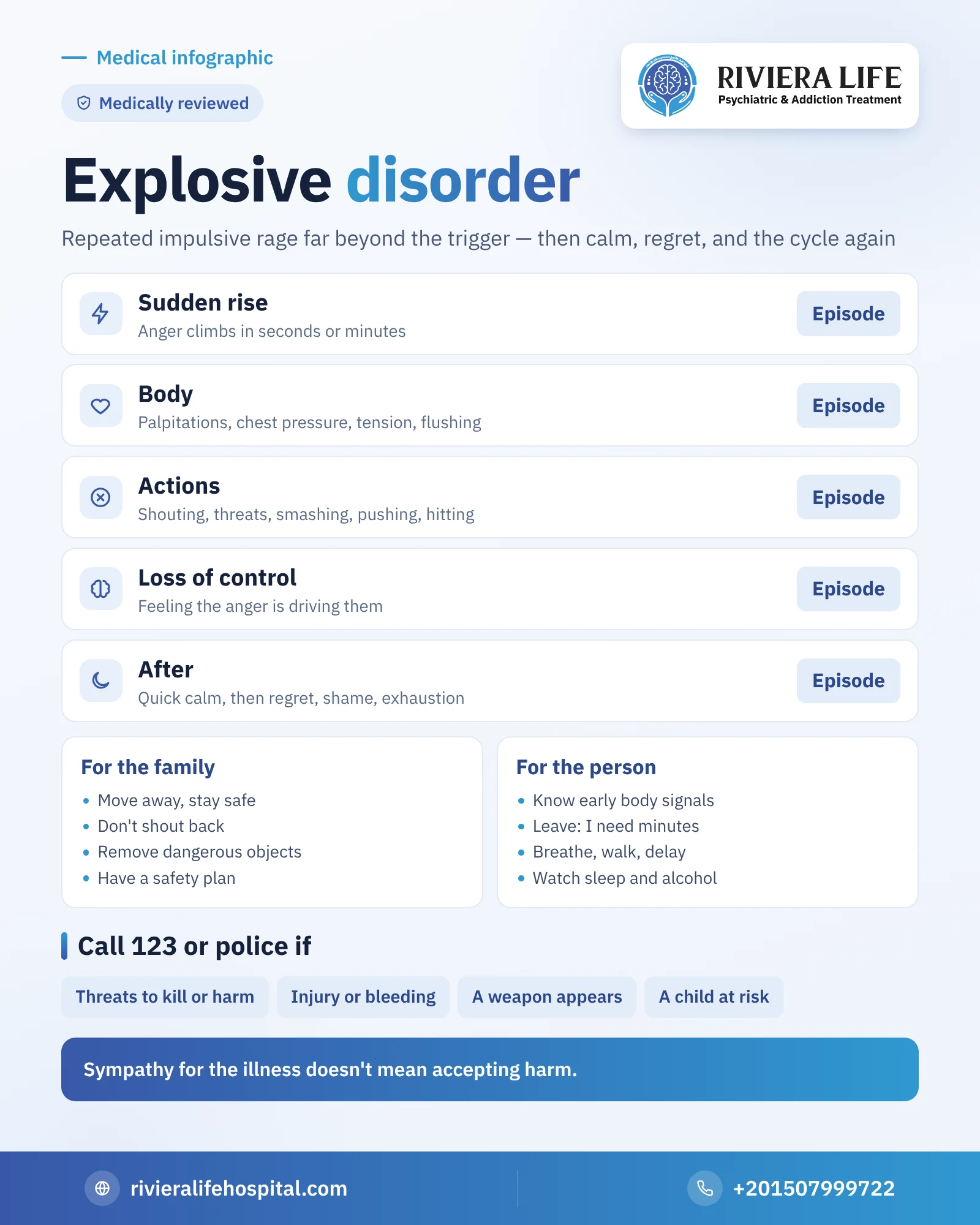
- Anger that rises within seconds or minutes without long warning.
- Physical symptoms before or during it: palpitations, pressure in the chest, muscle tension, trembling and heat in the face.
- Shouting, insults and threats, or throwing and smashing things, hitting walls, or pushing and hitting.
- A feeling of losing control, or that the anger is “driving” the person.
- Quick calm after the episode, followed by regret, shame or exhaustion, and sometimes justification and blaming the other party.
- Episodes that may last minutes, then return after days or weeks, hence the description “intermittent”.
The explosion cycle
The same circle repeats: tension builds up, then a small trigger, then an explosion, then brief relief, then regret and fear that it will happen again. The relief after the episode is what makes the circle repeat itself.
How it differs from ordinary irritability
Anger is a normal feeling, and it doesn’t become a disorder just because it repeats. To study general irritability, its hidden causes and ways to control it, read treating excessive irritability. Here, though, the picture is more serious:
| Aspect | Ordinary irritability | Intermittent explosive disorder |
|---|---|---|
| Intensity | Usually fits the situation | Far stronger than the trigger |
| Control | Can be stopped or postponed | Impulsivity that is hard to hold back |
| Result | A dispute or hurtful words | Smashing, assault, harm or legal consequences |
| Frequency | Linked to stress and exhaustion | Repeated episodes over months and years |
| Impact | Limited | Broken relationships, lost jobs and trouble with the law |
Causes and risk factors
- Genetics: the disorder recurs in some families, and genes seem to play a role in impulsivity.
- The brain: research points to differences in the activity of emotion and control centers, and a possible role for serotonin.
- Childhood: growing up in a home with frequent violence, shouting, abuse or neglect teaches the child that exploding is the solution.
- Stress: exhaustion, insomnia, and financial and marital problems lower the threshold of tolerance.
- Injuries and illnesses: head injuries, some types of epilepsy and brain diseases may change control over anger.
- Substances: alcohol, stimulants, drugs and anabolic steroids increase anger and impulsivity and may cause similar episodes.
What might it be confused with?
- ADHD: impulsivity and quick reactions, but with distraction and difficulty organizing. Read about ADHD.
- Bipolar disorder: anger in a manic episode lasts days and comes with little sleep, excess energy and grand ideas, while in explosive disorder the episode is short and mood between episodes is normal. See bipolar disorder.
- Borderline personality: anger in it is linked to fear of abandonment and unstable relationships; see borderline personality.
- Antisocial personality: aggression in it may be planned and come with an absence of remorse, while in explosive disorder it is spontaneous and followed by regret. See antisocial personality.
- Depression and trauma: anger may appear in men and teenagers instead of sadness, or after traumatic events. Read psychological trauma.
- Substance use: anger under the effect of a substance or during its withdrawal isn’t an independent diagnosis. Substance use may accompany explosive disorder, and here treating both together helps.
Call an ambulance on 123 or the police if
Everyone's safety comes first, and don't try to handle a violent episode alone. You can call the mental health line on 16328 for guidance.
- Someone threatens to kill or seriously harm, or has started assaulting someone
- An injury, fracture or bleeding has resulted from an episode
- A weapon or dangerous tool appears in the hand of the person who is enraged
- A child or older person is in danger because of the episode
- The enraged person talks about harming themselves or suicide
How does the family act during an episode?
- Move away and stay safe: leave the room or place if you feel in danger, take the children with you, and don’t try to hold or confront them.
- Don’t shout back: a low tone and short words: “We’ll talk later when we’ve calmed down”, then withdraw.
- No discussion in the heat of the moment: reproach and analysis come hours later when everyone has calmed down.
- Remove what might hurt: keep sharp tools and any weapons out of reach, especially in a family that witnesses episodes.
- A safety plan: agree on a place to go, a number to call, and a close person who knows what is going on, especially if the violence reaches the wife or children.
- Don’t excuse assault: sympathy for the illness doesn’t mean accepting harm, and seeking treatment is a condition for continuing the relationship safely.
What does the person themselves do?
- Learn your early physical signals: palpitations, heat in the face, tension in the jaw.
- Leave the situation as soon as they appear, even saying one sentence: “I need a few minutes”. This isn’t running away but protection.
- Breathe slowly, walk, and do a short physical activity to release the energy, and postpone any decision or message.
- Pay attention to sleep, alcohol and stimulants, as they reduce your ability to hold back.
- Apologize after calming down and repair what you broke, and look for treatment instead of settling for promises.
Treatment
Psychotherapy
Cognitive behavioral therapy designed for anger management is the most studied. In it the person learns to notice the thoughts that ignite the episode, reinterpret situations, relaxation techniques, problem-solving and communication skills, and practising provocative situations safely. Treatment usually includes individual or group sessions, and the family may take part. Read more about cognitive behavioral therapy.
Medicines
The psychiatrist may prescribe a medicine that reduces impulsivity and aggression; among the classes used are some antidepressants that act on serotonin, and sometimes mood stabilizers or other medicines depending on the case. Depression, anxiety or hyperactivity accompanying the disorder is also treated. These medicines aren’t started or stopped without the doctor, and anger doesn’t improve with sedatives or alcohol, as both may increase impulsivity.
When should you ask for help?
Ask for a psychological assessment if episodes in which you lose control repeat, if you have injured someone or smashed things, if those closest to you have become afraid of you, if you have lost a job or relationship because of anger, or if you feel regret and haven’t been able to change. And for families: ask for help if the episodes increase or come with threats, and don’t wait until a disaster happens.
How can Riviera Life help you?
The consultant psychiatrists at Riviera Life assess the disorder and any illnesses or substance use it may be mixed up with, set a suitable psychological and medication treatment plan, and involve the family in a support program, in complete confidentiality. The first consultation is free, and you can call +201507999722.
More from the anger and impulsivity guide
- Treating excessive irritability: the hidden causes and steps to control anger
- ADHD: a comprehensive guide
- Antisocial personality
- Psychological stress: its signs and effect on the body
- Anger test: an instant result
Questions many people ask
In explosive disorder the response is far stronger than the trigger and hard to hold back, and the episodes repeat and cause smashing, harm or consequences. Ordinary irritability usually fits the situation and can be stopped.
It can be, because the episodes expose others to harm and destroy relationships and work. Early psychotherapy eases the episodes and reduces their risks.
Move away to a safe place, don't confront them or shout back, put dangerous tools away, and call the ambulance on 123 or the police if there is a threat or assault. Discuss it later when they have calmed down.
The doctor may prescribe a medicine that reduces impulsivity, such as some antidepressants or mood stabilizers, along with psychotherapy. The decision is the doctor's alone, and it isn't started or stopped without their follow-up.
Yes, alcohol, stimulants and anabolic steroids may increase anger and impulsivity. The disorder isn't diagnosed if the direct cause is a substance, and specialist assessment is needed.