Delusional disorder is a psychiatric condition in which a person holds on to one or more delusions for at least a month, without showing the other signs of schizophrenia such as clear hallucinations and disorganized speech. What sets it apart is that the person may seem completely normal in his work, conversation and home, until someone comes near the subject of his delusion: his wife’s infidelity, a conspiracy at the company, or an illness the doctors can’t find.
That is why it is often discovered years late. Here we explain what a delusion means, the types of the disorder, what distinguishes it from ordinary suspicion and from schizophrenia, how it is diagnosed and treated, and how the family can act without clashing. Diagnosis is made by the psychiatrist only.
What exactly is a delusion?
A delusion is a false idea a person holds with complete certainty despite clear evidence to the contrary, and it isn’t linked to his culture, religion or environment. A belief the group shares, or a religious idea he was raised on, isn’t a delusion. The difference between a delusion and an ordinary mistake is that someone who is mistaken reconsiders when presented with the facts, while someone with a delusion interprets every new piece of evidence in a way that confirms his idea, so a denial becomes, for him, further evidence of a conspiracy.
How does it differ from schizophrenia and paranoia?
Delusional disorder belongs to the psychosis family, but it is less common in daily life than schizophrenia. The differences come down to the following:
- General functioning: in delusional disorder the person stays working and organized in most areas of his life, while schizophrenia usually affects thinking, speech and behavior in general.
- Hallucinations: not prominent in delusional disorder, and if they appear they are linked to the delusion itself, like someone who feels insects on his skin and believes he has an infection.
- Bizarreness: the delusion in delusional disorder is usually possible in principle, such as thinking he is being watched or deceived, not that he controls the weather.
- Mood disturbance: if the basis is episodes of mania or depression, the diagnosis is different, including psychotic depression.
Paranoia, on the other hand, is a description of a pattern of thinking that revolves around persecution and suspicion, and may be a symptom in more than one disorder, while delusional disorder is a standalone diagnosis with its own criteria.
The types: what does the delusion revolve around?
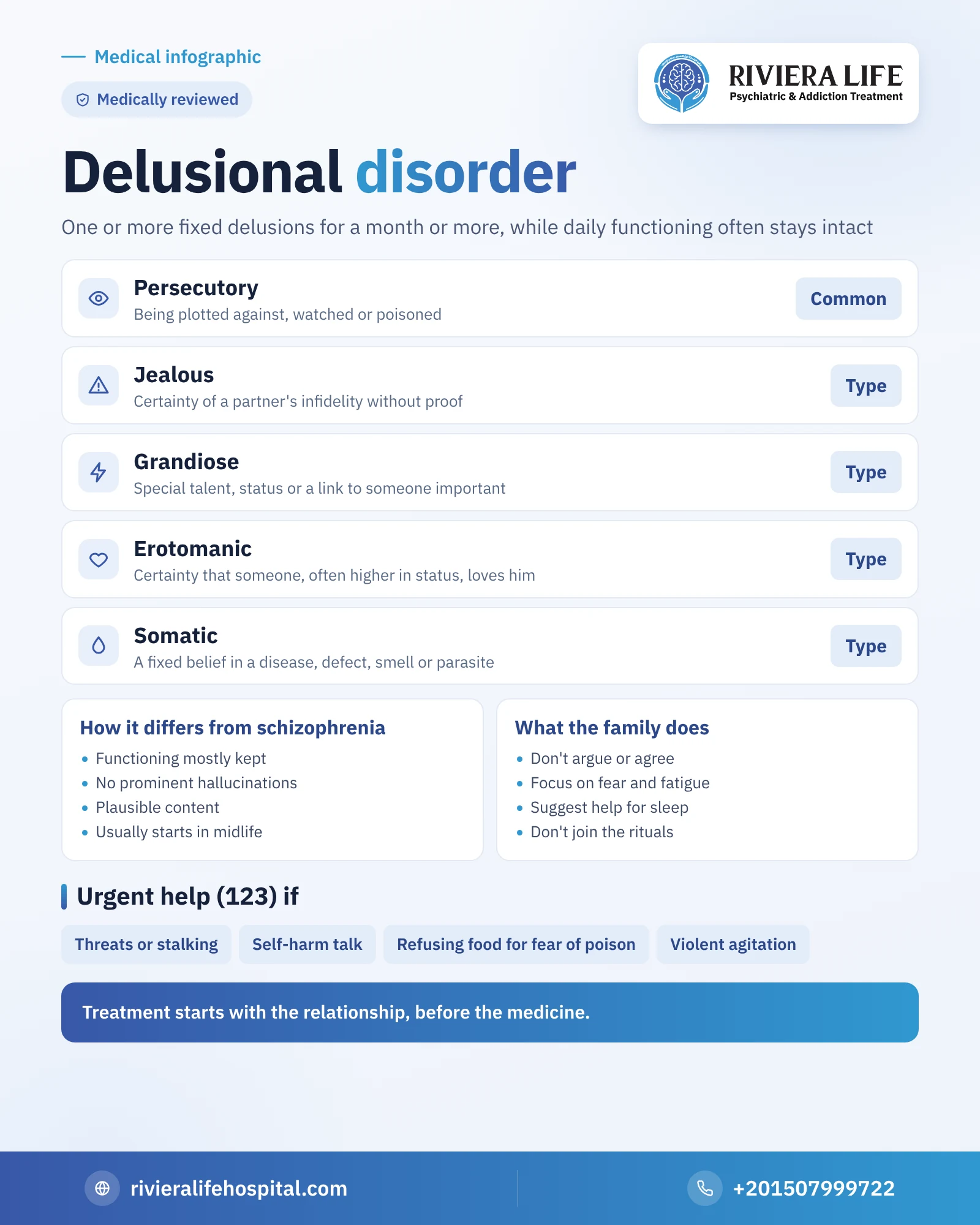
Doctors classify the disorder according to the dominant theme of the delusion:
- Persecutory: the belief that someone is conspiring against him, watching him, poisoning him or obstructing his interests. It is one of the most common types.
- Jealous: certainty that the partner is unfaithful without evidence, with repeated monitoring, searching and interrogation. To distinguish it from severe non-delusional jealousy we have a dedicated article on pathological jealousy.
- Grandiose: a belief in a special talent, ability, status or relationship with an important figure, detailed in delusions of grandeur.
- Erotomanic: certainty that another person, usually higher in status, is in love with him, even though the other person doesn’t know him or denies it.
- Somatic: a fixed belief in a disease, defect, smell or parasite in the body, with repeated moving between clinics despite normal tests.
More than one idea may come together, and the type is then called mixed. The doctor also describes whether the delusion’s content is bizarre or not.
How common is it and at what age does it start?
Delusional disorder is much less common than schizophrenia, and its rate among people is estimated at less than one percent. It usually begins in middle age or later, not usually in adolescence like schizophrenia. It affects men and women, with a difference in the dominant types according to studies. And because those affected work, marry and have children, many only reach the clinic after the dispute with the family, neighbors or work has escalated.
What are its possible causes?
There is no single confirmed cause. Research points to overlapping factors, including genetic predisposition and the presence of psychotic disorders or suspicious personality traits in the family, social isolation, weakening hearing or sight with age, migration or severe stress, and chronic tension. Some substances such as stimulants and hashish may also strengthen the appearance of delusions, which we cover in causes of psychosis. Physical causes such as brain diseases, thyroid, vitamins and medicines must always be ruled out.
When does the family sound the alarm?
- One idea controls conversation and decisions and consumes time and money.
- He rejects any alternative explanation and considers whoever disagrees a partner in the conspiracy.
- Complaints against the neighbors, colleagues or partner recur without tangible evidence.
- Compulsive monitoring, tracking and searching of the phone or belongings.
- Moving between doctors or doing many tests for an illness that doesn’t appear.
- Behavior that threatens others, such as following a person, calling him a lot or harming him.
Seek urgent help immediately if you see
Call an ambulance on 123 or go to the nearest emergency department if the delusion comes with danger.
- A clear threat to a specific person or stalking him
- Talk of self-harm or suicide
- Refusing food or medicine for fear of poisoning
- Agitation or violence that is hard to contain
How is it diagnosed?
The doctor listens to the patient and to someone close to him, and asks about the start of the idea and its effect on work and relationships. Then he rules out physical causes with an examination and tests, asks about substances and medicines, and distinguishes it from schizophrenia, mood disorders, paranoid personality disorder and OCD. It is essential to measure the patient’s degree of insight: does he accept the possibility that he is wrong, even a little? This determines the way of dealing with him. The family shouldn’t try to diagnose their relative, as determining the type and severity is specialist work.
How is delusional disorder treated?
Treatment here starts with the relationship before the medicine. A patient who feels the doctor believes and respects him returns for follow-up, while one who is confronted with the claim that his idea is crazy may flee treatment altogether and add the doctor to the list of conspirators. Among the pillars of treatment:
- Antipsychotics: the doctor sometimes prescribes them to ease the strength of the delusion and the anxiety and anger that accompany it, and the response may be partial and slow. We explain their families in antipsychotics.
- Cognitive behavioral therapy: it doesn’t attack the belief directly, but helps examine the evidence calmly and manage the anxiety and anger resulting from it.
- Treating accompanying illnesses: such as depression, anxiety and drug use, as their improvement eases the delusion.
- Family support: training in talking without arguing or agreeing.
- A stay: considered when there is danger to the patient or others, or he refuses food or medicine.
The medicine isn’t adjusted or stopped except by the doctor’s decision. And many patients may improve in their functioning and relationships even if the idea remains to a milder degree.
How does the family deal with it without clashing?
- Don’t argue about the idea or mock it, and don’t agree with it. It is enough to say: I see the matter differently, but I see how exhausting this is for you.
- Focus on feelings: fear, tiredness and lack of sleep, not on whether the belief is right.
- Suggest the doctor as a helper for the sleep and anxiety the problem has caused, not to prove the idea is wrong.
- Don’t take part in the delusion’s rituals, such as searching the house, checking on the neighbors or monitoring, as this entrenches it.
- Record your observations to give to the doctor: when it began, what changed, and whether he uses anything.
For more on the behaviors that appear in a psychiatric patient and how the family responds, we write in psychiatric patient behavior, and in when do you need a psychiatrist.
What about the outlook?
Delusional disorder tends to be chronic in some people, but their social and occupational functioning usually stays better than that of schizophrenia patients. Outcomes improve when follow-up starts early and contact continues with a doctor the patient trusts, and the risk of legal and family problems decreases when the accompanying symptoms of anger, anxiety and drug use are treated.
How can Riviera Life help you?
At Riviera Life, psychiatry and addiction consultants assess the case calmly and respectfully, rule out physical causes and drugs, then set a plan combining medication when needed with psychotherapy, the family program and aftercare, in complete confidentiality. The first consultation is free, and you can get in touch around the clock on +201507999722.
More from our psychosis guide
Questions many people ask
In delusional disorder the delusion remains the main symptom and the patient usually keeps his general functioning, without prominent hallucinations or disorganized speech as in schizophrenia.
Yes, many improve with regular follow-up, psychotherapy and sometimes antipsychotics, and the idea may remain to a milder degree while functioning improves.
Because he believes completely in the truth of his idea and doesn't see himself as ill, so direct confrontation increases his refusal and building trust gradually is preferable.
It may be if it reaches a fixed certainty of infidelity without evidence, and the doctor determines this after assessment; not every severe jealousy is an illness.
Don't argue with him or agree with him; acknowledge his feelings and fear, suggest the doctor for treating sleep and anxiety, and don't take part in the delusion's rituals.