A psychosis relapse means the return of delusions, hallucinations or severe confusion after a period of improvement or stability. It doesn’t usually come suddenly out of nowhere; in most cases it is preceded by weeks of small changes in sleep, mood and thinking that the family notices before the patient himself does.
It doesn’t mean treatment has failed or that the patient has “gone back to zero”, but it deserves quick action because each untreated episode makes the next recovery slower. Here we explain what relapse looks like, what sparks it, how to read its early signs, what the family does on the first day, and how a plan is built to reduce the chance of it recurring. Any change in medication is decided by the treating doctor alone.
What is the difference between relapse and passing fluctuation?
Everyone has bad days. The patient may sleep badly one night, get tense before an exam or be upset after a disagreement, and this alone doesn’t mean relapse. Relapse is the return of a group of symptoms that had eased, and their persistence for consecutive days, with a clear decline in daily functioning: he doesn’t go to work, neglects his hygiene, his conversation with his family changes. The practical rule doctors agree on is that a change that lasts more than a few days and resembles what preceded the patient’s first episode deserves a call to the doctor, even if it seems minor.
This article is about psychosis specifically. The return of sadness and loss of pleasure after improving from depression has different signs and a different plan in depression relapse.
Why does relapse happen? The most common causes
There is no single cause, but some factors recur in most stories:
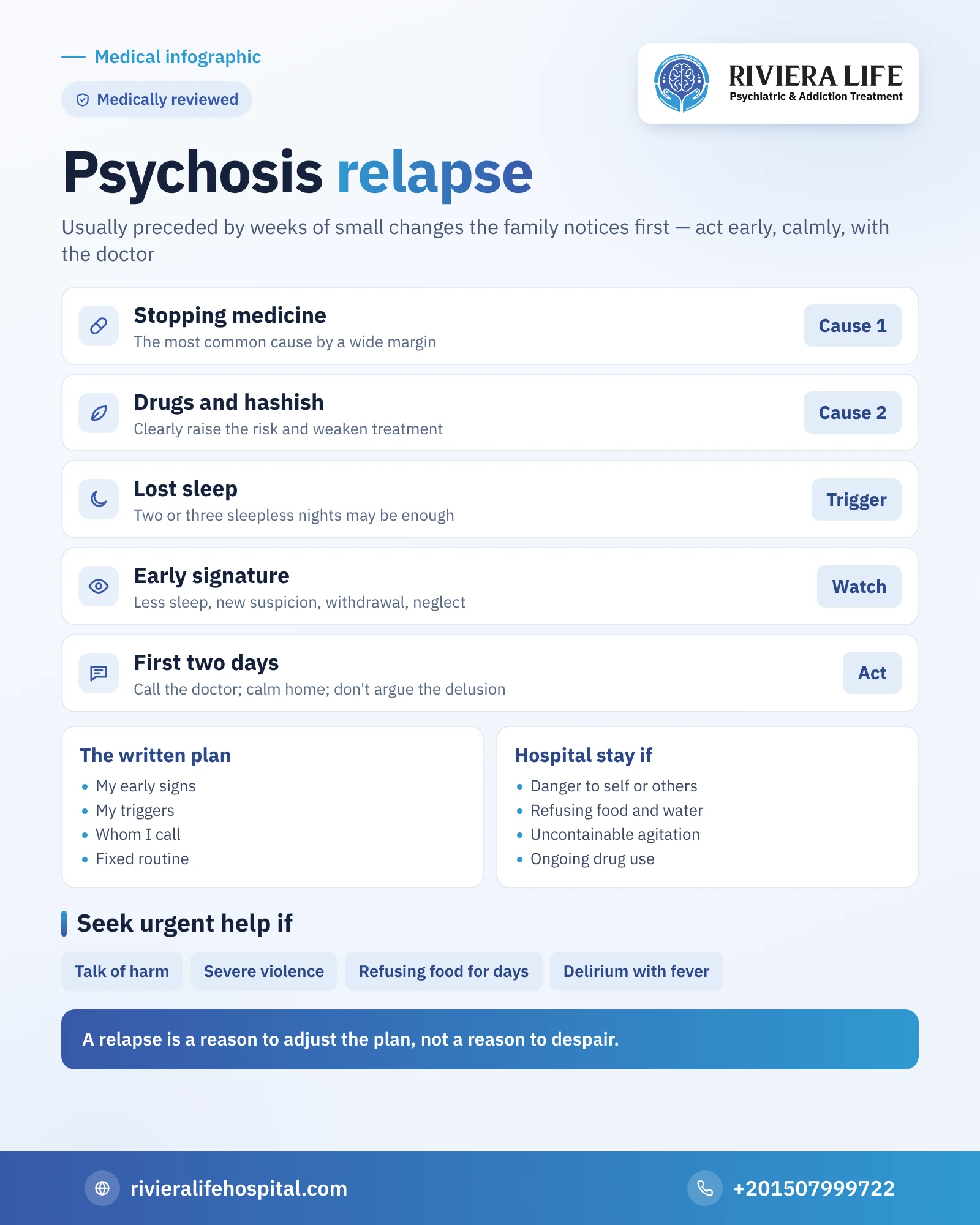
- Stopping medication or missing doses: by far the most common cause. The patient improves and thinks he is cured, or side effects bother him so he stops quietly without telling the doctor.
- Drugs, and hashish especially: they clearly increase the risk of symptoms returning, and weaken the effect of treatment. The details of this relationship are in our article on drug-induced psychosis.
- Lack of sleep: two or three nights of continuous staying up may be enough in some patients to spark an episode.
- Major stress: losing a job, the death of a relative, a marital dispute or exams.
- An environment full of criticism and shouting: research links high emotion and constant criticism at home to an increased risk of relapse; this doesn’t mean the family is the cause, but that the way of talking can be improved with training.
- Follow-up being cut off: missing the regular appointment means no one sees the first changes.
Early warning signs: what precedes an episode?
The signs differ from person to person, but each patient usually has a particular “signature” that recurs in almost every episode. Among the most commonly noticed:
- Less sleep or reversed sleep times, and disturbed early waking.
- Anxiety and tension without a reason, or unusual quickness to anger.
- Withdrawal from family and friends, keeping the room door closed all day.
- New suspicion of neighbors or colleagues, or of food and the phone.
- Difficulty concentrating and following conversation, or talk that jumps between topics with no link.
- Neglecting hygiene, food and medication times.
- The return of old complaints: “I heard something”, or “someone is following me”.
A family that knows the early signs of their son or husband has a precious opportunity: intervening before things reach agitation or danger. It is best for these signs to be written on a sheet with the doctor, not left as impressions.
What does the family do in the first two days?
The aim isn’t to convince the patient that his ideas are wrong; this rarely works and may increase estrangement. The aim is to reach the doctor in the quickest and calmest way.
- Call the treating doctor or the hospital and say exactly what has changed: when it started, how many nights without sleep, and whether the medicine has stopped.
- Ask calmly about the medicine: is he taking it? And don’t accuse. He may have stopped because of a side effect that can be treated.
- Reduce stimulation: calm lighting, a less noisy home, fewer visitors, and don’t argue about the delusion.
- Encourage sleep, food and water, and keep coffee, stimulants and late nights away.
- Make sure the patient isn’t using hashish or anything else, and tell the doctor frankly, as medical confidentiality protects him.
- Don’t give him any medicine of your own or double anything, as adjustment is the doctor’s job.
Seek urgent help immediately if you see
Call an ambulance on 123 or go to the nearest emergency department, and don't leave the patient alone.
- Talk of harming himself or others, or voices ordering him to do so
- Severe agitation or violence that is hard to contain
- Refusing food and water for days
- Delirium and confusion with fever, or after using or withdrawal
- Trying to run away from home and putting himself in danger
You can ask for guidance from the General Secretariat of Mental Health hotline on 16328.
What does the doctor do at relapse?
He starts with a simple question: why now? So he reviews adherence to medication, sleep, drugs and stress, and checks whether there is a physical cause such as an infection, a salt imbalance or the effect of another medicine. After that he decides whether adjusting the plan in the clinic is enough or a stay is needed. He may restart the same medicine if the patient had stopped it, change it if it didn’t work, or look for an alternative if side effects were the reason for stopping. When poor response recurs to more than one medicine, he may consider other medicines for treatment-resistant cases. You will find an explanation of the families of these medicines in antipsychotics.
When is a hospital stay preferable?
Not every relapse needs a bed. But a stay becomes the safest option when there is danger to the patient or others, complete refusal of food and drink, agitation that can’t be controlled at home, ongoing drug use, or when there is no one at home to watch the patient. A stay is a chance to adjust medication under observation, regulate sleep and keep the patient away from triggers for a few days. It doesn’t mean depriving him of his family; the family is part of the plan.
Long-acting medicines: for whom?
When the main problem is forgetting tablets or stopping repeatedly, the doctor may offer a type of antipsychotic given by injection every few weeks instead of daily tablets. This method doesn’t suit everyone and isn’t imposed on the patient; it is discussed with him as a way of relieving him of daily remembering. The decision is medical and shared between the patient and the doctor.
A relapse prevention plan: one sheet that changes a lot
The best time to write the plan is a time of calm, not a time of crisis. It usually includes:
- My early signs: the first thing that usually changes in me (sleep, suspicion, withdrawal).
- My triggers: late nights, drug use, missing medication, and the kinds of stress that harm me.
- Whom I call: the doctor, a family member I agree with in advance, and the emergency number.
- What others do: what I allow them and what bothers me, and which hospital I prefer they take me to.
- A fixed routine: sleep at regular times, daily activity, and avoiding alcohol and drugs.
Much research has found that combining regular medication, family intervention and cognitive behavioral therapy reduces relapses more than medication alone. The details of these elements are in our article on psychosis treatment.
When relapse recurs: don’t blame anyone
Some patients go through more than one episode despite good adherence. This doesn’t mean the patient or family has fallen short; psychosis is an illness with its own nature, and some of its forms tend toward repeated episodes, including schizophrenia. What matters is that each relapse turns into a lesson by which the medication and plan are adjusted, not a reason for despair. And if relapse is linked to substance use, the patient needs treatment for psychosis and addiction together, as we explain in schizophrenia and addiction.
How does the family look after itself?
A family that accompanies a patient between episodes gets tired too. It helps for more than one member to share the care, for the main carer to get regular rest, and to ask the doctor about a family program. The patient recovers better in a calmer home, and a calmer home needs a family that isn’t exhausted.
How can Riviera Life help you?
At Riviera Life, psychiatry and addiction consultants review the cause of the relapse and adjust the treatment plan with round-the-clock medical supervision when a stay is needed, then build with the patient and family a written prevention plan with a family program, aftercare and complete confidentiality. The first consultation is free, on +201507999722.
More from our psychosis guide
Questions many people ask
No, relapse is common in psychotic illnesses and means the plan needs review, and the patient usually returns to improvement after it is adjusted.
The most common are stopping or missing medication, then using drugs and hashish, lack of sleep, stress, and follow-up being cut off.
His sleep times usually change, his tension or suspicion increases, and he withdraws and neglects himself; if this continues for days, call the doctor.
It is better to talk, understand why he stopped, and look into alternatives with the doctor such as long-acting medicines; force is used only when there is danger and under medical supervision.
It can't be guaranteed, but regular medication, sleep, avoiding drugs, family intervention and a written plan reduce its likelihood a lot.