Rivotril is the brand name for clonazepam, one of the benzodiazepine medicines that sedate the nervous system. A doctor prescribes it mainly to treat types of epileptic seizures and panic disorder. Its level in the blood peaks roughly one to four hours after taking it, and it stays in the body a long time because its half-life is usually between thirty and forty hours. Its most common side effects are sleepiness, dizziness and poor balance, and its greatest danger is breathing suppression when combined with alcohol or opioids, along with the possibility of dependence with regular use. That is why it is only taken on prescription and under follow-up, and isn’t stopped suddenly.
What is Rivotril?
Rivotril belongs to the benzodiazepine family, the same family that includes diazepam, lorazepam and alprazolam. Its active substance is clonazepam, and it is available as tablets and, in some countries, as oral drops or injections used in hospital. It stands out from many of its relatives in being long-acting, meaning the body clears it slowly, which makes its effect calmer and steadier through the day, but also means its effects can build up with repeated doses.
What is Rivotril used for?
The approved uses of clonazepam cover two main conditions:
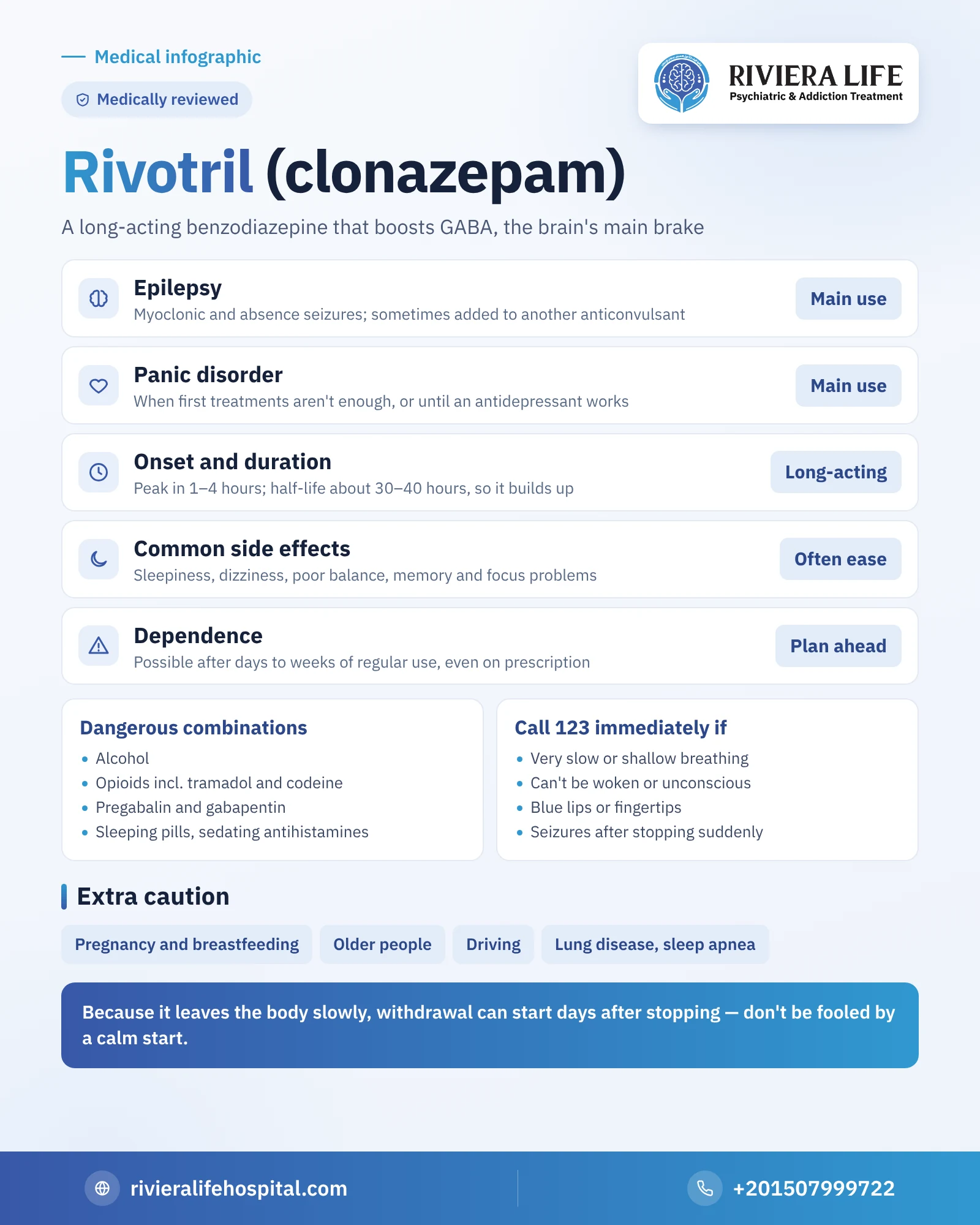
- Epilepsy: especially myoclonic seizures, absence seizures and some difficult epilepsy syndromes in children and adults; it may be added to another anticonvulsant.
- Panic disorder: whether or not accompanied by fear of crowded places. Some doctors prescribe it when first treatments aren’t enough, or until an antidepressant starts working. To learn about this condition, see our article on panic attacks.
A psychiatrist may turn to it in other specific situations, such as the restlessness caused by some antipsychotics, or acute catatonia. Using it to treat insomnia or everyday stress without a clear diagnosis isn’t one of its indications.
How does clonazepam work in the brain?
The brain depends on a balance between signals that excite nerve cells and others that brake them. The most important braking neurotransmitter is GABA. Clonazepam binds to a special site on GABA-A receptors, making them respond more strongly to GABA, so excess electrical signals calm down. This effect prevents the spread of the electrical discharge that causes an epileptic seizure, and eases the overexcitement that accompanies a panic attack. You’ll find a broader explanation of this mechanism in our article on GABA and anxiety.
When does Rivotril start working, and how long does it last?
The body absorbs clonazepam from the gut quickly and almost completely, and it reaches its highest level in the blood within one to four hours. That is why many people feel calm or sleepy within the first hour, with differences between people depending on age, liver function and whether there is food in the stomach. Because its half-life is long, its effect lasts many hours, and it builds up in the blood during the first days of regular use until it stabilizes. This means that judging its benefit in panic disorder takes days, not hours, and that sleepiness may extend into the next morning.
Side effects of Rivotril
Most common effects result from the sedation itself, and ease in many patients after the first weeks:
- Sleepiness, tiredness and slowed reactions.
- Dizziness, unsteadiness and poor coordination.
- Difficulty concentrating and poor memory for recent events.
- Headache and muscle weakness.
- Increased saliva in some patients.
There are less common effects that call for contacting the doctor quickly: new or worsening depression, thoughts of self-harm, unusual irritability or aggression, signs of allergy such as a rash and swelling of the face, or yellowing of the skin and eyes.
Call an ambulance on 123 immediately
If someone taking Rivotril shows any of the following signs:
- Very slow, shallow or irregular breathing
- Severe sleepiness making them hard to wake, or loss of consciousness
- Blue lips or fingertips
- Swelling of the face, tongue or throat with difficulty swallowing or breathing
- Seizures, especially after stopping or reducing the medicine suddenly
Important warnings before using it
- Pregnancy and breastfeeding: using it near the end of pregnancy may cause the newborn lethargy, feeding difficulty and withdrawal symptoms, and it may reach a breastfed baby through milk and increase sleepiness. Don’t start or stop the medicine without discussing it with the doctor; in women with epilepsy, stopping it may be more dangerous than continuing.
- Older people: more sensitive to its effect, so they have a higher risk of confusion and falls and need closer follow-up.
- Driving and machinery: avoid driving until you know how the medicine affects you, as slowed reactions may last a long time; the details of this risk are in our article on driving under the influence of drugs.
- Breathing diseases: anyone with chronic obstructive lung disease or sleep apnea needs a careful assessment, because the medicine can weaken breathing.
- Liver and eyes: it isn’t usually given to someone with severe liver disease or an acute attack of narrow-angle glaucoma.
Drug interactions: alcohol, opioids and pregabalin
The most dangerous thing that can happen with Rivotril is combining it with another substance that suppresses the nervous system. Alcohol and opioids, including tramadol, codeine and morphine, multiply its effect on the brain’s breathing center, and the combination can lead to coma or death. Pregabalin, gabapentin, sleeping pills and some sedating antihistamines act similarly. Other epilepsy medicines and some antidepressants and antipsychotics also interact with it and may change its level in the blood. Tell your doctor about every medicine or herb you take, and read about this danger in our article on mixing drugs.
Is Rivotril addictive?
Yes. Physical dependence on it can develop after days to weeks of regular use, even if it is taken as the doctor prescribed. In some people it may develop into misuse, increasing the amount on their own or seeking the feeling of relaxation. Physical dependence alone doesn’t mean addiction, but it needs a clear plan from the start. We explained how this dependence forms and who is most at risk in our article on Rivotril addiction, and compared it with diazepam in the difference between Valium and Rivotril.
Why mustn’t it be stopped suddenly?
After a period of use, the brain adapts to the presence of the medicine, so if it suddenly disappears, nervous overexcitement returns strongly. This may appear as severe anxiety, insomnia and tremor, and can reach dangerous seizures, especially in people with epilepsy. Because clonazepam leaves the body slowly, stopping symptoms may be delayed for several days, so the person thinks they have passed the danger. The doctor sets the reduction for each patient individually, and there is no single schedule that suits everyone. Read about this stage in Rivotril withdrawal symptoms, and about the steps to a safe exit in Rivotril addiction treatment.
Common mistakes in using Rivotril
- Taking tablets from a relative or friend because “their symptoms are like mine”.
- Increasing the amount when the effect seems weaker instead of seeing the doctor.
- Taking it with a glass of alcohol or an opioid painkiller “just once”.
- Relying on it alone to treat panic without psychotherapy that addresses the roots of the fear.
- Stopping it suddenly before travel or a drug test, or out of fear of addiction.
- Leaving tablets within reach of children or teenagers at home.
Questions to ask your doctor
- Why did you choose this medicine for my case specifically, and what are the alternatives?
- How long is treatment expected to last, and when will we review the need for it?
- Does it conflict with any medicine or supplement I take?
- Which signs should make me contact you immediately?
- How will we stop it when the time comes?
How can Riviera Life help you?
If you have been taking Rivotril for a while and feel you can no longer do without it, or are afraid to stop it, a medical assessment is the first step. At Riviera Life, consultants in psychiatry and addiction treatment follow each case under round-the-clock medical supervision, and set a withdrawal plan that takes into account the original reason for the prescription, whether epilepsy or panic. The hospital is licensed by the Ministry of Health, has fourteen years of experience, and is located in Sheikh Zayed, Giza. The first consultation is free and confidential, and is also available online: +201507999722.
More from our benzodiazepines guide
- Diazepam (Valium)
- Lorazepam (Ativan)
- The harms of benzodiazepines
- How long benzodiazepines stay in your system
- Benzodiazepine withdrawal symptoms
Questions many people ask
Rivotril is the brand name for clonazepam, a sedative medicine from the benzodiazepine group prescribed mainly for epilepsy and panic disorder.
It is used to treat types of epileptic seizures and panic disorder, and a psychiatrist may prescribe it in other specific situations; it isn't used for everyday stress without a diagnosis.
It reaches its peak level in the blood within one to four hours, and many people feel its effect in the first hour, while its benefit in panic disorder needs days of regular use.
Physical dependence can develop after days to weeks of regular use even on prescription, and in some people it may develop into misuse.
No. Stopping suddenly can cause severe anxiety, insomnia and seizures, and the doctor sets the reduction for each case individually.