The relationship between drugs and sex usually begins with a promise: stronger desire, longer performance, or more boldness. But what happens with continued use is the opposite in most cases: desire, erection, ejaculation and fertility are affected, the risks of infection and unplanned pregnancy rise, and the marital relationship itself erodes. This article is an overview that explains the mechanism common to different substances, compares their families in a single table, then refers you to the dedicated article for each substance. It also explains what can return after stopping, and when you need a doctor.
Why do some people link drugs and sex?
It rarely starts with the search for pleasure alone. Many men who reach the clinic started because of performance anxiety, premature ejaculation that embarrassed them, or a friend’s advice that “a pill” would solve the problem. Some use the substance to overcome shyness or tension at the start of a marriage. With a first experience that seems successful, a false link takes root in the brain: the relationship only works with the substance.
This link is the most dangerous part of the subject, because it turns a simple, treatable problem into a dependence that is hard to undo, and hides the real cause that needed assessment from the start.
How do drugs affect sexual function in general?
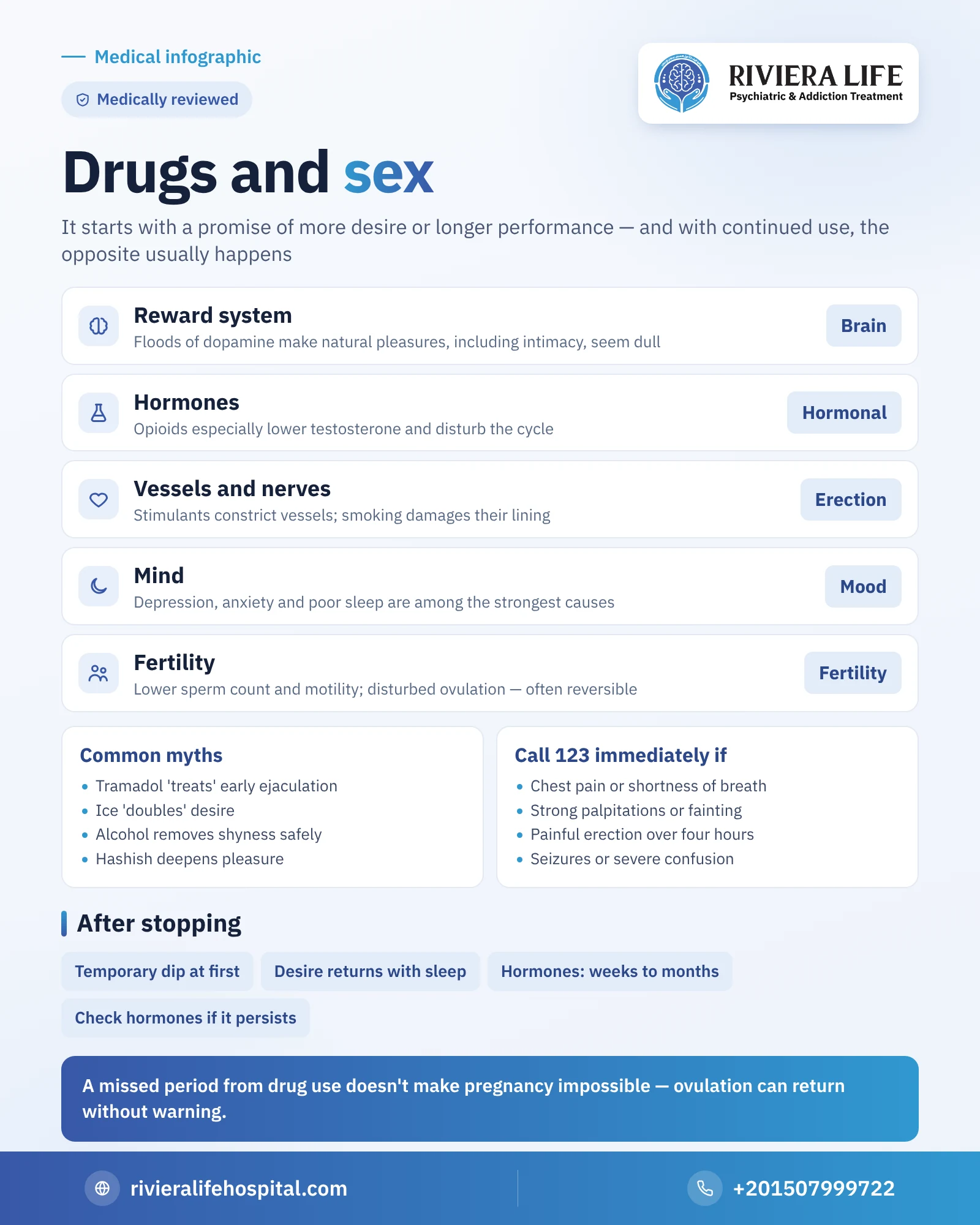
Healthy sexual function needs four things working together: a brain that sends the signal of desire, balanced hormones, blood vessels that widen at the right time, and a stable psychological state. Drugs of all kinds hit all of these links:
- The reward system: the substance floods the brain with dopamine, so natural pleasures, including intimacy, seem dull over time.
- Hormones: some substances, most clearly opioids, lower testosterone and disturb the menstrual cycle in women.
- Vessels and nerves: stimulants constrict the vessels, and smoking damages their lining, so erection weakens.
- The mind: the depression, anxiety and poor sleep that accompany use are among the strongest causes of weak desire.
The sexual effect by type of substance
Each substance has its own details, and we have devoted a separate article to each. This table summarizes the difference between what is rumored and what actually happens with continued use:
| Substance | What is rumored | What usually happens with continued use |
|---|---|---|
| Heroin and sex | Prolongs the act | Weak desire, low testosterone and difficulty reaching orgasm |
| Methamphetamine and sex | Doubled desire | Impulsivity and risky behavior, then weak erection and coldness |
| Cocaine and sex | Confidence and boldness | Difficulty with erection, delayed orgasm and disturbed fertility |
| Captagon and sex | Energy and delayed ejaculation | Insomnia and irritability that weaken the relationship, and declining performance |
| Amphetamine and sex | Activity and focus | Fluctuating desire and difficulty with erection with continued use |
| Hashish and sex | Deeper pleasure and relaxation | An inconsistent effect, and it may weaken erection and semen quality |
| Alcohol and sex | Removes shyness | Raises desire and weakens ability, and harms hormones in the long term |
| Spice and sex | A stronger alternative to hashish | An unpredictable effect, and poisoning risks that come before any sexual effect |
Stimulants: impulsive desire and declining performance
Ice, cocaine, captagon and amphetamine raise arousal at first in some users, but at the same time constrict blood vessels, so high desire combines with weak erection, a paradox that increases frustration. With continued use these substances exhaust the reward system, so after each period of use comes a comedown in which desire disappears completely. More dangerous still, impulsivity weakens judgment, so the likelihood of unprotected sex rises.
Opioids and sedatives: delayed ejaculation isn’t strength
In Egypt, using tramadol to delay ejaculation without a prescription is widespread, based on what friends say. The delay here comes from depressing the nervous system, and with time it brings weak desire and lower hormones, then dependence on the tablet itself, alongside the risk of seizures. We detailed the comparison in our article on the difference between tramadol and Viagra. The effect of heroin and morphine is of the same kind and more severe, while sedatives weaken arousal and orgasm in both sexes.
Hashish, alcohol and synthetic substances
Hashish and alcohol give a feeling of relaxation and the loss of shyness, which is what makes many people link them with sex. But alcohol in particular raises desire and lowers ability at the same time, and chronic excess harms the liver and hormones. The effect of hashish varies from person to person. As for synthetic mixtures such as spice and strox, their first danger is sudden poisoning, and talk of their sexual effect comes far after that.
How do drugs affect women?
Much is written about men alone, while women who use suffer weak desire, dryness that makes sex painful, difficulty reaching orgasm, and a disturbed or absent menstrual cycle. An essential warning here: a period stopping because of drug use doesn’t mean pregnancy is impossible, as ovulation may return without warning. Women who use are also more exposed than others to sex under pressure or without a real ability to refuse, which calls for special psychological care.
Fertility and pregnancy
Most substances weaken fertility as long as use continues: in men, sperm count and motility may fall, and in women ovulation is disturbed. These indicators usually improve after stopping. Use during pregnancy has direct harms to the fetus that vary by substance, which is why any planning for pregnancy needs treatment to be stable first, with medical follow-up.
Risky sexual behavior and infection
Under the influence of a substance, thinking about consequences declines, so multiple and unprotected relationships increase. Drug use, especially by injection, is linked to a higher risk of viral hepatitis and HIV, some of which pass to the partner through sex. That is why a good treatment plan includes confidential testing for these infections, to protect the patient and their partner. And if relationships themselves turn into compulsive behavior the person can’t stop, that is a different subject, explained in our article on sex addiction symptoms.
The danger of combining drugs with sex enhancers
Some men turn to erection medicines to make up for what the substance has damaged, sometimes combining them on the same night. Combining a strong stimulant with an erection medicine doubles the burden on the heart, and combining erection medicines with nitrate medicines may drop blood pressure dangerously.
Call an ambulance on 123 immediately if you see
After combining a drug with a sex enhancer, or during sex under the influence of a substance:
- Pain or pressure in the chest, or shortness of breath
- Strong palpitations, fainting or dizziness that doesn’t go away
- A painful erection lasting more than four hours
- Seizures or severe confusion
- A very high temperature with agitation
Does sexual life return after stopping?
In most cases yes, though the improvement is gradual, not immediate. In the first weeks things may temporarily get worse: coldness, premature ejaculation or performance anxiety may appear, and this is part of the body rebalancing. Then desire improves as sleep and mood become regular, and hormones return within weeks to months. Improvement is delayed by long use, untreated depression, smoking and lack of movement. If the problem persists after months of stability, hormone tests and assessment of the blood vessels identify the cause.
When should you seek help, and how do you talk to your partner?
Seek an assessment if sex is no longer possible without a substance, if weak desire or erection persists, if your period has stopped for a long time, or if you are planning to have children. Silence between spouses turns a medical problem into suspicion; calm conversation and reassurance that there is a treatable cause ease the pressure on both sides.
At Riviera Life, consultants in psychiatry and addiction treatment deal with sexual complaints as a normal part of the assessment, in complete confidentiality, and the family program involves the partner when that helps. The first consultation is free on +201507999722, and you will find the general steps of treatment in our article on drug addiction.
Read also
Questions many people ask
A temporary improvement may seem to happen at first with some substances, but it comes at the cost of desire, erection and hormones with continued use, and usually ends in dependence on the substance.
Using it for this without a prescription is common in Egypt but carries the risk of dependence, seizures and weak desire; it is better to assess the cause of premature ejaculation and treat it medically.
Yes. Most weaken fertility as long as use continues, and the indicators usually improve after stopping and the hormones stabilizing.
The combination is dangerous, especially with stimulants because it doubles the burden on the heart, and with nitrate medicines because it may drop blood pressure sharply.
It varies by substance and length of use, but improvement usually starts within weeks to months as sleep, mood and hormones become regular.