Social media addiction isn’t just spending a long time on Facebook, TikTok or Instagram; it is use in which the person loses control: they open the app without deciding to, keep going even though they feel bad afterwards, and their sleep, mood and self-image are affected. It isn’t yet an official standalone diagnosis, but doctors treat it as problematic use with clear signs and effective treatment. In this article we explain why these apps are hard to resist, the warning signs, their effect on mood, sleep and body image, and why teenagers are more affected, with a practical four-week plan to cut down use.
What is social media addiction?
It means a pattern of using social media platforms that resembles addictive behaviors in form: constant preoccupation with the app, needing more time, distress when away, failure to cut down, and a negative effect on study, work or relationships.
It is part of a wider picture. Internet addiction is an umbrella that includes gaming, gambling, shopping and pornographic sites, and smartphone addiction focuses on the device itself. Here, though, we are talking specifically about social content: likes, comments, comparison and following.
Why is it hard to leave the app? A design that knows your brain
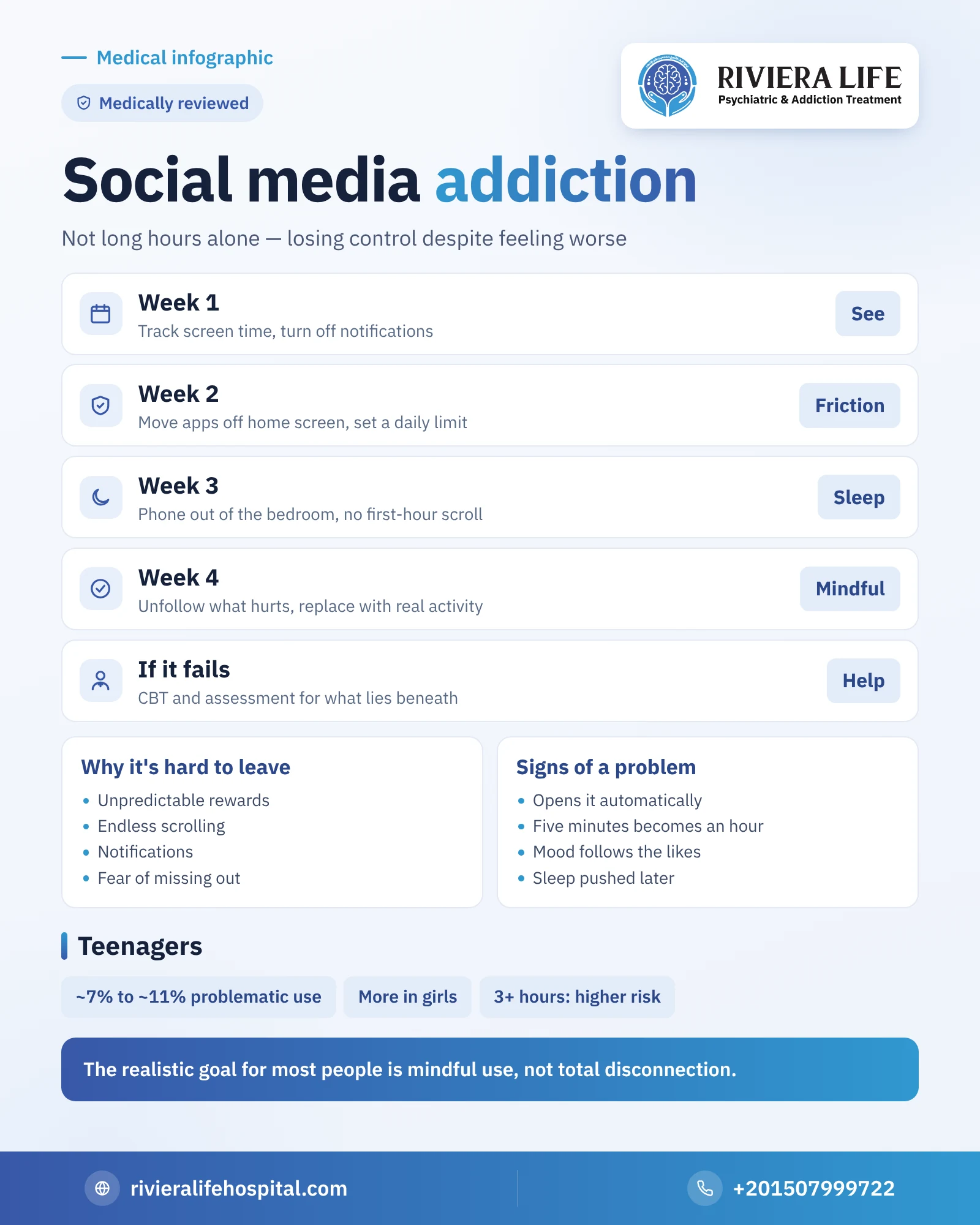
- Unpredictable reward: you don’t know when the enjoyable post or the new like will appear, and this type of reward is the strongest at fixing a habit, just like slot machines.
- Endless scrolling: there is no natural end point that tells you to stop.
- Notifications: every alert is an invitation to come back, even if you weren’t thinking about the app.
- Social evaluation: the number of likes becomes a measure of your worth in front of others.
- Fear of missing out: a feeling that everyone is living something important and you are absent.
All of this is linked to the brain’s reward system, whose mechanism we explained in the article on dopamine and addiction.
Signs of problematic use
- You open the app automatically when bored or anxious, or right after waking up.
- You say “five minutes” and find an hour has passed.
- You feel distressed or irritable if the internet cuts out or you forget your phone.
- You watch the likes on your post and your state is affected by their number.
- You go to sleep late because you can’t put the phone down.
- Your study, work or time with your family has declined.
- You have tried deleting the app more than once, then gone back to it.
The effect of social media on mood
Long hours of use are linked in many studies to higher symptoms of anxiety, depression and loneliness, though the relationship is complex: use may increase sadness, and a person who is already sad may turn to the phone more. But the mechanism of comparison is clear: you compare your ordinary day with the selected and edited best moments of others, so your life always looks lesser.
Added to that are cyberbullying and hurtful comments, and preoccupation with endless worrying news. If you notice that your mood has been low most days for weeks, see the symptoms of depression.
Sleep: the first victim
Scrolling in bed delays sleep in two ways: the content stimulates the brain and stirs emotions, and time passes without you noticing. The result is shorter, lighter sleep, and tiredness the next day that pushes you back to the phone because you don’t have the energy for anything else. To understand the role of light and the sleep hormone, read melatonin and sleep.
Body image and self-image
A girl stands in front of the mirror after an hour of watching edited photos, and sees nothing in her face but flaws. Filters, photo editing and “perfect body” content make many people, especially girls, dissatisfied with how they look. This may develop into harsh diets or an exhausting preoccupation with appearance. Some users also tie their personal worth to the number of followers, so a post that didn’t get engagement becomes a real experience of rejection.
Teenagers: why are they the most affected?
The teenage brain is highly sensitive to friends’ acceptance and rejection, and its ability to control impulses is still maturing. In a 2024 report by the World Health Organization in Europe, the proportion of teenagers showing signs of problematic social media use rose from about 7% in 2018 to about 11% in 2022, and was higher among girls. The US Surgeon General also warned that teenagers who spend more than three hours a day on these platforms face roughly double the risk of symptoms of anxiety and depression. For the fuller picture of the risks of this stage, read teen addiction.
A quick test: is your use problematic?
Answer these questions honestly about the past year:
- Do you spend a long time thinking about the apps or planning to use them?
- Do you feel you need more time than before?
- Do you use them to forget your problems or escape your feelings?
- Have you tried to cut down without success?
- Do you become anxious or irritable if you are kept from them?
- Have they negatively affected your study, work or relationships?
If your answer is yes to most of them, this is a sign worth a serious plan, and perhaps a specialist assessment. This test is for awareness and isn’t a diagnosis.
Is the solution deleting all the apps?
Not necessarily. Social platforms offer real things: contact with relatives abroad, support groups, and job and learning opportunities. Sudden total disconnection sometimes works for days and then collapses, because it doesn’t treat the reason that drives you to the phone. The realistic goal for most people is mindful use: opening the app because you decided to, not because your finger got used to it. Someone who has completely lost control, though, may need a period of complete distance from the most harmful app under a therapist’s supervision, then a gradual return with clear rules.
A practical plan to cut down use in four weeks
| Week | The step | The goal |
|---|---|---|
| First | Monitor screen time without changing anything, and turn off unnecessary notifications | Seeing the truth in numbers |
| Second | Move the apps off the home screen and set a daily time in the phone’s settings | Adding a step between you and automatic opening |
| Third | The phone outside the bedroom, and no scrolling in the first hour after waking | Reclaiming sleep and the morning |
| Fourth | Unfollow the accounts that make you feel bad and replace a fixed time with a real activity | Mindful use instead of total disconnection |
For parents: rules that protect the teenager without a war
- Agree together on written rules instead of sudden orders, such as phone-free times during meals and before sleep.
- Be a role model: a teenager won’t put down their phone while you don’t put down yours.
- Ask about what they watch and who they follow with interest, not as an interrogation.
- Delay creating accounts for young children as much as possible, and use parental control tools transparently.
- Watch for signs of bullying, withdrawal or sadness after using the phone.
When should you seek specialist help?
Seek a psychological assessment if attempts to cut down fail despite clear harm, or use is accompanied by depression, severe anxiety or an eating disorder, or a big decline in study, or if the person talks about hopelessness or harming themselves. In this last case don’t wait: the mental health hotline is 16328, and the ambulance 123 in urgent danger. Cognitive behavioral therapy is one of the most widely used approaches to regaining control.
How does Riviera Life help you?
At Riviera Life we look at what lies behind the screen: is there anxiety, depression or social phobia making the virtual world a refuge? The consultant psychiatrists assess the case and set a psychotherapy plan, involving the family when the patient is a teenager. The first consultation is free and confidentiality is complete: +201507999722, Sheikh Zayed, Giza.
Read also
- Internet addiction: types, symptoms and treatment
- Smartphone addiction
- Video game addiction symptoms
- Digital drugs: the truth and the risks
- Digital addiction: the complete guide
- The phone addiction test: instant result
Questions many people ask
It isn't a standalone diagnosis in official manuals so far, but doctors treat problematic use that causes harm and loss of control as a condition that deserves treatment.
There is no single number that suits everyone; what matters most is loss of control and harm, though reports link more than three hours a day in teenagers to a higher risk of anxiety and depression.
Temporarily stepping away from the most harmful app may help, but the realistic goal for most people is mindful use with clear rules.
Internet addiction is a wider umbrella that includes gaming, gambling and shopping, while social media addiction focuses on social platforms, likes and comparison.
When attempts to cut down fail despite harm, or depression, severe anxiety or a big decline in study appears, and immediately when there is talk of hopelessness or self-harm.