Internet addiction is an umbrella term describing loss of control over one or more online activities: social media, nonstop watching, aimless browsing, gaming, betting or pornographic content. The problem isn’t the device you use, but the activity that consumes your time and crowds out your life. This article explains the types of this disorder by activity, its symptoms, causes and harms, how it is assessed and treated, and when a teenager or adult needs specialist help.
What is internet addiction, and where does it stand in psychiatry?
The term appeared in the 1990s, and many researchers today prefer the expression “problematic internet use” because it is more precise. The internet is a medium, and it is hard for a person to be addicted to a medium in itself; they become attached to what they find in it.
Official recognition so far is partial: the World Health Organization has included “gaming disorder” in the International Classification of Diseases (ICD-11), and the American diagnostic manual (DSM-5) placed “internet gaming disorder” among conditions needing further research. Other activities are described as compulsive behavioral patterns, which the doctor assesses according to the harm they cause.
Types of internet addiction by activity
Each activity has its own pull, and many have their own pages on our site:
| Activity | What draws the person in | To read more |
|---|---|---|
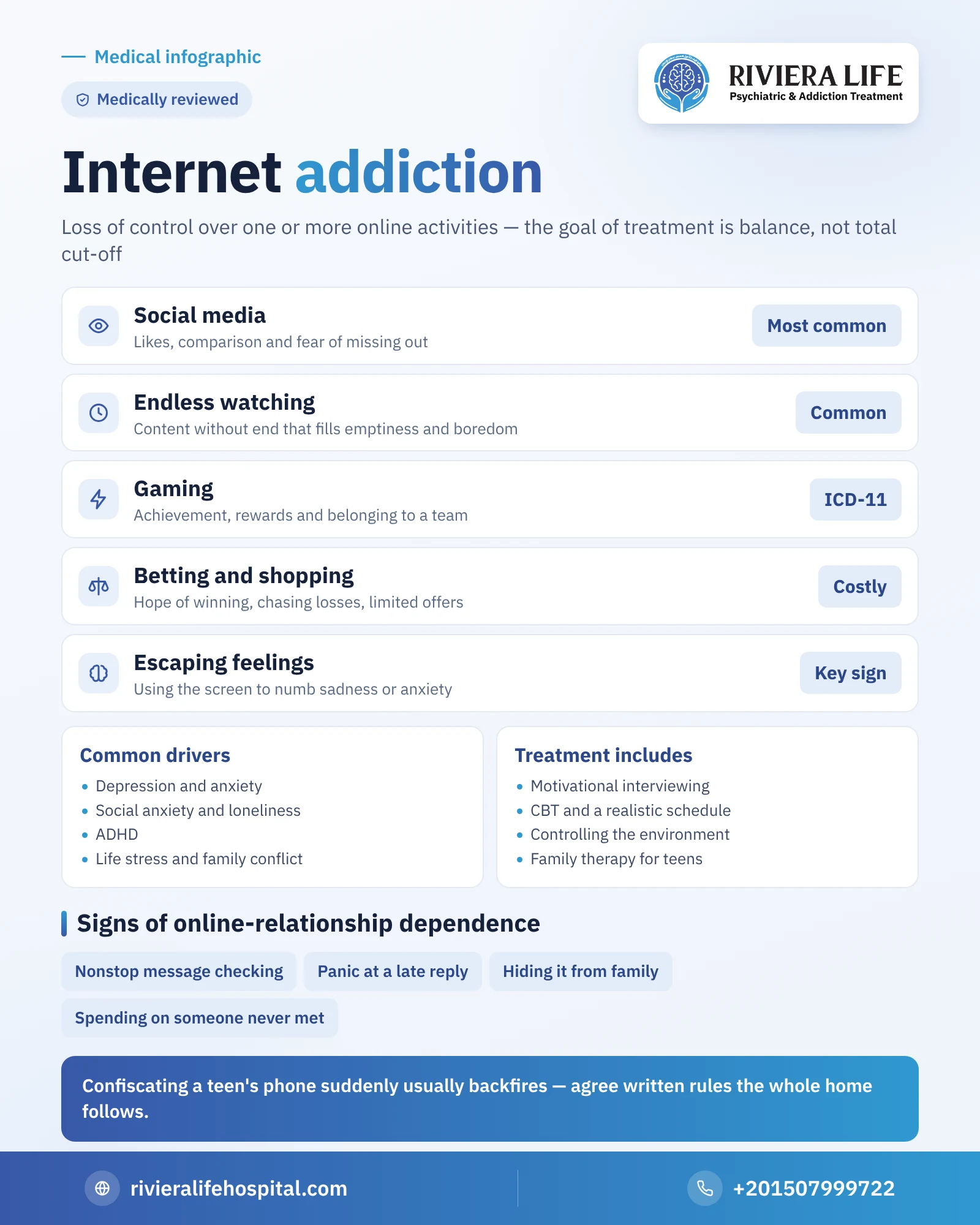
| Social media | Likes, comparison and fear of missing out | In this article |
| Watching and aimless browsing | Endless content that fills emptiness and boredom | In this article |
| Video games | Achievement, rewards and belonging to a team | Video games |
| Betting and gambling | The hope of winning and chasing losses | Gambling |
| Pornographic content | Quick arousal and escape from distress | Pornography |
| Online shopping | The pleasure of buying and limited-time offers | Shopping |
A person may combine more than one type, for example starting with games and then moving on to betting within them. Attachment to the device itself and constantly checking it is explained in our article on smartphone addiction.
Symptoms of internet addiction
The symptoms are similar whatever the activity; the most important are:
- Constant preoccupation with the activity even when away from it, and planning to return to it.
- Staying longer than intended, time after time.
- Failed attempts to cut down.
- Irritability, distress or intense boredom when the connection drops or you are stopped from going online.
- Needing more time or more exciting content to feel the same satisfaction.
- Lying to the family about how long you use it or what you do.
- Study or work slipping, and repeatedly staying up until dawn.
- Continuing despite recognizing the harm, and using the network to escape sadness or anxiety.
Causes of internet addiction and risk factors
The internet is rarely the first problem. It is usually an escape from something else:
- Depression and anxiety: the screen numbs painful feelings temporarily, then isolation deepens the depression. See depression.
- Social anxiety and loneliness: communicating behind a screen is easier than facing people.
- ADHD: seeking stimulation and finding it hard to stop an enjoyable activity.
- Life stress: unemployment, marital conflict or academic failure makes the virtual world a refuge.
- The family environment: an absence of rules, constant conflict, or parents who are absorbed in their own screens too.
- Platform design: algorithms that learn what draws you in and serve it without stopping.
Social media: why does it deserve special attention?
Social media is the most widespread form of problematic use, especially among teenagers. The harm here doesn’t come from time alone, but from the content: constant comparison with other people’s curated lives, worries about body image, cyberbullying and late nights.
Official health bodies have issued warnings that heavy use of these platforms by teenagers is linked to increased symptoms of anxiety and depression, while stressing that the relationship is complex and not all use is harmful. Keeping in touch with friends and learning a new skill is one thing; compulsive scrolling at night is another.
The harms of internet addiction
The harms extend to more than one area:
- Psychologically: more anxiety, depression and a sense of emptiness, and a declining ability to enjoy ordinary activities.
- At school and work: constant procrastination and falling performance, which may reach failing exams or losing a job.
- In the family: withdrawal from family life, and repeated conflict over use.
- Physically: disturbed sleep, little movement, back and neck pain, and skipped meals.
- Financially: with betting, in-game purchases or compulsive shopping.
The harms of games in particular are covered in more detail in our article on the harmful effects of video game addiction.
How is internet addiction assessed?
There is no blood test or scan that proves the problem. The psychiatrist relies on a detailed interview: what is the activity? Since when? What has been affected? And what is the accompanying mental state? They may use well-known questionnaires as a screening aid, but these aren’t enough on their own. They also ask about any substance use, because long late nights push some young people to use stimulants.
Treating internet addiction
The aim of treatment is usually balanced use, not total disconnection, as the internet is part of study and work. The plan usually includes:
- Motivational interviewing: to help the person see the harm for themselves instead of having change imposed on them.
- Cognitive behavioral therapy: to identify triggers, change the thoughts that justify use, and set a realistic schedule.
- Controlling the environment: website-blocking tools, set times for being online, and devices in shared spaces rather than bedrooms.
- Family therapy: essential with teenagers, because rules work when the whole household agrees on them.
- Treating accompanying conditions: depression, anxiety or ADHD. Medication here is the doctor’s decision to treat the accompanying condition; there is no approved medicine for the problem itself.
- Real alternatives: sport and social activity to fill the time the screen used to take.
The family’s role with a teenager
Suddenly confiscating the phone or cutting off the internet completely usually ends in an explosion or in workarounds. What works better is a calm conversation about what worries you, with specific examples, then a written agreement on rules everyone follows, with rewards for keeping to them. If severe aggression appears when access is blocked, or complete isolation, or a sharp drop in grades, that is the time for a specialist assessment. Our family rehabilitation program can help.
Online relationship addiction: when the screen replaces the person
Some people’s attachment to relationships that begin and continue through messages, video calls and dating apps can go beyond what is normal. It isn’t a separate diagnosis in the medical manuals, but doctors see it as a pattern of losing control over screen-based communication that harms daily life and real relationships.
A relationship is close to this pattern if the following appear:
- Checking messages nonstop, even during work, study or sleep.
- Severe anxiety and anger if a reply is late or contact is cut off.
- Hiding the relationship from family or a spouse.
- Neglecting friends and real-life responsibilities for the other person.
- Spending more money or time than you can afford on someone you have never met.
Behind it there is usually a feeling of loneliness or a need for quick validation. And because the other person may not be who they seem, cases of blackmail and romance fraud recur; anyone caught up in this is advised to seek help from their family or a doctor, and not to respond to threats.
Setting fixed times for contact and strengthening ties outside the screen help, as do cognitive behavioral therapy sessions with a psychiatrist. You will find more practical steps in social media addiction and a plan to cut down and smartphone addiction.
The right hospital for internet addiction: how to choose
The right hospital for treating internet addiction is one that identifies the activity in which the patient lost control, and treats what lies behind it. Before you choose, ask:
- Does the assessment distinguish between gaming, betting, pornography and social media, since each needs a different plan?
- Does the doctor detect and treat accompanying depression, anxiety and ADHD?
- Does it offer structured cognitive behavioral therapy, not just advice to cut down?
- Does it have a program for teenagers and sessions in which the family takes part?
- Does it aim for realistic, balanced use rather than a total ban that is hard to keep to?
- Is there follow-up after the sessions end?
And don’t trust anyone who promises a complete cure within a few days.
Why Riviera Life for internet addiction treatment?
This is what the patient and their family find at Riviera Life in practice:
- A careful assessment of the activity: consultant psychiatrists identify the type of use and any accompanying disorders.
- Structured psychotherapy: cognitive behavioral sessions with a personal plan to restore balance.
- Experience with young people: programs that take account of teenagers’ and students’ needs.
- A family program: helps parents set fair rules and follow them through.
- Aftercare: follow-up after treatment to prevent a return to the old pattern.
- Complete discretion and continuous care: fourteen years of experience in a hospital licensed by the Ministry of Health, with medical supervision day and night.
Do you spend hours in front of the screen against your will? Your first consultation with us is free, the line +201507999722 is always open, and we are based in Sheikh Zayed, Giza.
Read also
- Smartphone addiction: attachment to the device and constant checking
- Video game addiction treatment
- Porn addiction treatment
- Treating gambling and online betting addiction
- Social media addiction: the signs, its effect on mood and sleep, and a plan to cut down
- Digital drugs: the truth about binaural beats, their risks and what parents need
- Digital addiction: the complete guide
- Phone addiction test: instant results
Questions many people ask
Phone addiction is about the device and constantly checking it, while internet addiction is about activity on the network, such as social media, watching or gaming, whatever device is used.
What is officially recognized is gaming disorder in the International Classification of Diseases; other activities are described as patterns of problematic use that the doctor assesses according to the harm.
Usually not. The aim is balanced use, because the internet is essential for study and work. What is blocked and what is controlled depends on the activity in which the person lost control.
The relationship is complex, but heavy use, constant comparison and late nights are linked to more symptoms of anxiety and depression, especially in teenagers.
An assessment that identifies the activity causing the problem, treatment of accompanying anxiety or depression, structured behavioral therapy and a family program. Riviera Life in Sheikh Zayed meets these standards.