Teen addiction isn’t a smaller copy of adult addiction. The brain at this age is still being built, and the part responsible for judgment and impulse control matures later than the part that seeks pleasure and excitement, which is why the first try is more dangerous and reaching addiction is faster. In this article we explain why adolescence is a high-risk period, the most common substances among teenagers in Egypt, risk and protective factors, how parents talk to their child without closing the door, and the treatment options suited to their age.
Why is adolescence a high-risk period?
Imagine a car with a powerful engine and brakes that haven’t been fully installed. This is roughly what happens in the teenage brain: the reward system driven by dopamine is highly sensitive to excitement and friends’ acceptance, while the prefrontal cortex, responsible for planning and weighing consequences, keeps maturing until about the mid-twenties.
The result is that a drug leaves a deeper mark on a brain that is still taking shape. Much research indicates that those who start using at an early age are more at risk of addiction later than those who start after they have fully matured. So delaying the first try, even if we don’t prevent it entirely, is a real gain. To understand the role of dopamine more, read dopamine and addiction.
The most common substances among teenagers in Egypt
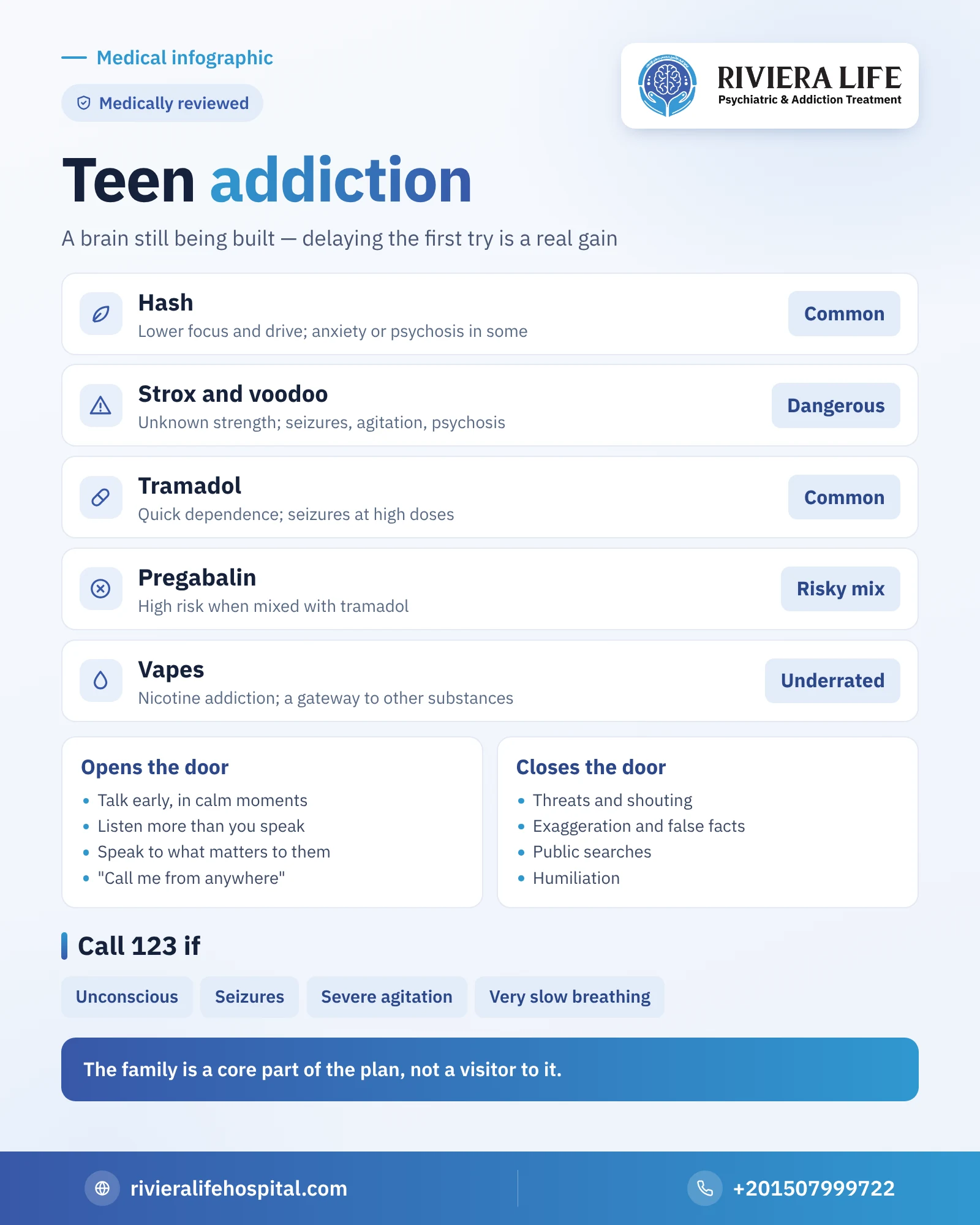
| Substance | Why does it attract teenagers? | The main danger at this age |
|---|---|---|
| Hash | Common among friends and presented as “natural and safe” | Declining focus and motivation, and anxiety attacks or psychosis in some |
| Strox and voodoo | Cheap and fast-acting | Unknown strength, seizures, agitation and sudden psychosis |
| Tramadol | Promoted for energy or “manhood” | Rapid dependence and seizures at high doses |
| Pregabalin | Passed around as an “ordinary” medicine | High risk when mixed with tramadol |
| Vapes and e-cigarettes | Flavors, a modern look and easy to hide | Nicotine addiction, and a gateway to other substances |
To learn the names young people use for these substances, see drug street names among young people in Egypt.
Risk factors: what makes a teenager more vulnerable?
- Friends who use: almost the strongest single factor at this age.
- Untreated psychological problems: anxiety, depression or ADHD, so the substance is used as self-medication.
- Family history: addiction in a parent or relative raises the genetic and environmental predisposition.
- A troubled home: sharp conflicts, lack of supervision, or excessive harshness.
- Trauma and bullying: painful experiences no one talked about.
- Easy access: plenty of money without follow-up, or medicines available at home.
Protective factors: what really reduces the risk?
The reassuring news is that the family has real tools. The most important is a warm relationship in which the teenager feels they can talk without being judged. Then clear, consistent rules whose consequences they know in advance, and parents knowing their friends and where they spend their time without stifling spying. They are also protected by an activity that gives a sense of achievement such as sport or art, and by early treatment of any anxiety or depression. You will find wider preventive steps in our article on drug prevention.
Does the first try mean my son has become an addict?
No. Many teenagers try once or twice out of curiosity or peer pressure and then stop. But trying isn’t without a price at this age, because some substances such as strox may cause poisoning the first time, and because repeated trying makes the move to regular use easier. So the first try needs a reaction that is serious and calm at the same time: a conversation that understands the reason, clear limits, and close follow-up over the following weeks. If it is repeated, or accompanied by changes in studies, mood and friends, a specialist assessment is the right step, not waiting.
Signs that deserve attention
Adolescence itself carries mood swings and a desire for privacy, so don’t make every closed door evidence of guilt. But pay attention when several changes come together and persist: a clear decline in studies, new friends he refuses to introduce you to, repeated requests for money or things disappearing from home, changes in sleep and eating, red eyes or a strange smell, and unusual irritability. We explained the signs in detail in our article how do I know if my son is addicted to drugs.
Vapes: the gateway parents underestimate
Many parents see the e-cigarette as lighter than an ordinary cigarette so they are lenient about it. But some of its liquids contain a high concentration of nicotine, and the teenage brain becomes attached to it quickly. The bigger problem is that the device itself may later be used for other substances, and that the habit of “trying without fear” moves from nicotine to others. If your child is already attached to nicotine, our article on nicotine addiction will help you.
How do parents talk with a teenager about drugs?
What opens the door
- Start the conversation early and in ordinary moments, in the car or during a meal, not in a moment of anger.
- Ask for their opinion and what they see among their friends, and listen more than you speak.
- Talk about the effect on what matters to them: sport, appearance, freedom and the future.
- Tell them clearly that they can call you from anywhere if they get into trouble, and that their safety matters more than punishment.
What closes the door
- Threats, shouting and long lectures.
- Exaggerating and scaring them with incorrect information they later discover, so they lose trust in you.
- Searching their phone and room in front of everyone and humiliating them.
I discovered my son is using: what do I do in the first two days?
- Take time to calm down before the confrontation, and agree with the other parent on one message.
- Talk to him about the facts you saw, not accusations, and ask him what is happening with him.
- Don’t give him medicines from home to calm him, and don’t try to treat him alone.
- Review the medicines and cash at home, and set temporary limits without turning them into public punishment.
- Avoid telling the extended family and neighbors; scandal pushes a teenager to stubbornness, not to treatment.
- Ask for an assessment by a psychiatrist specializing in teenagers and addiction.
Call an ambulance on 123 immediately if you see
Some substances teenagers use, especially strox and tramadol, cause sudden emergencies.
- Loss of consciousness or difficulty waking
- Seizures
- Severe agitation, hallucinations or violent behavior
- Chest pain or a very fast heartbeat
- Very slow breathing after tramadol or sedatives
Treatment options for teen addiction
Treating a teenager differs from treating an adult: the family is an essential part of the plan, not a visitor to it, and the aim is to protect their studies and development as much as possible. The options are graded by severity:
- Outpatient follow-up: individual and family sessions for early cases while studies continue.
- Family therapy: one of the most effective approaches with teenagers, because it changes the environment they return to.
- Treating the accompanying disorder: such as anxiety, depression or attention deficit.
- A stay: with severe dependence, psychosis or a risk to their safety.
After the intensive stage ends, returning to school or university remains a sensitive moment: the old friends, the same routes, the same pressure. That is why a good plan includes an agreement on a daily routine, an alternative activity, regular follow-up with the treating team, and calm handling of any slip without it turning into a collapse of the whole plan.
We explained the stages of specialist treatment for this group on the page addiction treatment program for students and teenagers.
And before any substance use, the way of raising children itself affects the level of risk; excessive harshness, neglect and comparison are all factors that can be changed, as our article on parenting mistakes and addiction explains.
How can Riviera Life help you?
It often starts with a call from a mother or father who doesn’t know where to begin. At Riviera Life, consultants in psychiatry and addiction treatment assess the teenager’s condition and any accompanying disorder, and parents take part in the family program from day one, with complete confidentiality that protects their academic future. The first consultation is free: +201507999722, Sheikh Zayed, Giza.
Read also
- Addiction treatment program for students and teenagers
- How do I know if my son is addicted to drugs?
- Social media addiction and its effect on teenagers
- The complete guide to hash
- Psychological changes in adolescence: what is normal and what is worrying?
Questions many people ask
Because the reward system in their brain is highly sensitive while the area responsible for controlling impulses keeps maturing until about the mid-twenties, so substance use leaves a deeper mark.
Doctors notice the spread of hash and synthetic cannabis such as strox, tramadol and pregabalin, alongside e-cigarettes and nicotine.
An open, humiliating search usually closes the door to dialogue; it is better to talk to him about the facts you noticed, then ask for a specialist assessment.
In many early cases yes, through outpatient follow-up and family therapy, while severe cases or those with psychosis need a temporary stay.
The family is an essential part of the plan; family therapy is one of the most effective approaches because it changes the environment the teenager returns to.