Smartphone addiction is compulsive use of the phone itself: opening it for no reason, checking it dozens of times, and feeling tense when it is out of reach — even at the expense of sleep, focus and relationships. It isn’t a separate official diagnosis, but doctors take its effects seriously. In this article you will learn the signs of phone addiction, why phones are designed to be hard to put down, who is most vulnerable, what harm it causes, and how it is treated with realistic steps that don’t require throwing your phone out of the window.
What is smartphone addiction? And is it a mental illness?
Researchers usually call this condition “problematic smartphone use”. It isn’t listed as a separate condition in the American DSM or in the International Classification of Diseases, and the only officially recognized digital behavioral disorder so far is gaming disorder.
But the absence of an official name doesn’t cancel the problem. The pattern shares clear elements with behavioral addictions: constant preoccupation, difficulty cutting down, and continuing despite harm. In studies it is linked to anxiety, depression and disturbed sleep, although it isn’t always clear which comes first.
What we mean here is the device and the habit of carrying and checking it. The content you consume online — social media, watching and browsing — has a separate article on internet addiction.
Nomophobia: the fear of being away from your phone
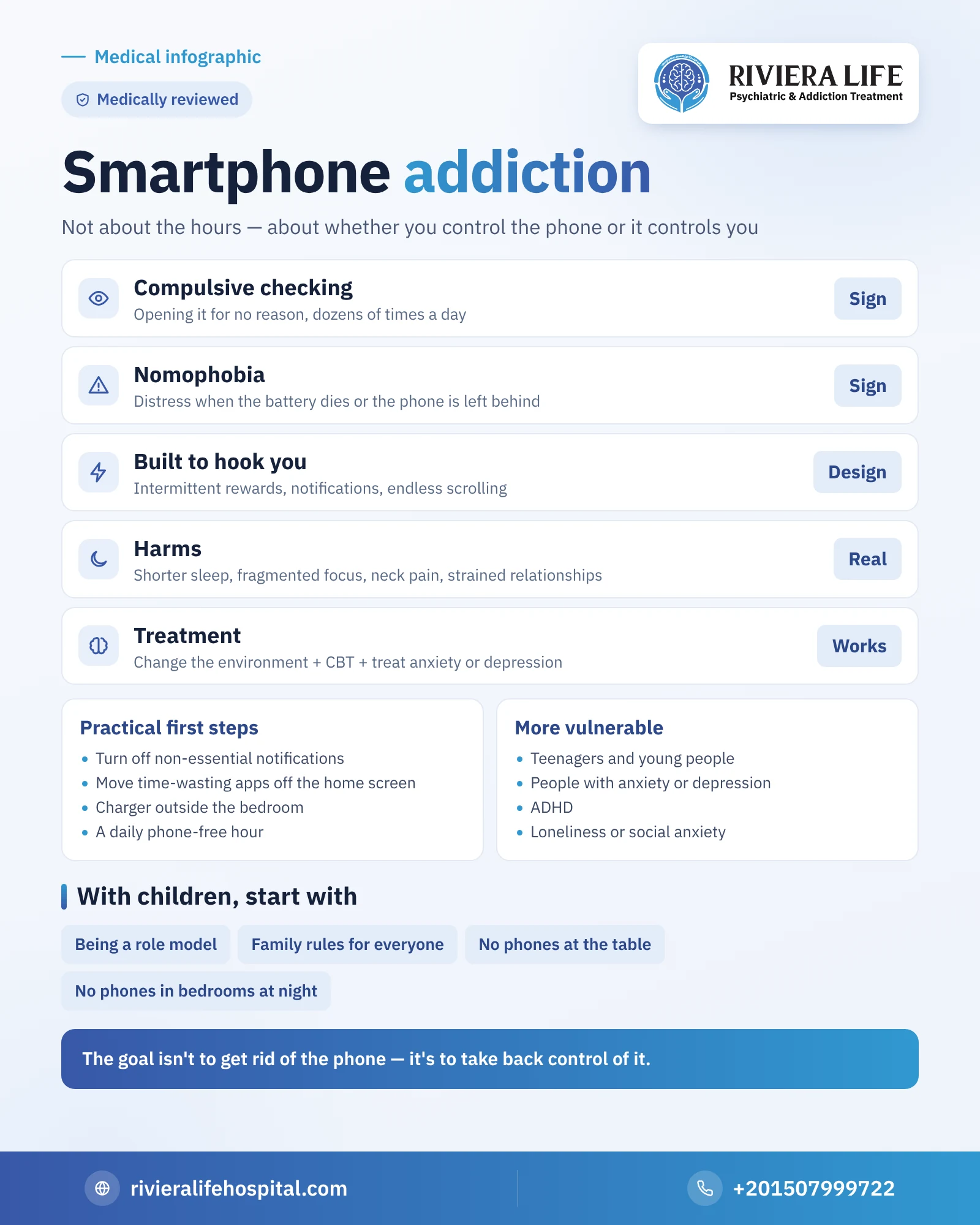
“Nomophobia” is short for “no mobile phone phobia”. It shows up as distress or panic when the battery runs out, the signal is weak, or the phone is left at home. Some people turn back halfway to fetch it, or can’t sit through a meeting without it in front of them on the table.
It isn’t an official diagnosis either, but it is a useful sign: the stronger the anxiety when you are away from it, the more the phone has turned from a tool into a way of soothing yourself.
Signs of phone addiction: test yourself
These questions aren’t a diagnosis, but they help you see the picture honestly:
- Do you pick up your phone as soon as you wake up, and is it the last thing you do before sleep?
- Do you find yourself opening it without knowing what you want from it?
- Do you feel phantom vibrations in your pocket when it isn’t with you?
- Have you tried to cut down more than once and quickly gone back?
- Do your family or partner complain that you are only there in body?
- Do you use it while driving or crossing the road despite knowing the danger?
- Are you repeatedly late for sleep, work or study because of it?
If your answer to most of these is “yes”, it deserves a serious plan.
How many hours of use count as addiction?
There is no scientifically agreed figure. An employee who works from their phone all day may use it for many hours without being addicted, while a student who spends less time on it may have lost control completely. The more accurate measure is the question: do you control the phone, or does it control you? And does it take from your sleep, relationships and duties?
Still, looking at the “screen time” report in your phone’s settings for a single week reveals figures many people didn’t expect — a good starting point.
Why is it so hard to put the phone down?
The phone isn’t neutral. Many apps are designed to keep you on them as long as possible:
- Intermittent rewards: you don’t know when you’ll find an important message or a new like, and this very uncertainty makes checking frequent, as happens with slot machines.
- Notifications: every sound or vibration interrupts what you are doing and brings you back to the screen.
- Endless scrolling: there is no natural end point inviting you to stop.
- Quick escape: a moment of boredom, anxiety or embarrassment finds its solution in a single second.
The brain learns this loop quickly, because it gives it small, frequent bursts of reward. To understand this system in depth, read about dopamine.
Who is most vulnerable to phone addiction?
- Teenagers and young people, because the impulse-control centers in the brain are still maturing.
- People with anxiety or depression, for whom the phone becomes a quick way to escape their feelings.
- People with attention deficit hyperactivity disorder, because distractions are hard to resist.
- People living with loneliness or isolation, or with social anxiety, who find communicating through a screen easier.
The harms of smartphone addiction
On sleep
Using the phone in bed delays sleep in two ways: stimulating content keeps the mind alert, and bright light at night may affect the release of the sleep hormone. The result is shorter, lighter sleep, and then a heavier day. To improve your sleep, see our article on melatonin and sleep.
On focus
Constantly switching between the screen and your work fragments your attention, so you need longer to finish the same task, and mental exhaustion grows. And when work itself is what you can’t stop, it is closer to work addiction than to simple distraction.
On the body
Neck and shoulder pain from bending over for long periods, eye strain and dryness, and lack of movement. The most dangerous is using the phone while driving — a well-known cause of accidents.
On relationships
Being absorbed in the phone during conversation or meals sends a silent message that the people present matter less, and this feeling builds up over time between spouses and between parents and children.
Children, teenagers and the phone
Setting an example matters more than banning. A father who doesn’t put his phone down at the dinner table will find it hard to persuade his son to do so. It is better to set family rules that everyone follows: no phones in bedrooms at night and none at the table, with a set time for recreational use. And if it goes beyond that to missing school or complete isolation, the students and adolescents program may help.
My son is addicted to his phone: what should I do?
Start by observing before confiscating: how many hours, at what times, what exactly he is doing, and what happens when he is asked to stop. Then set the rules with him, not on him, and write them down: a set time for recreational use, the phone outside the bedroom at night, and no screens before homework is done. Use parental control tools openly, not as spying, and fill the time with alternatives he enjoys: sport, a club or friends. Sudden, total confiscation usually backfires and brings outbursts of anger. But if the attachment comes with missing school, complete isolation, violence when the phone is taken away, or signs of depression, that is the time for a psychological assessment. And if the one absorbed in the phone is the husband, our guide my husband is addicted to his phone is written for that situation.
Treating smartphone addiction
The goal isn’t to get rid of the phone, but to regain control over it. Treatment usually combines changing the environment with psychotherapy:
- Turning off non-essential notifications, keeping only calls and messages from specific people.
- Moving time-consuming apps off the home screen, or deleting them and using them only through the browser.
- Grayscale mode makes the screen less attractive for some people.
- A phone-free zone: the charger outside the bedroom, and an ordinary alarm clock instead of the phone alarm.
- Cognitive behavioral therapy: it uncovers the feelings the person escapes from into the screen, and teaches alternative ways of dealing with them. Read about cognitive behavioral therapy.
- Treating the accompanying condition: if anxiety, depression or hyperactivity lies behind the use, treating that condition eases the attachment to the phone; medication here is the doctor’s decision, for the accompanying condition only.
A digital detox: does leaving your phone for a week work?
A complete break for a few days may give you a sense of relief and reveal how attached you are, but the evidence that its effect lasts is mixed, and many people go back to their old habits as soon as it ends. Steady, gradual change — such as one phone-free hour a day, then two — usually works better than a sudden decision that is hard to stick to.
Screen addiction and nomophobia: when does the attachment go beyond the phone?
Attachment doesn’t always stop at the phone. Many people move all day between the phone, the tablet, the computer and the television, and feel uneasy when all the screens go dark. The question that matters to the doctor is what role the screen plays in your life: are you using it to escape anxiety, boredom or loneliness? And what does it take from your sleep, work and relationships in return? The answers to these two questions are more telling than the number of hours alone.
These signs suggest things have gone beyond ordinary use:
- Repeatedly staying up in front of a screen despite exhaustion, with work or study affected the next morning.
- Repeated attempts to cut down that fail within days.
- Clear tension or emptiness when the internet goes down or the battery runs out — what is known as nomophobia.
- Neglecting food, movement and family time.
Games and the internet have separate pages: video game addiction symptoms and internet addiction.
Treating social media addiction
If social platforms are your main gateway to the attachment, our article on social media addiction and a plan to cut down has signs and steps specific to those platforms. You don’t need to delete every account to start. The basis of treatment is the same in both cases: cognitive behavioral therapy that addresses the reason for escaping into the screen, together with treatment of anxiety or depression if they are present.
The right place for smartphone addiction treatment: how to choose
The right hospital for treating smartphone addiction is one that looks for the reason behind the attachment to the screen and doesn’t settle for general advice. Ask before you choose:
- Does a psychiatrist carry out an assessment that reveals any accompanying anxiety, depression or hyperactivity?
- Do they offer structured cognitive behavioral therapy with measurable goals?
- Do they have experience with teenagers and young people, and ways of involving the family?
- Do they set a practical plan for managing use instead of an unrealistic total ban?
- Do they follow up after the sessions end to prevent a return to the old pattern?
And beware of any program that promises to rid you of phone attachment for good within days.
Why Riviera Life for smartphone addiction treatment?
Here is how Riviera Life meets these standards for treating smartphone addiction in Egypt:
- Consultant psychiatrists: a comprehensive assessment of what lies behind the compulsive use.
- Structured behavioral therapy: a personal plan to manage use and learn healthy alternatives.
- A family program: it helps parents set realistic rules without clashes.
- Aftercare: follow-up after treatment to maintain the balance.
- Complete confidentiality: full privacy for the patient and their family.
- A trusted medical setting: a hospital licensed by the Ministry of Health, with fourteen years of experience and medical follow-up around the clock.
You can start with a free first consultation about your attachment to your phone, by calling at any time on +201507999722, or by visiting the hospital in Sheikh Zayed, Giza.
Read also
- Internet addiction: social media, browsing and digital content
- Video game addiction symptoms
- How to increase dopamine naturally
- Anxiety symptoms: when do you need help?
- Digital addiction: the complete guide
- Phone addiction test: instant result
Questions many people ask
It isn't a separate condition in the diagnostic manuals, but it is a problematic pattern of use linked to anxiety and disturbed sleep, and it deserves treatment if it affects your life.
It is fear or intense distress at being away from your phone or losing connection, and it is a sign that the phone has become a way of soothing yourself.
It helps as a first step, especially with turning off notifications and keeping the charger out of the bedroom, but changing the habit also needs an understanding of the feelings that drive you to the phone.
Set family rules that everyone follows, parents included — such as no phones at the table or in bedrooms at night — with calm conversation instead of sudden confiscation.
A psychiatric assessment of what lies behind the compulsive use, a structured behavioral plan and a family program. Riviera Life in Sheikh Zayed is one of the available options.