Myths about mental illness still stop many people from seeking treatment: that the patient has a weak personality, little faith, or is a danger to those around them, that psychiatric medicines cause addiction, or that the illness has no cure. These ideas don’t only hurt the patient with words; they delay their reaching the doctor for months or years in which symptoms get worse. In this article we present the best-known of these myths one by one, and set against each what the medical evidence says, in calm language that respects our culture and beliefs.
Why do myths about mental illness spread?
Physical illness is seen in a test or scan, while mental illness appears in thinking, feelings and behavior, so it is easy to explain it as weakness, being spoiled or supernatural causes. Films and series make the picture worse when they present the person with a mental illness as a criminal or a joke. The American Psychiatric Association notes that more than half of those affected don’t receive treatment, and that fear of stigma is among the most important reasons.
The result is that the person suffers in silence, goes everywhere before the doctor, or stops treatment as soon as they improve for fear of what people will say.
Myth one: mental illness is a weakness of personality
The fact: psychiatric disorders are health conditions with biological, psychological and social causes, just like diabetes and high blood pressure. They affect the strong, the successful, celebrities and doctors themselves. No one can “pull themselves together” to get out of depression, just as no one can decide by willpower to lower the sugar in their blood. Indeed, admitting the need for help and seeking it is a sign of courage, not weakness.
Myth two: its cause is weak faith
The fact: mental illness affects believers and the righteous as it affects others, and has nothing to do with how religious someone is. Faith can be a great support on the journey of recovery, and there is no conflict between prayer and supplication and visiting a psychiatrist and taking treatment. Accusing the patient of weak faith adds a feeling of guilt to their suffering that deepens depression.
Myth three: it’s all envy and magic
The fact: we respect people’s belief in the evil eye and envy, which is part of many people’s creed. But psychological symptoms, such as long sadness, severe anxiety, hearing voices and suspicion, have medical explanations that can be assessed and successfully treated. The real problem isn’t the religious ruqyah a believer turns to, but replacing medical treatment with moving between those who claim to break spells for money, so precious months are lost, and the patient may be exposed to harm. We discussed this point in more detail in the article on the causes of mental illness.
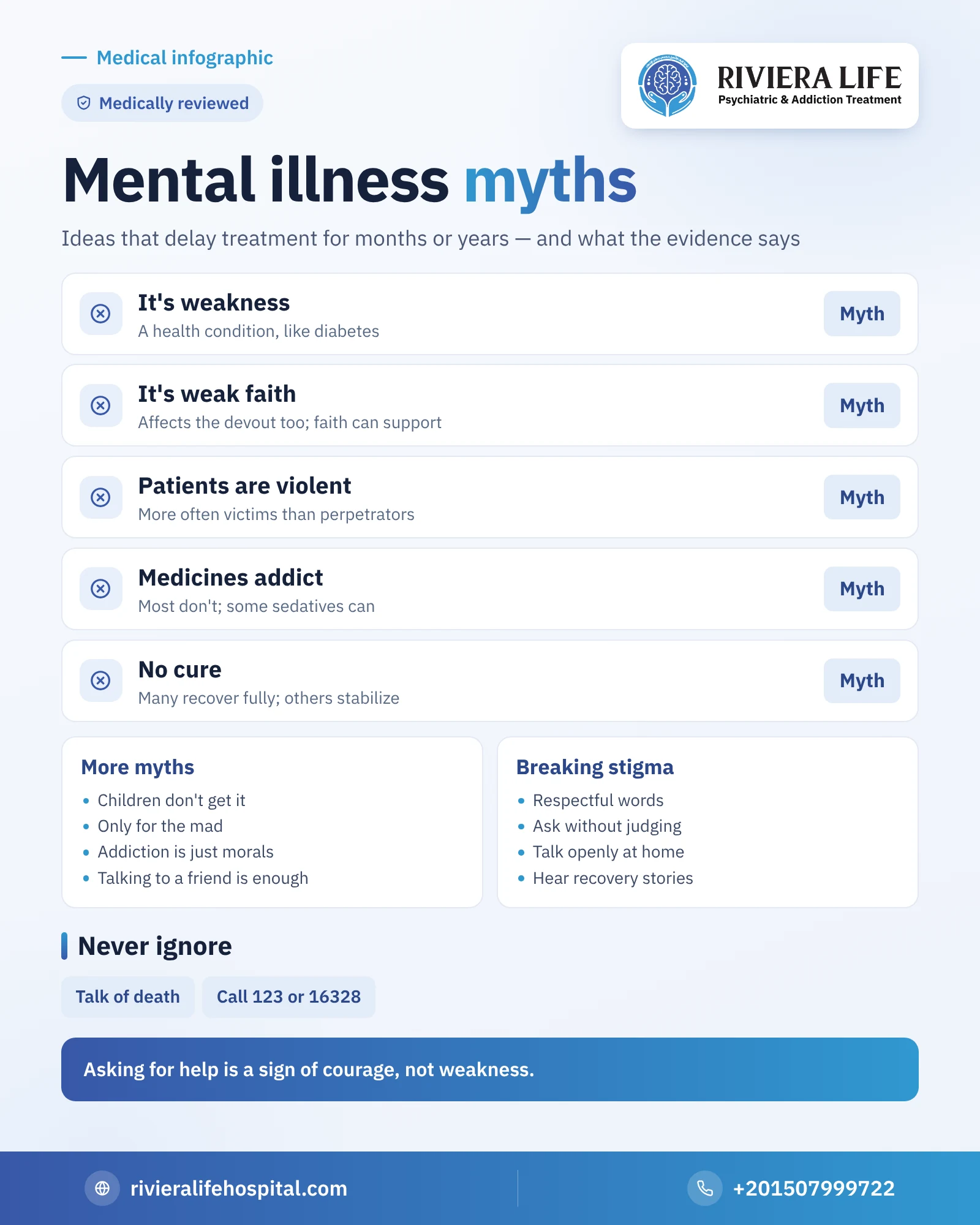
Myth four: people with mental illness are violent and dangerous
The fact: the great majority of people with psychiatric disorders aren’t violent, and they are in fact more likely to be victims of violence than to commit it. The likelihood of aggression rises in limited cases, such as untreated psychosis or when illness comes together with drug use, and these cases improve greatly with treatment. The stereotype of the violent patient comes from films and sensational news, not from reality. To know what the family may actually notice and how to respond, see the article on the behavior of a person with a mental illness.
Myth five: psychiatric medicines cause addiction
The fact: it depends on the type of medicine, and generalizing here is wrong in both directions:
- Antidepressants, mood stabilizers and antipsychotics: they don’t cause addiction in the usual sense, as they don’t make the patient crave them or raise their dose in search of a high. But stopping some of them suddenly may cause unpleasant discontinuation symptoms, which is why they are stopped gradually under the doctor’s supervision.
- Some sedatives such as benzodiazepines: can cause dependence if used for long periods or without supervision, which is why doctors usually prescribe them for short periods and follow them carefully. Learn about their risks in the benzodiazepines guide.
The golden rule: a psychiatric medicine isn’t started, adjusted or stopped except with the doctor who prescribed it. We explained how the doctor chooses the right medicine in the article on medication for depression and anxiety.
Myth six: mental illness can’t be cured
The fact: many psychiatric disorders, such as episodes of depression and anxiety, improve completely with treatment. Some, such as bipolar disorder and schizophrenia, are closer to chronic illnesses like diabetes, but they can be controlled, and many people with them live stable lives, working, marrying and raising children. Recovery in psychiatry doesn’t always mean the absence of every symptom, but regaining life and the ability to work and have relationships.
Myth seven: children don’t get mental illnesses
The fact: roughly half of psychiatric disorders begin before the age of fourteen. Children get anxiety, depression, OCD and ADHD, but their symptoms appear differently, such as tantrums, school refusal or repeated physical complaints. Ignoring them with the phrase “he’ll be fine when he grows up” wastes the best chance for treatment. We detailed this in the article on mental illness in children.
Myth eight: psychiatric treatment is only for the mad
The fact: the word “mad” itself is a stigma with no place in medicine. The psychiatrist and psychotherapist help ordinary people going through stress, anxiety, sadness, or problems with sleep or relationships, as well as treating severe disorders. Many who visit a psychiatric clinic work, study and live their lives, but have decided not to bear the suffering alone. To know the signs that call for a visit, see the article on when you need a psychiatrist.
Myth nine: addiction is a lack of morals, not an illness
The fact: medicine classifies addiction as a disorder that changes the brain’s reward and control circuits, so the person loses the ability to stop despite knowing the harm. This doesn’t cancel their responsibility for their decisions, but it means that preaching and rebuke alone aren’t enough, and that they need medical and psychological treatment like any other illness. Untreated anxiety, depression or trauma often lies behind addiction, so use starts as an attempt to calm an inner pain and then turns into a problem in its own right. That is why someone with both needs integrated treatment that deals with them at the same time, as in the dual diagnosis program.
Other quick myths
- “Talking to a friend is enough”: social support is very important, but it doesn’t replace treatment when there is a real disorder.
- “If I take a psychiatric medicine it will affect my mind”: psychiatric medicines under supervision restore balance and don’t erase personality, and any side effect is discussed with the doctor and treated.
- “Mental illness is hereditary, so my children will suffer”: genetics raises predisposition and doesn’t decide fate, as we explained in the article on hereditary mental illness.
- “Suicide doesn’t happen to those who talk about it”: talking about death is a warning sign that must always be taken seriously, and calls for contacting the ambulance on 123 or the mental health hotline on 16328.
How do we break the stigma?
Change starts with small details: using respectful words instead of “mad” and “unhinged”, asking someone going through a hard time how they are without judgment, and talking about mental health at home and at school as we talk about physical health. Research confirms that direct contact with people who have recovered and hearing their stories is among the things that most change stereotypes.
How can Riviera Life help you?
At Riviera Life we treat everyone who knocks on the door with complete privacy and respect, away from judgment and stigma. You can start with a free first consultation with a consultant psychiatrist in Sheikh Zayed, to ask, understand and decide the next step yourself.
Read also
- Mental illness: symptoms, types and treatment
- The causes of mental illness
- When you need a psychiatrist
- The behavior of a person with a mental illness
- Is a person with a mental illness responsible for their actions? Medicine, law and the family
- Schizophrenia vs split personality: a common myth and a medical fact
- Neurosis vs psychosis: insight, reality and modern terms
Questions many people ask
No. Antidepressants, mood stabilizers and antipsychotics don't cause addiction in the usual sense, while some sedatives may cause dependence with long use, so they are prescribed carefully.
The great majority aren't violent; the likelihood of aggression rises in limited cases such as untreated psychosis or with drug use, and it improves with treatment.
There is no conflict between them, as faith can be a support for recovery; what matters is that nothing replaces medical assessment and treatment.
Many conditions, such as episodes of depression and anxiety, improve completely, and some need long follow-up like diabetes but can be controlled with a stable life.
Usually because of stigma, wrong images in the media and fear of what people will say. But the visit is confidential, and the doctor treats ordinary people going through stress as well as severe conditions.