Addiction in women isn’t a smaller copy of addiction in men; a woman usually reaches dependence faster and with smaller amounts, and her road often starts from a box of prescribed medicine, not a cigarette in the street. In a society that judges a woman many times more than a man, use turns into a heavy secret she carries alone for years before asking for help. This article explains what distinguishes a woman’s addiction: the body, the ways it starts, its relationship with trauma and mood, fears about pregnancy and motherhood, the signs that are misinterpreted, and what treatment that respects her privacy looks like.
Why does addiction in women differ from addiction in men?
A faster course from the start to dependence
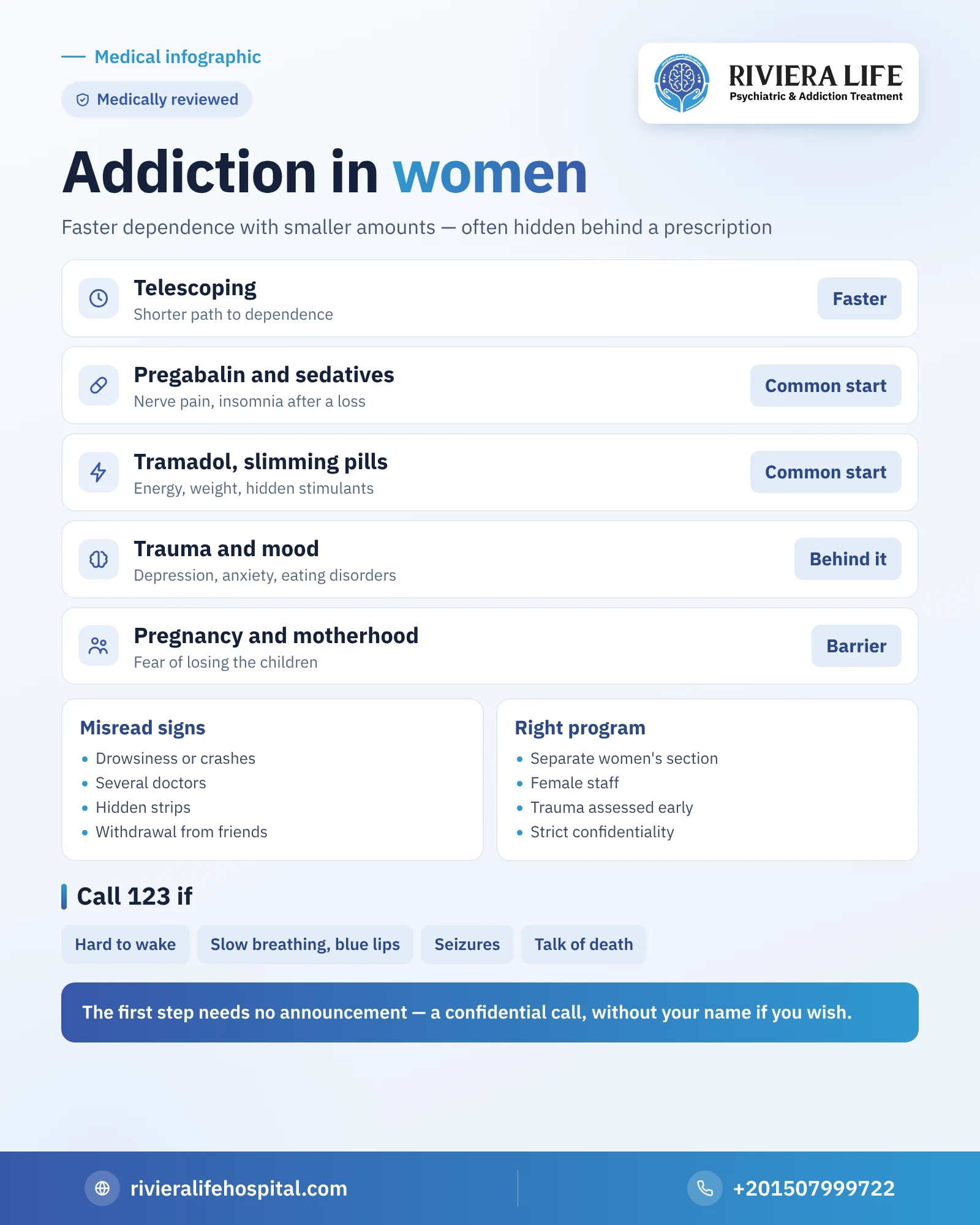
Researchers describe a phenomenon called “telescoping”, meaning the compression of the time span: many women start using at a relatively later age, or in smaller amounts than men, then reach dependence and health complications in a shorter time. This has been clearly observed with alcohol, opioids and sedatives. In practice this means that “she doesn’t take much” isn’t a reason for reassurance.
The body and hormones
The proportion of water in a woman’s body is lower on average, so the substance reaches a higher concentration in the blood with the same amount, and this is very clear with alcohol. Studies indicate that hormonal fluctuation during the menstrual cycle may change the intensity of craving and the response to some substances, especially stimulants. And women are sometimes affected by harm to the heart, liver and brain faster than men when use goes on for long.
From the pharmacy to dependence: the most common road
Many women aren’t looking for a high, but for sleep, calm, a thinner body, or the ability to bear a long day between home, work and children. That is why prescribed medicines, or those passed around without a prescription, take up a large place in women’s addiction stories in Egypt:
| Substance | How the story usually starts | Why it deceives its user |
|---|---|---|
| Pregabalin | A prescription for nerve pain or anxiety, or advice from a friend | It seems like “an ordinary medicine” so she increases the dose without consultation |
| Sedatives (benzodiazepines) | Insomnia after childbirth, divorce or a loss | The relief is fast, and stopping suddenly may be dangerous |
| Tramadol | Period, back or post-operative pain | It gives energy and a better mood at first |
| Slimming products of unknown origin | A desire to lose weight quickly | Some may contain stimulant substances not mentioned on the pack |
The common thread is that the medicine is used to treat an undiagnosed psychological distress. And any adjustment or stopping of a prescribed medicine must be done with the treating doctor only. You will find the details of each substance in the guides to pregabalin, benzodiazepines and tramadol.
Stigma in Egyptian society: why does a woman use in secret?
An addicted man is described as “lost” and then his return is awaited, while a woman is accused in her morals and reputation and the reputation of her whole family. This difference pushes many women to use alone at home, without witnesses, which makes an overdose more dangerous because no one is nearby to save her. It also pushes them to get the medicine from more than one pharmacy, hide the strips in handbags, and postpone treatment until a crisis happens that can’t be hidden.
One recurring picture says: a mother in her thirties, working and raising two children, takes pills “so she can get through the day”, and everyone sees her as holding together. No one asks her, and she doesn’t dare speak.
Trauma, depression, anxiety and eating disorders
Substance use disorders in women are strongly linked to previous painful experiences, to depression and anxiety, and to disorders of the relationship with food and the body. Sometimes the substance comes first, and sometimes the psychological pain comes first and then the substance is used to silence it. What matters is that treating the addiction alone isn’t enough if the original wound remains untreated, and that it is best for one team to treat both disorders together as in the dual diagnosis program. The guide to post-traumatic stress disorder explains how traumatic experiences leave their mark on sleep, mood and behavior.
Pregnancy, motherhood and the fear of losing the children
The biggest thing that stops a mother from admitting it is fear: that custody of her children will be taken from her, that her husband and his family will find out, or that she will be judged a bad mother. The medical truth is that asking for treatment is the best thing she can do for herself and her children, and that motherhood is a strong reason for recovery, not an obstacle to it.
- During pregnancy: some substances reach the fetus, and stopping some of them suddenly, such as opioids, sedatives and alcohol, may be dangerous to both mother and fetus, which is why any change is made under medical supervision.
- After childbirth: the doctor needs to know what the mother is taking to decide on the safety of breastfeeding and follow up the newborn.
- Prescribed medicines: don’t stop a psychiatric medicine on your own because you discovered you are pregnant; discuss the alternatives with the doctor. To learn more about a specific medicine see the article on pregabalin and pregnancy.
Signs of addiction in women that are misinterpreted
Many signs of use in women are attributed to exhaustion, hormones or “pressure at home”, so attention to them is delayed:
- Drowsiness or slow speech at unusual times, or excessive activity followed by collapse.
- Repeated visits to different doctors, or prescriptions that run out before their time.
- Medicine strips hidden in strange places, or unexplained expenses.
- Withdrawal from friends and occasions, and irritability when asked about the medicine.
- A clear change in weight, appetite or sleep.
- Sudden neglect of things she used to care about a great deal.
One sign doesn’t mean addiction, but several signs together deserve a calm conversation and a medical assessment.
Call an ambulance on 123 immediately if you see
Mixing sedatives with pregabalin, tramadol or alcohol may slow breathing dangerously, especially when using in isolation.
- Difficulty waking or loss of consciousness
- Very slow breathing, unusual snoring or blue lips
- Seizures after suddenly stopping a sedative or after a large dose of tramadol
- Talk of death or self-harm
What stops women from asking for treatment?
- Stigma and scandal: the fear that “people will know” is sometimes stronger than the fear of the illness itself.
- Caring for the children: who will look after them if the mother enters a treatment program?
- Financial dependence: many women don’t have the decision to spend on their own treatment.
- A partner who uses: when the husband himself is an addict, recovery at home becomes almost impossible, which we cover in the article on how to deal with an addicted husband.
- Mixed treatment environments: some women don’t feel safe talking about personal experiences in front of men.
What does suitable treatment for a woman look like?
The medical principles of treatment are the same, but a good program takes into account what a woman specifically needs. When asking about any place, look for the following:
- A separate section or accommodation for women, and women-only group sessions.
- Female nursing staff and therapists as far as possible, especially when talking about traumatic experiences.
- Assessment of trauma, depression and eating disorders from the start, not only after the substance is withdrawn.
- Special care for the pregnant woman and the mother after childbirth in coordination with the obstetrician.
- Strict confidentiality in data, visits and communication with the family.
- Flexibility that takes the mother’s role into account, such as planning childcare or programs other than full residence when the case allows.
And if you are the one with the problem, the first step needs no announcement: a confidential call in which you ask, without giving your name if you wish.
The right hospital for treating women’s addiction: how to choose
The right hospital for treating women’s addiction is the one that provides what a woman specifically needs: complete privacy, treatment for the psychological wound behind the use, and safe withdrawal from the medicines that are commonly addictive among women. Ask:
- Is there a separate section or accommodation for women, and female staff in nursing and therapy?
- Are pregabalin and sedatives withdrawn gradually under continuous medical supervision?
- Are depression, anxiety, trauma and eating disorders assessed within the plan?
- How is your data protected, and who has the right to know that you are receiving treatment?
- Does the team deal with pregnant and breastfeeding women in coordination with the obstetrician?
- Is there follow-up after discharge that suits a woman returning to a home and children?
And don’t trust any place that promises you a guaranteed cure or a final cure in a few days.
How Riviera Life meets these standards in treating women’s addiction
These are the details of what Riviera Life offers in this area:
- Complete confidentiality: your data and your story don’t leave without your permission, which is the most important thing a woman who fears stigma needs.
- Specialist consultants: consultants in psychiatry and addiction treatment who assess the use and the accompanying psychiatric disorder together.
- Safe withdrawal of medicines: round-the-clock medical supervision while stopping pregabalin, sedatives and tramadol.
- Official license: a hospital licensed by the Ministry of Health.
- Long experience: fourteen years of work and thousands of recovered cases.
- A program for the family: helps the husband or family support instead of blame.
- Aftercare: follow-up after discharge that reduces the risk of relapse in the hardest months.
The first consultation is free, and you can ask in it about accommodation and privacy arrangements before any decision. Contact us around the clock via +201507999722; we are based in Sheikh Zayed, Giza.
A woman can start her journey at an addiction treatment center that respects her privacy, with a free and confidential first consultation.
Read also
- Drug addiction: definition, signs and methods of treatment
- The dual diagnosis program for treating addiction and a psychiatric disorder
- Excessive irritability in women: causes and treatment
- How to choose an addiction treatment hospital
- The effect of drugs on the menstrual cycle: delay, absence and when to see the doctor
Questions many people ask
Research indicates that many women reach dependence and its complications in a shorter time and with smaller amounts, a phenomenon called telescoping, so a small amount isn't a reason for reassurance.
Yes, especially sedatives, pregabalin and opioid painkillers if the dose increases or the period lengthens without follow-up. The solution isn't stopping suddenly, but seeing the doctor to set a safe plan.
Treatment in respectable hospitals is confidential, and information isn't shared except with the patient's permission, except in cases of severe danger determined by the doctor.
Asking for treatment is a responsible step that protects the children, and recovery strengthens the mother's position. For any legal question specific to custody, a specialist lawyer should be consulted.
Look for complete confidentiality, separate women's accommodation and female staff, safe supervised withdrawal of sedatives and pregabalin, and treatment of trauma and depression. Riviera Life in Sheikh Zayed meets these criteria, with a free first consultation.