The effect of drugs on the menstrual cycle may appear as a delay, irregularity or absence for months, because the cycle depends on precise hormonal signals between the brain and the ovaries, and substances that affect the brain may disrupt these signals. The cycle may also be affected indirectly: weight loss, insomnia, poor nutrition and psychological stress. An irregular cycle alone doesn’t mean a woman is using, and its absence isn’t a sign of being safe from pregnancy. Here is what is known, what is still uncertain, and when you need a doctor.
How does the menstrual cycle work, in brief?
In an area of the brain called the hypothalamus, regular signals are sent ordering the pituitary gland to secrete hormones that stimulate the ovaries. An egg is prepared and estrogen and progesterone are secreted, and the cycle usually repeats roughly every month. Any factor that disrupts the brain, reduces energy or raises stress may delay the signal, so the period is delayed or absent. Accordingly, most of the causes of disturbance covered in this article pass through the brain.
The effect of each substance on the cycle
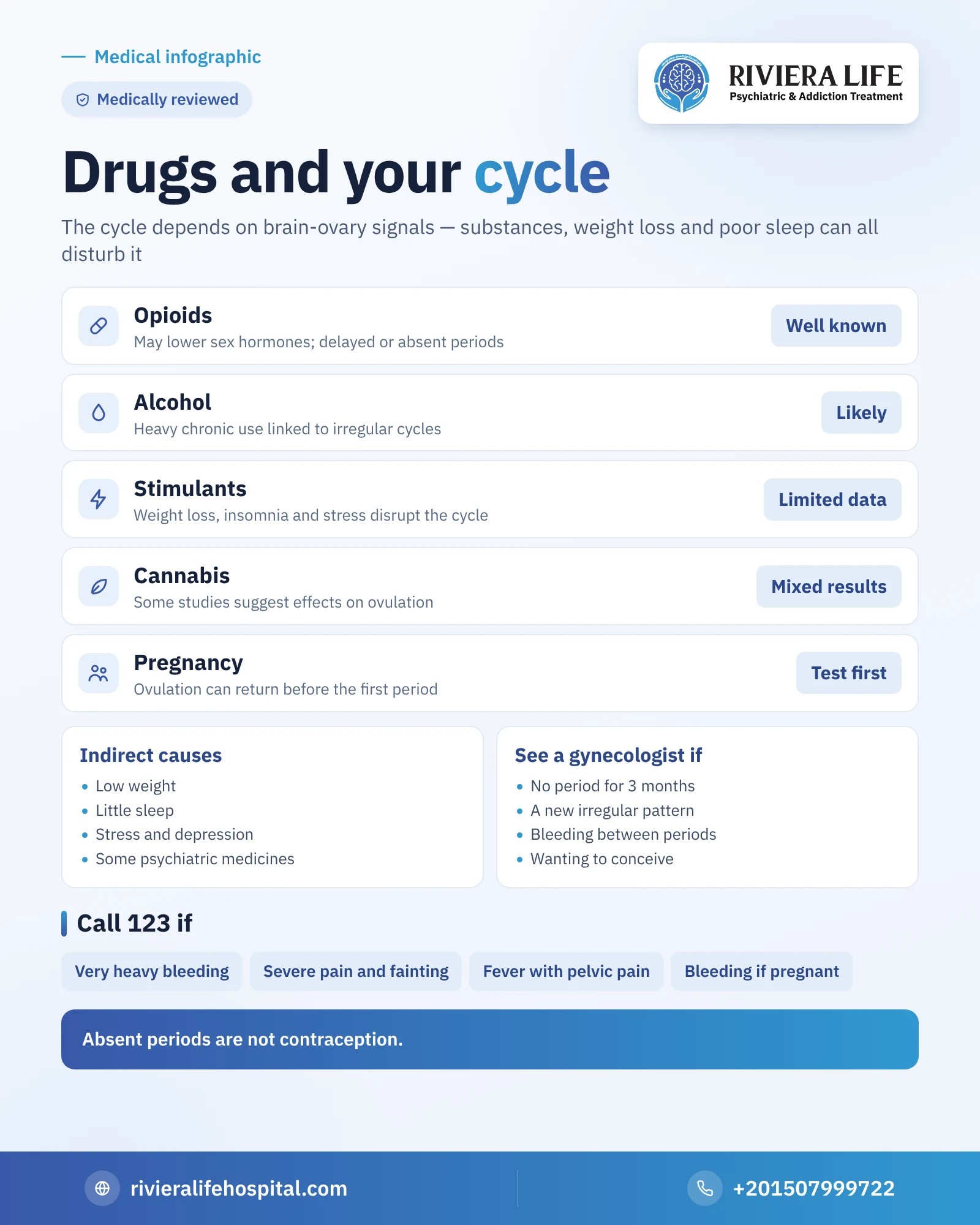
| Substance | What is known about its effect | Degree of certainty |
|---|---|---|
| Opioids (tramadol, codeine, heroin, morphine) | May lower sex hormones so periods are delayed or absent | Well known with chronic use |
| Alcohol | Chronic heavy use may be linked to cycle disturbance and weak ovulation | Likely |
| Tobacco and nicotine | Linked to more painful periods and an earlier menopause | Likely |
| Stimulants (ice, Captagon, cocaine) | Weight loss, insomnia and exhaustion may disrupt the cycle | Direct evidence limited |
| Hashish and marijuana | Some studies have suggested an effect on hormones and ovulation | Results conflicting |
| Sedatives and pregabalin | No consistent direct link; may act through sleep and mood | Unsettled |
The response may differ from one woman to another depending on the amount, duration and health condition, and the cause can’t be inferred from the symptom alone.
Opioids: the clearest link
Opioids suppress the area responsible for sending hormonal signals, so estrogen falls in many women who use them for a long time. The effects of this include delayed or absent periods, lower sexual desire, vaginal dryness and, over time, weaker bones. This applies to prescribed painkillers with long use, not only to illicit drugs. For the general picture of this family, read our opioids guide.
Indirect ways the cycle is disturbed
- Low weight and poor nutrition: stimulants reduce appetite, and a body that doesn’t find enough energy may stop the cycle to save resources.
- Little sleep and late nights: disrupt the body clock and hormones.
- Stress, anxiety and depression: raise cortisol, which may delay ovulation.
- Infections and inflammation: some risk behaviors increase the chance of pelvic infections.
- Certain psychiatric medicines: some may raise prolactin and disturb the cycle, such as risperidone. Don’t stop a medicine yourself, and tell your doctor what you notice.
And the cause may not be related to substance use at all: ovarian cysts, thyroid disorder, or pregnancy itself. That is why a medical examination is essential.
Absent periods don’t mean you won’t get pregnant
This is one of the most common and dangerous mistakes. Ovulation may return before the first period appears, so pregnancy happens without the woman noticing. And a delayed period may be thought to be a disturbance caused by the drug, so weeks pass without the pregnancy being discovered. If your period is late and you are sexually active, do a pregnancy test first. And if you are pregnant or may be, read drugs and pregnancy, ask for safe help, and don’t suddenly stop a substance your body has come to depend on without medical advice.
Accompanying symptoms that deserve attention
Disturbance of female hormones isn’t limited to the timing of the period. You may notice lower sexual desire, vaginal dryness, headaches, mood swings, night sweats and difficulty getting pregnant. Some are explained by substance use or medication, and some have another cause. Write down what you notice and the date of your last period, as the details help the doctor more than you imagine. And don’t be embarrassed to mention what you take, as the doctor deals with it medically.
Does the cycle return after stopping?
In many cases the cycle gradually becomes regular again after stopping and as weight, sleep and nutrition stabilize, which may take weeks or several months depending on the case. Don’t assume a specific date, as responses differ. And if the cycle hasn’t returned after a reasonable period of stability, that is a reason to see the doctor, not to wait longer. During withdrawal the cycle may change temporarily with insomnia and tension, and this isn’t necessarily a bad sign.
Fertility and planning a pregnancy
If you want to become pregnant in the future, a disturbed cycle caused by substance use may delay fertility, but it is usually able to improve after stopping and treatment. Don’t rely on absent periods as a method of contraception. Discuss a suitable method with your doctor if you don’t want to become pregnant now, including one suited to your particular health circumstances. And if there is a chance of pregnancy while using medicines or substances, ask for advice early instead of waiting.
The cycle and fluctuating craving
Research covered by scientific bodies such as NIDA indicates that female hormones may affect the response to substances and craving, and that some women notice a difference in their cravings between phases of the cycle. This field is still being studied, but the practical observation is useful: if you notice that relapse or craving intensifies before your period, tell the treatment team so they can set a plan for those days. You will find a wider context in women’s addiction.
Call an ambulance on 123 immediately if you see
The cause may be heavy bleeding, an ectopic pregnancy or a severe infection.
- Bleeding that fills a pad every hour for several hours
- Severe lower abdominal pain with dizziness or fainting
- High fever with pelvic pain and a foul smell
- Bleeding or severe pain with a possible pregnancy
Bones and long-term health
Estrogen protects the bones, and when it is low for a long time, bone density may gradually decrease. This makes a prolonged absence of periods a health matter, not a cosmetic one, and an additional reason to assess the condition rather than ignore it. Good nutrition, moderate sun exposure and regular physical activity, with the doctor’s guidance, help support health during recovery.
At any stage of recovery, a gynecologist can carry out a simple examination including a pregnancy test, hormones, thyroid and ultrasound when needed, to distinguish what was caused by substance use from what was caused by something else that is treatable.
When should you see a gynecologist?
- No period for three months or more, with pregnancy ruled out.
- Periods very far apart or very close together in a way that is new for you.
- Pain that ordinary painkillers don’t help.
- Bleeding between periods or after intercourse.
- Wanting to become pregnant with an irregular cycle.
Don’t be afraid to disclose substance use or medication; doctors need the correct information to protect you, and medical confidentiality is protected.
And remember that tracking your cycle is a practical way to follow your health during recovery: write down its date and changes every month, as its gradual return to regularity is a good sign that the body is regaining its balance, and a long delay is a signal to consult the doctor without waiting. This small record also helps the treatment team because it links physical and psychological improvement.
How can Riviera Life help you?
Riviera Life treats women in complete confidentiality with a team of psychiatry and addiction consultants, with round-the-clock medical supervision during withdrawal, and the assessment can be coordinated with a gynecologist when needed. The first consultation is free on +201507999722, Sheikh Zayed, Giza.
Read also
- Women’s addiction: why it is different and how a woman starts treatment confidentially
- Drugs and pregnancy
- Depression symptoms in women
- Opioid addiction symptoms
Questions many people ask
Periods may be delayed or absent with chronic use of some substances, most clearly opioids, and the cause may be indirect, such as weight loss and insomnia.
Yes, ovulation may return before the first period, and absent periods aren't a method of contraception; a pregnancy test is needed if in doubt.
In many cases they return gradually as weight, sleep and nutrition stabilize, which may take weeks or months, and the doctor should be seen if they are delayed.
Some may raise prolactin and disturb the cycle; the doctor should be told without stopping the medicine on your own.
When periods are absent for three months with pregnancy ruled out, or with heavy bleeding, severe pain, bleeding between periods, or a wish to become pregnant with an irregular cycle.