
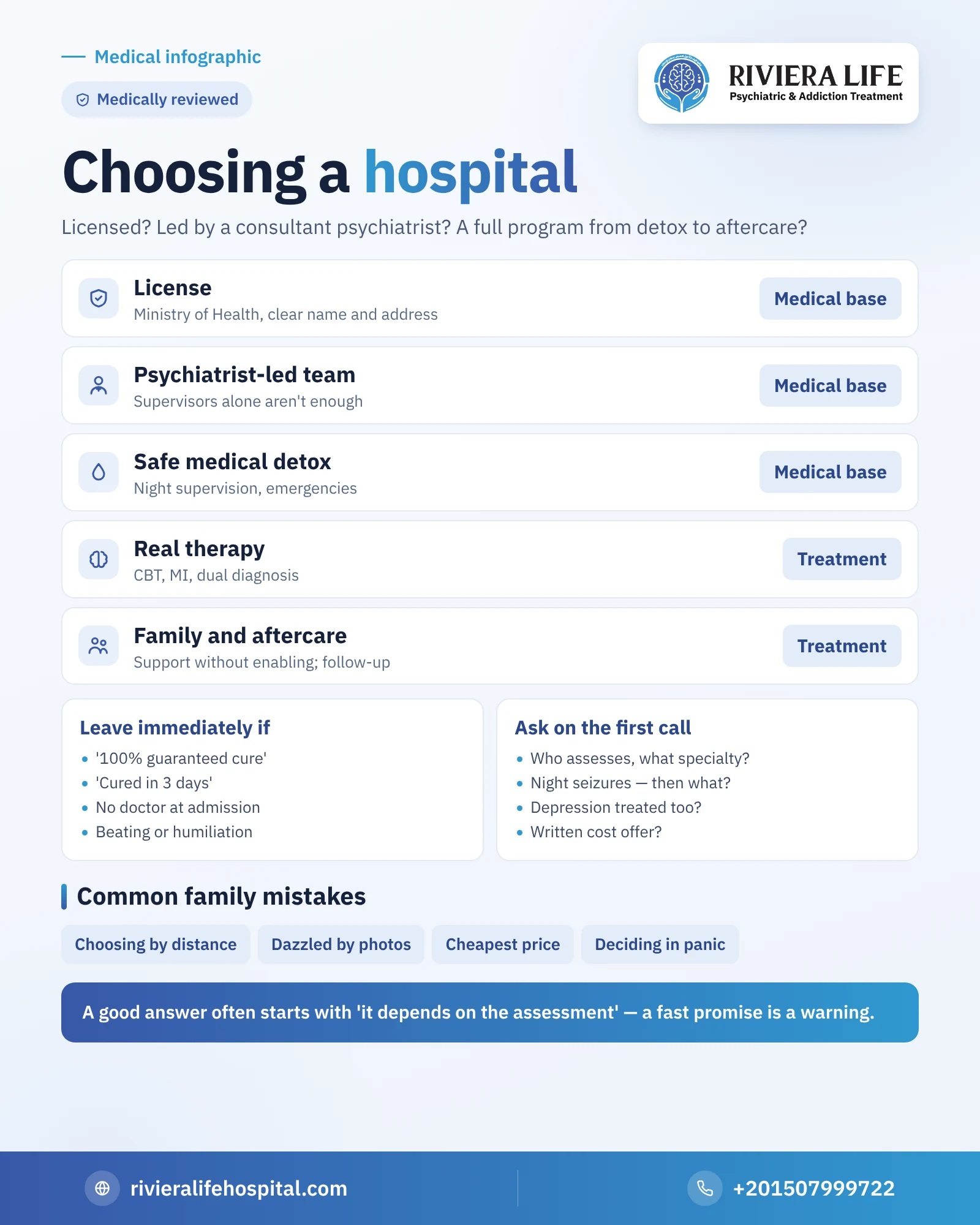
How do you choose an addiction treatment hospital? Start with three decisive questions: is the place licensed? Is treatment led by a consultant in psychiatry and addiction treatment? And does it offer a complete program from safe detox to aftercare? After that come the details that separate a good hospital from one selling illusions: treatment of accompanying psychiatric disorders, an individual plan, a program for the family, confidentiality, and frankness in talking about results and cost. This article is a practical checklist, with warning signs that should make you leave immediately, and questions to ask on the first call.
Before searching: what does the case actually need?
There is no single “best hospital” for every patient in the absolute sense; there is the right place for this case specifically. A young man who has used hash for a year without health problems is different from a man who has drunk alcohol daily for ten years, or a woman dependent on sedatives with depression. So before calling, gather: which substance or substances? Since when? Have seizures or hallucinations happened before? Are there psychiatric or physical illnesses? Has treatment been tried before? This information makes the call useful, and quickly reveals to you who listens to your case and who recites a ready script. And if you want an example of a place that presents its answers to these questions publicly, see our page on addiction treatment hospital in Egypt as we see and apply them. These selection criteria become clearer if you know how drug addiction treatment runs from the first assessment to follow-up.
Checklist (1): the medical foundation
- License: a facility licensed by the Ministry of Health, with a clear name and address. Don’t accept a “branch” you can’t visit.
- A team led by a psychiatrist: a consultant in psychiatry and addiction treatment who assesses the patient and decides the plan, with nursing staff and psychotherapists. A supervisor alone isn’t enough.
- Capacity for medical withdrawal: alcohol and sedative withdrawal may cause seizures or delirium, and opioid withdrawal is very painful. Ask about night supervision and handling emergencies.
- Dual diagnosis treatment: a large proportion of patients have depression, anxiety or another disorder, and whoever treats the addiction alone leaves half the problem. Read about the dual diagnosis program.
Checklist (2): the treatment itself
- Comprehensive assessment and an individual plan: the plan is built after examining the patient, not one program for everyone.
- Real psychotherapy: individual and group sessions using known methods such as cognitive behavioral therapy and motivational interviewing, not just detox and residence.
- A program for the family: the family is part of the treatment, and needs to learn to support without enabling.
- Aftercare: follow-up after discharge with a clear plan, because the first months are the highest risk for relapse. The details are in the aftercare program.
Checklist (3): trust and transparency
- Confidentiality: a clear policy to protect the patient’s data and who has the right to know any information.
- Frankness about results: addiction is a chronic illness prone to relapse, and an honest place talks about the chances of improvement and the factors of success, not guaranteed cure rates.
- A safe, clean environment: decent rooms, spaces for activity, and announced rules that respect patients’ dignity. Luxury is an added advantage, not a basic criterion.
- Cost transparency: a written offer explaining what the price includes and doesn’t include. To understand the factors of price see the cost of addiction treatment in Egypt, and for psychiatric clinic prices psychiatric hospital prices in Egypt.
Warning signs: when do you leave immediately?
| What you hear or see | Why is it dangerous? |
|---|---|
| “We guarantee you a 100% cure” | No psychological or medical treatment guarantees an absolute result |
| “Treatment in 3 days and it will never come back” | Detox is only a first step, and rehabilitation needs time |
| No doctor at admission, only supervisors present | Dangerous withdrawal may turn into an emergency with no one to treat it |
| Complaints of beating, humiliation or deprivation of food | Violence creates trauma and rejection, not recovery |
| Confining the patient without a medical assessment justifying it | Admission without consent has medical and legal controls |
| “Herbal treatment” that replaces doctors | There are no herbs that treat addiction, and some are harmful |
To know the difference between legitimate medical admission and centers that move patients by force read treating an addict by force.
Questions to ask on the first call
- Which doctor will assess the patient, and what is their specialty?
- How do you deal with withdrawal from this substance specifically? And what happens if seizures appear at night?
- Do you treat accompanying depression or anxiety within the program itself?
- How is the duration of treatment set? And can the plan be changed according to progress?
- What is the family’s role? And how and when can we contact the patient?
- What happens after discharge? And how long does follow-up last?
- Can we visit the place before admission?
- Do you provide a written, detailed cost offer?
A good answer is specific and often starts with “it depends on the assessment”, while a worrying answer is a quick promise or evasion of details.
Full residence or outpatient treatment?
Full residence suits severe dependence, dangerous withdrawal, a clear psychiatric disorder, repeated relapses, and a home environment where the substance is easily available. Milder, stable cases with strong family support may suit half-residency or home treatment under medical supervision. A good hospital suggests the level the case needs, not the most expensive. You will find the details of each level in the full residential program, the half-residency program and the home treatment program.
Cases that need an extra question
Some patients need something general checklists don’t mention. A woman needs greater privacy, and perhaps a separate section and female staff, which we detail in addiction in women. A teenager needs a program that takes into account their studies and the role of their parents, as in the students and teenagers program. And someone who relapsed after previous treatment needs to ask: what will be different this time?
What do you notice when visiting the place?
The visit reveals what calls don’t say. Notice how the staff speak with patients, whether the patients seem calm or afraid, and whether daily schedules of activities and sessions are posted and available. Ask about the emergency room and its equipment, and the number of nurses at night. And if the place refuses a visit without a convincing reason, that is an answer in itself.
Common mistakes families make when choosing
- Choosing by proximity only: the place closest to home isn’t necessarily the most suitable, and sometimes distance from friends and sources of the substance is an advantage.
- Being dazzled by photos: a swimming pool and hotel rooms don’t mean there is a psychiatrist on the night of the seizures.
- Looking for the cheapest price: a short program without rehabilitation may end in a quick relapse and paying the cost twice.
- Deciding in panic: calling the first number in an advertisement after a night crisis, without a single question about the license.
- Hiding information from the team: concealing another substance or a previous suicide attempt makes the plan incomplete and may make detox dangerous.
If the case is an emergency, such as loss of consciousness, seizures or severe hallucinations, the priority is an ambulance on 123 or the nearest emergency department, and choosing the hospital comes after the patient stabilizes.
How does Riviera Life meet this checklist?
These are the details of what Riviera Life offers in this area:
- License: a hospital licensed by the Ministry of Health, with a known location in Sheikh Zayed, Giza.
- A team led by specialists: consultants in psychiatry and addiction treatment who assess each case and set its plan.
- Safe medical withdrawal: round-the-clock medical supervision all days of the week.
- A program for the family: in which the family takes part to learn the right support.
- Aftercare: follow-up after discharge to protect recovery.
- Complete confidentiality: the data of the patient and their family are fully protected.
- Extended experience: fourteen years of work and thousands of recovered cases.
- A free first consultation: in which you ask all the questions on the list before any commitment.
Try the previous questions with us yourself. Contact us around the clock via +201507999722.
For families in Cairo and Giza, the guide to addiction treatment centers in Cairo details what to check when comparing.
Read also
- The cost and prices of addiction treatment centers in Egypt
- The full residential program for addiction treatment
- Can a drug addict quit on their own?
- Addiction in women: why it differs and how it is treated
- Fear of addiction treatment: eight common fears and how to deal with them
- The importance of early addiction treatment: why not wait for rock bottom and the signs to act