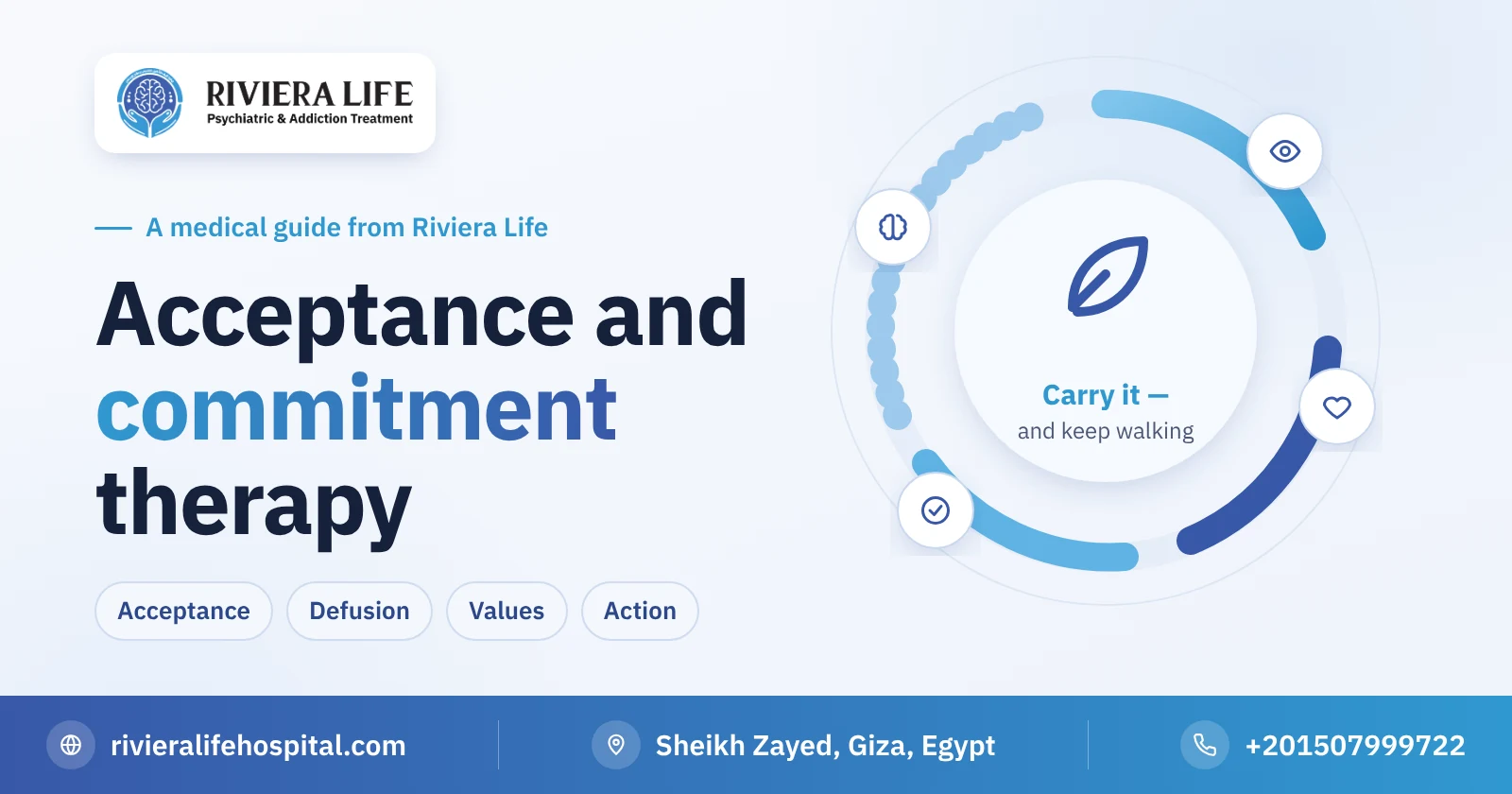
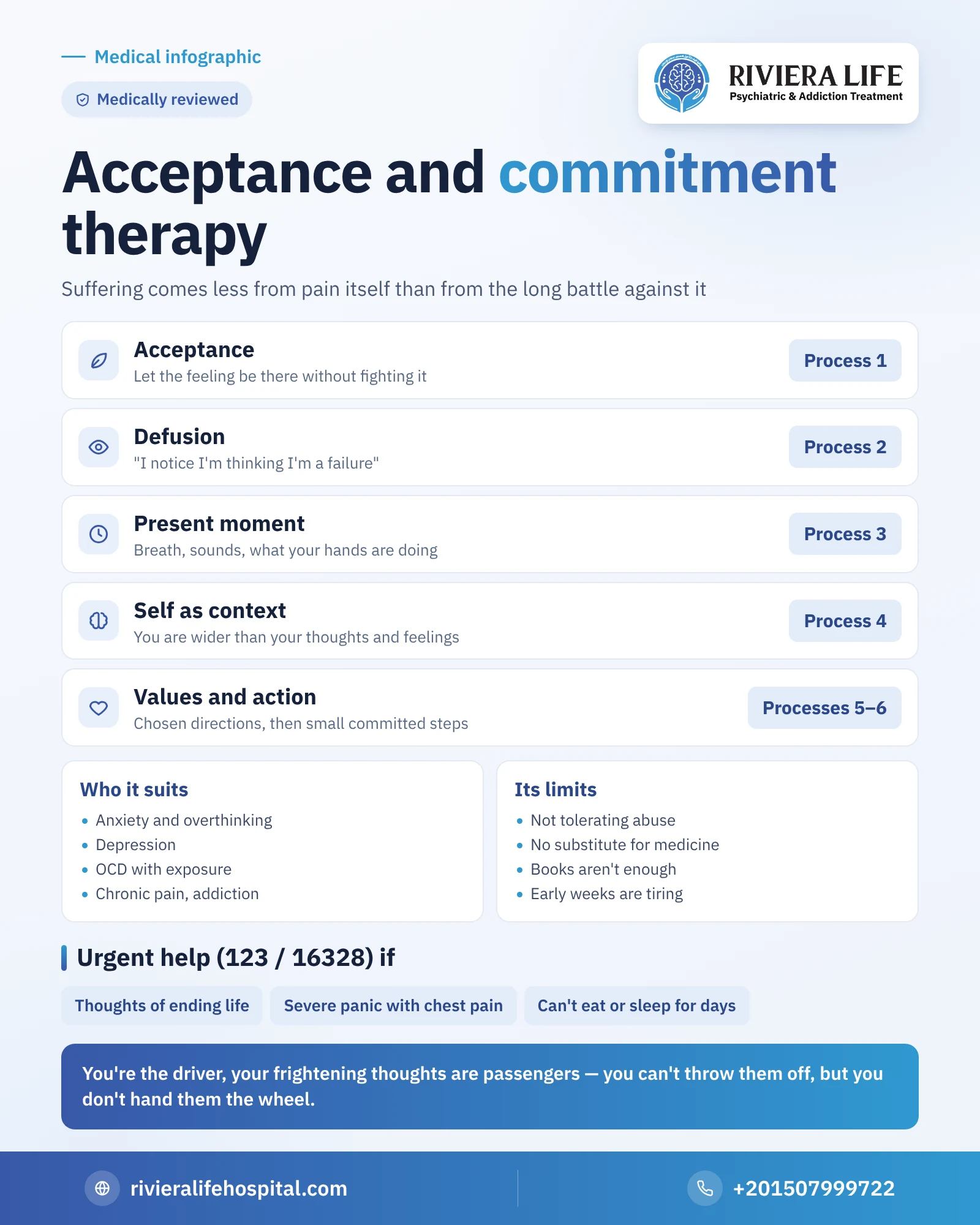
Acceptance and commitment therapy, abbreviated as ACT and pronounced “act”, is a psychotherapy that doesn’t try to silence disturbing thoughts or eliminate feelings of anxiety, but teaches you to carry them with you as you walk towards what matters in your life. The basic idea is that human suffering comes less from pain itself than from the long battle against it. This article explains the principle of the therapy, its six processes, who it suits, how it differs from cognitive behavioral therapy, and what the scientific evidence says about it in anxiety, depression and addiction.
What is acceptance and commitment therapy?
It was developed by the American psychologist Steven Hayes and his colleagues from the late 1980s, and it is one of the “third wave” therapies that came after behavioral and then cognitive therapy. Its stated aim isn’t for you to feel permanently happy, but to gain what it calls “psychological flexibility”: the ability to be present in the moment, open up space for what you feel, and act according to what you value even when the feeling isn’t comfortable. Therapists compare this to someone who wants to travel to a distant city; he doesn’t wait for the weather to clear completely, but continues the road even if rain is pouring.
The problem it treats: the battle with thoughts
Most of us deal with anxiety, sadness or craving as an enemy that must be suppressed. We try not to think about it, distract ourselves, or avoid everything that triggers the feeling. This may work temporarily, but it often returns more strongly and narrows life: the person stops going out, working or getting close to people for fear of the feeling. ACT sees this “experiential avoidance” as the loop that keeps suffering going. Instead of asking: how do I get rid of this feeling? the therapy asks: what do you want to do with your life with this feeling present?
The six processes of psychological flexibility
Acceptance
Allowing the feeling to be present without struggling with it. Acceptance here doesn’t mean accepting injustice or surrendering, but stopping spending energy on denying what is actually there.
Cognitive defusion
You learn to look at the thought instead of looking through it. When your mind says “I’m a failure”, you notice that this is a thought passing through you, so you say to yourself: “I notice that I’m thinking I’m a failure”. The thought doesn’t disappear, but it loses its authority over your decisions.
Contact with the present moment
Simple training in attending to what is happening now: breathing, sounds and what you are doing with your hands. This reduces getting lost between regret over the past and fear of the future.
Self as context
You are wider than your thoughts and feelings; there is a “you” that notices everything that passes. This gives a sense of stability even when the mood changes.
Values
Values are directions you choose for your life: being a present father, an honest friend, or a person who learns. They aren’t goals that are achieved and finished. The therapist helps distinguish them from other people’s expectations.
Committed action
Specific small steps you take according to your values, even if accompanied by anxiety: a postponed call, returning to walking, or attending a therapy session. Here understanding turns into behavior.
What do the sessions look like?
Sessions are held individually or in groups, and a course of therapy usually takes from eight to sixteen sessions, and may be shorter or longer depending on the case. The therapist uses dialogue, exercises and metaphors. One of the best known is the bus metaphor: you are the driver and your frightening thoughts are passengers shouting in the back; you can’t throw them off, but you don’t hand them the wheel.
Small exercises are given between sessions: noticing a thought instead of arguing with it, or identifying a value and taking one step towards it. The therapy may seem strange at first to someone used to being asked to prove his thoughts wrong, but it relieves many when they realize they don’t need to win every inner argument.
The difference between ACT and cognitive behavioral therapy
| Point of comparison | Traditional cognitive behavioral therapy | Acceptance and commitment therapy |
|---|---|---|
| Its stance on the disturbing thought | Examines it and corrects its distortion | Notices it and reduces your attachment to it without argument |
| The goal | Reducing symptoms | A meaningful life with or without the symptoms |
| The role of values | Secondary | Central |
| Mindfulness | An optional addition | An essential part |
The difference isn’t as sharp as it seems; many therapists mix the two approaches. If you want the foundation, read cognitive behavioral therapy then compare it with dialectical behavior therapy, which shares the idea of acceptance with ACT but is longer and more structured.
Who does it suit?
- Anxiety of all kinds: especially with overthinking and fear of bodily sensations, with details in overthinking.
- Depression: it helps break withdrawal and rumination, and its options are discussed with the doctor in depression treatment.
- Obsessive-compulsive disorder: it teaches tolerating doubt without rituals, and is sometimes used with exposure therapy.
- Chronic pain and long illnesses: where suffering can’t be eliminated so adaptation is part of treatment.
- Addiction: it is being studied as a complementary treatment for dealing with craving and thoughts that provoke relapse.
- Stress and burnout: it helps with helplessness under the pressure of work and responsibility.
What does the scientific evidence say?
Many trials of ACT have been carried out in anxiety, depression and chronic pain, and reviews indicate that it is better than waiting lists and usual care in several studies, and close in effectiveness to established therapies in many cases. But the quality of studies varies, some are small, and it hasn’t clearly outperformed cognitive behavioral therapy in all disorders. In addiction the evidence is promising but less established than approved medication and behavioral treatments, so it is considered supportive, not a replacement.
ACT and addiction
Many in recovery suffer from craving accompanied by thoughts such as “I can’t bear it” and “once won’t hurt”. ACT teaches that craving is a wave that passes, and that the thought doesn’t oblige you to act. The therapist combines accepting the sensation with linking the decision to values: what would I lose if I responded? And who do I want to be? But this comes after stabilizing the physical condition with safe withdrawal, and within a comprehensive relapse prevention plan, not alone.
The limits of the therapy and what to be careful of
- Acceptance isn’t a justification for harmful behavior or advice to endure violence or abuse.
- It doesn’t replace medical assessment and medicine when the condition is severe, such as depression with suicide risk or psychosis.
- Books and apps give a good idea, but they aren’t enough for someone with crises or a severe disorder.
- Feeling emotionally tired in the first weeks is normal, because the patient is facing what he used to avoid.
How can you apply a simple principle today?
Try a short exercise without therapeutic claims: when a painful thought appears, call it a “thought” and add “I notice that I’m thinking”. Then ask yourself: what small step serves what matters to me now? Carry it out even with the feeling present. This doesn’t treat a disorder, but it trains you to understand the approach before going to a therapist.
Seek urgent help immediately if you see
Call an ambulance on 123, the mental health hotline on 16328, or go to the nearest emergency department.
- Thoughts of ending life or a wish to disappear
- A severe panic attack with chest pain or severe shortness of breath
- Losing the ability to eat, sleep or care for oneself for several days
How can Riviera Life help you?
Choosing a psychotherapy starts with an accurate diagnosis, not with the name of a fashionable method. Riviera Life’s psychiatry and addiction consultants assess your condition in complete confidentiality, then decide on the appropriate plan, including family support and follow-up after discharge. The first consultation is free on +201507999722.
More from our psychotherapy guide
- Cognitive behavioral therapy
- Dialectical behavior therapy
- Anxiety: the complete guide
- Depression: the complete guide
- Music and art therapy: how it works, who it suits and its limits
- Meditation in addiction treatment: the MBRP program, its exercises and when to postpone it
Questions many people ask
It is allowing the feeling to be present without struggling with it, not accepting injustice or surrendering to what harms you.
Yes; it focuses on changing your relationship with the thought rather than correcting its content, and makes values central, although some therapists mix the two approaches.
Usually between eight and sixteen sessions, and it may be shorter or longer depending on the case and the diagnosis.
It is being studied as a complementary treatment that helps accept craving without responding to it, but it doesn't replace medical withdrawal and a relapse prevention plan.
Self-help materials may give a good idea, but they aren't enough for someone with a severe disorder or repeated crises, and here a therapist is needed.