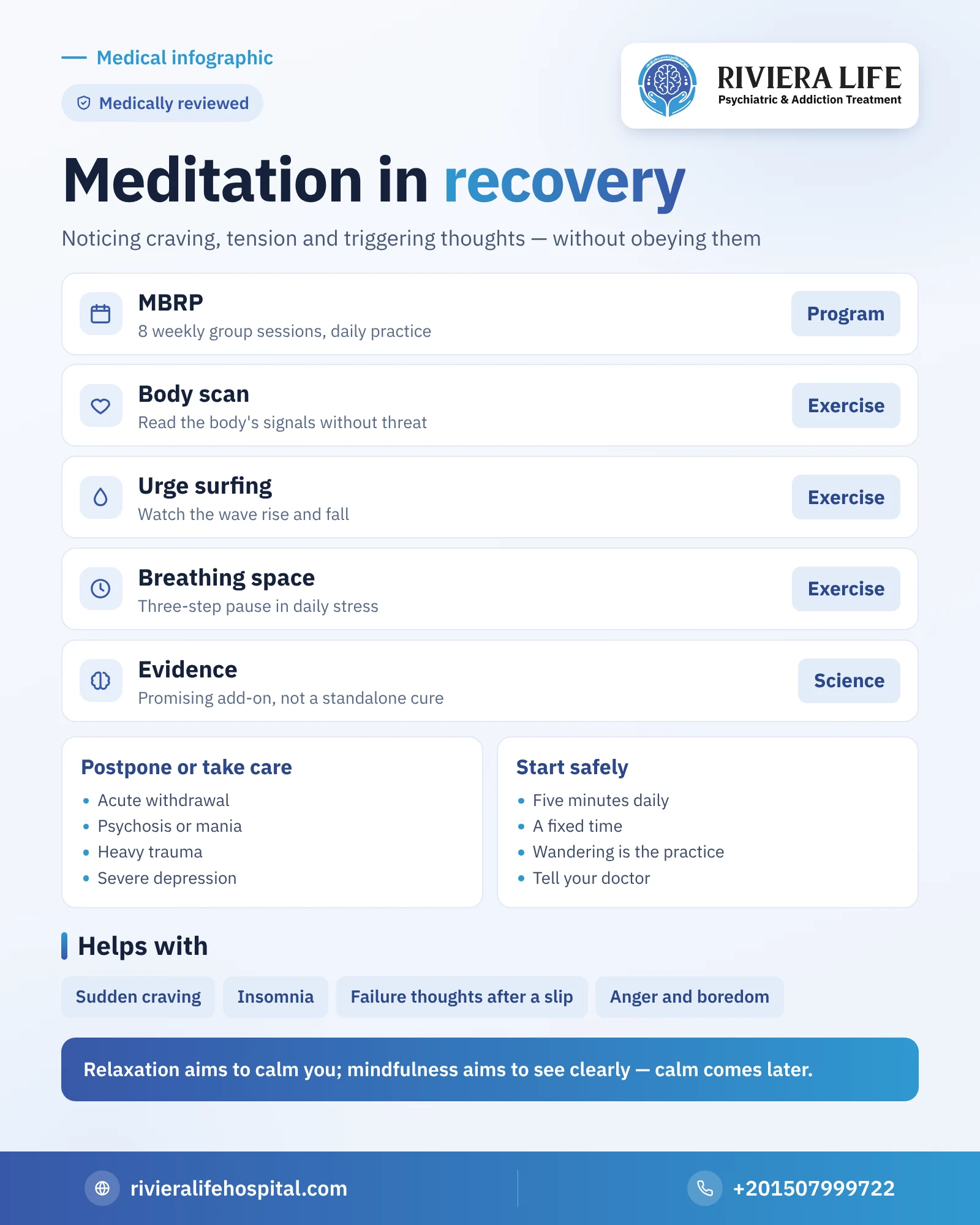
Meditation in addiction treatment isn’t a relaxation session with calm music, but organized training in noticing craving, tension and triggering thoughts without carrying out what they ask of you. Its best-known medical version is “mindfulness-based relapse prevention” (MBRP), a group program of eight weeks designed specifically for people in recovery. This article explains what it means, the exercises used, what scientists know about its effectiveness, when meditation is useful and when it is postponed, and how it integrates with medical treatment instead of replacing it.
What is meant by meditation here?
The word covers many practices, but what is used in addiction is mindfulness: deliberately paying attention to what is happening at this moment, of breaths, body sensations, thoughts and feelings, without passing judgment on them. What is required isn’t emptying the mind, as the mind doesn’t empty, but noticing that it has wandered and returning gently. This skill in itself is what helps in recovery, as relapse usually happens in seconds in which a passing craving turns into automatic behavior without any awareness.
Why does addiction treatment turn to mindfulness?
The addict learns over time to escape any uncomfortable feeling with the substance. Anxiety means using, boredom means using, and even joy may lead to using. So the habit becomes an automatic reaction. Mindfulness works to undo this link: it inserts a small space between the sensation and the decision. Addiction researchers add that craving has a beginning, a peak and an end, and that both fighting it violently and giving in to it prolong it, while watching it lets it fade.
The MBRP program: what is it and how is it organized?
It was developed by researchers at the University of Washington, including Alan Marlatt and Sarah Bowen, and combines relapse prevention with meditation. Clear features recur in it:
- Eight weekly sessions in a group, each about two hours long.
- Exercises in the session and short daily homework at home.
- A specific topic each week, such as recognizing triggers, then dealing with craving, then the role of thoughts, then a balanced life.
- It usually comes after an intensive treatment stage or during aftercare, as it is a program for maintaining recovery, not for withdrawal.
The basic exercises
Body scan
Moving attention slowly through parts of the body to notice tension, numbness or warmth in them. It teaches the recovering person to read their body’s signals instead of ignoring them or interpreting them as a threat.
Urge surfing
When the urgent desire appears, they don’t resist it or obey it, but imagine it as a wave that rises then falls, and describe to themselves where they feel it in their body and how it changes. The desire becomes an event that passes, not an order that must be carried out.
The short breathing space
A short pause made up of three steps: paying attention to what is happening now, then settling on the breath, then widening attention to the whole body, and this pause leads you to choose instead of reacting automatically. It can be practiced in a few minutes and in daily situations such as traffic or an argument.
Meditation while walking and eating
Turning a daily activity into training in presence, and it suits those who find it hard to sit still.
The difference between meditation and relaxation
Many leave meditation after days because they didn’t feel relaxed, so they think they are doing it wrong. Relaxation aims for you to calm down, while mindfulness aims for you to see clearly what is happening, whether calm or disturbing. You may come out of the exercise more aware of your tension, not calmer, and this is acceptable, as calm comes later as a side effect with continuation. And meditation has no connection to a religion or belief; it is training in attention practiced by people of every background.
What does the scientific evidence say?
In a large trial whose results were published in a peer-reviewed psychiatry journal, participants after addiction treatment had less return to drug use and heavy drinking episodes at the twelve-month follow-up compared with those who received a traditional relapse prevention program. Later reviews supported that combining it with usual treatment may reduce craving and improve emotional regulation, to degrees that vary by study and substance. But the picture isn’t conclusive: many studies are small, the differences are sometimes modest, and there is no evidence that meditation replaces medicines or group and individual therapy. So it is more accurate to say it is a promising addition, not a standalone treatment.
How does it help in dangerous moments?
- Sudden craving: instead of rushing to the phone or calling the dealer, you stop for three minutes and watch the wave.
- Insomnia: breathing and body scan exercises ease the tension that prevents sleep in the first months of recovery.
- Failure thoughts after a slip: “I’ve failed so there’s no point” is a thought that is noticed and described, and not automatically believed after the slip.
- Anger and boredom: the recovering person learns to express them without treating them with the substance.
Stress plays a big role in relapse, and you will find what concerns it in the article on psychological stress, while overthinking covers the rumination cycle in which these exercises also help.
When is meditation postponed or practiced cautiously?
- During acute withdrawal: the priority is medical safety and supervision, not sitting in silence.
- With psychosis or mania: symptoms may increase with long sessions, so it is practiced under the doctor’s supervision and with short exercises if allowed.
- With heavy trauma: paying attention to the body may stir painful memories, so a therapist who knows how to adjust the exercise is needed, and the article on post-traumatic stress disorder treatment explains the reason for caution here.
- Severe depression and thoughts of ending life: medical follow-up comes first.
A beginner may feel anxiety, distress or sleepiness during the exercise, and this is common and not proof of failure. But if the distress clearly increases, stop and talk to the therapist.
Meditation and relapse prevention: where is its place in the plan?
Meditation works best when it is part of a system: safe withdrawal, then psychotherapy, medicines when needed, family support, and an aftercare program. The article on the relapse treatment program explains the wider plan, and the aftercare program clarifies when these exercises usually start: after the recovering person stabilizes, not in the first days. It harmonizes with acceptance and commitment therapy, which overlaps with it in accepting craving.
How do you start with a safe step?
- Start with five minutes a day then increase gradually, as regularity is better than long, intermittent sessions.
- Choose a fixed time, such as after waking or before sleep.
- If your mind wanders, this is the exercise itself: notice and return without blame.
- Tell your doctor or therapist that you practice it, especially if you take a medicine or have an accompanying psychiatric disorder.
- Avoid programs that promise recovery from addiction through meditation alone or ask you to stop treatment.
The family’s role
Meditation asks of the family only an environment that allows a short quiet time, and respect for the recovering person’s commitment to it without mockery or checking on what they are doing. It is useful for the family to try the breathing exercises themselves, as pressure on a relative exhausts everyone. And understanding that craving may return despite the patient’s commitment to the exercises prevents blame at the first relapse.
Call an ambulance on 123 immediately if you see
Exercises don't treat medical emergencies. Seek immediate help if any of the following happen.
- Seizures, hallucinations or severe confusion while stopping the substance
- Shortness of breath, very slow breathing or loss of consciousness
- Thoughts of ending life or self-harm
How does Riviera Life help you?
Recovery needs more than one technique. The consultants in psychiatry and addiction at Riviera Life assess your condition, follow it around the clock under medical supervision, and set a plan that extends to the family and follow-up after discharge. The first consultation is free and confidential on +201507999722.
More from the psychotherapy guide
- The stages of recovery from addiction
- Relapse treatment program
- The aftercare program after addiction treatment
- Cognitive behavioral therapy
Questions many people ask
A group program of eight weekly sessions that combines relapse prevention with mindfulness, designed for people recovering from addiction.
No. It is a promising addition alongside safe withdrawal, psychotherapy, medicine when needed and aftercare programs.
An exercise in which the recovering person notices the craving as a wave that rises then falls without resisting it or responding to it, so it passes safely.
It isn't given priority; medical safety and supervision come first, then meditation is added after the condition stabilizes.
No; mindfulness is training in attention practiced by people of every background without being tied to a belief.