The short answer
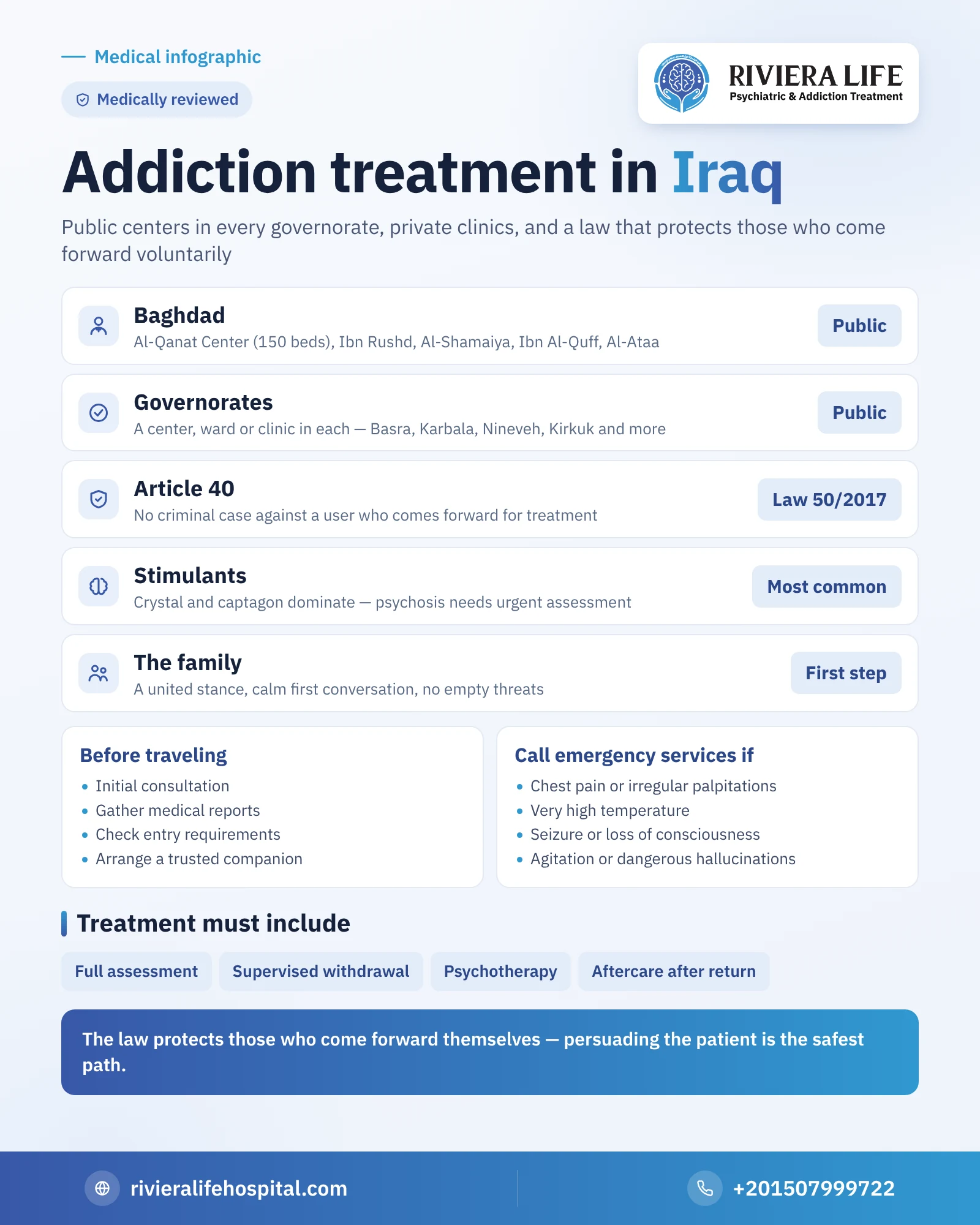
The Iraqi Ministry of Health provides addiction treatment in centers, wards and clinics spread across the governorates. The most notable in Baghdad are the Al-Qanat Addiction Treatment Center with 150 beds, Ibn Rushd Hospital, Al-Shamaiya Hospital, Ibn Al-Quff Hospital and Al-Ataa Center, and in the governorates hospitals including Al-Hayat in Basra and Imam Al-Hassan in Karbala. Article 40 of Narcotics Law No. 50 of 2017 provides that no criminal case is brought against a user who comes forward on their own for treatment at the competent hospital.
- BaghdadAl-Qanat Center, Ibn Rushd, Al-Shamaiya and Al-Ataa
- The governoratesA center or ward in every governorate
- Voluntary treatmentNo case against someone who comes forward themselves
Many Iraqi families discover a son’s addiction late, then face two hard questions: how do we talk to him without losing him? And where do we treat him without everyone knowing? Addiction treatment in Iraq is possible, and there are public and private psychiatric and addiction services, but the road begins at home before the hospital. This guide accompanies you step by step: from discovering the problem, to the first conversation, to dealing with emergencies, then choosing a place of treatment inside or outside Iraq, and what happens after returning.
Addiction treatment hospitals and centers in Iraq
The Ministry of Health has expanded addiction services in recent years, and its spokesman says every governorate has at least one center, ward or clinic. Among the most notable providers:
- In Baghdad: the Al-Qanat Addiction Treatment Center with 150 beds, alongside Ibn Rushd Hospital, Al-Shamaiya Hospital, Ibn Al-Quff Hospital and Al-Ataa Center.
- In the governorates: Al-Hayat Hospital in Basra, Al-Zahraa Hospital in Wasit, Imam Al-Hassan Hospital in Karbala, Al-Salam Hospital in Nineveh and Azadi Hospital in Kirkuk, as well as units in Diyala, Dhi Qar, Babylon and Muthanna.
Data from the United Nations Office on Drugs and Crime indicate that the number registered in public health services for drug use disorders doubled between 2017 and 2021, and that more than two-thirds of those in treatment in 2022 were treated for amphetamine-type stimulants, that is, crystal and captagon. Crystal is known in Iraq as the most widespread substance, while captagon circulates under names including “Abu Hilalain”.
Private hospitals and clinics
In Baghdad, Erbil, Basra and other cities there are private psychiatric hospitals and clinics offering assessment and outpatient treatment, and some offer inpatient stays. Before choosing, make sure the facility is licensed, has a psychiatrist specializing in addiction and round-the-clock medical supervision during detox, and use our checklist for choosing an addiction treatment hospital.
How do you start?
The shortest route is for the patient to go themselves to the nearest public addiction hospital or ward in their governorate, or to start with a psychiatrist who refers them there. Coming forward for treatment yourself matters legally, as the section on Iraqi law below explains.
When the family discovers the addiction: what to do first?
The first reaction of many parents is anger, shock or trying to hide it. These are understandable feelings, but they aren’t a good basis for a decision. Start calmly: gather what you know about the substance, how long the use has been going on, and whether your son has shown psychological symptoms such as suspicion, aggression or days without sleep.
Then agree with at least one partner in the family on a united stance, because the patient exploits disagreement between the father and mother. If you don’t know the signs precisely, first read how to know if my son is addicted.
Fear of what people will say: how it delays treatment
In a society where family and tribal ties are intertwined, many fear that treating their son will become the talk of the town. So the family chooses silence, tries treatment at home, or waits for him to “come to his senses on his own”. The problem is that waiting doesn’t protect the family’s reputation; it gives the addiction more time to deepen. Often the matter is exposed in the end in a worse way: an accident, a problem at work, or an emergency admission after an overdose.
The solution isn’t to ignore privacy, but to look for a place that truly respects it, whether inside or outside Iraq. For those thinking of traveling, it is useful to read about the stages of addiction treatment in Turkey and what to check beforehand.
Stimulants: why do they need special attention?
In talk about Iraq in recent years, crystal (methamphetamine) and captagon come up repeatedly, alongside sedative pills and hashish. Stimulants in particular may cause days without sleep, suspicion and persecutory ideas, and sometimes hallucinations and aggression. These cases need an urgent psychiatric assessment, not just being locked up or isolated at home. You will find the details of the medical stages in crystal and ice addiction treatment.
Call an ambulance immediately if you see
In Iraq call the local emergency number, and in Egypt 123, if after using stimulants there is:
- Chest pain or strong, irregular palpitations
- A very high body temperature with sweating or dehydration
- A seizure or loss of consciousness
- Agitation or hallucinations that make him a danger to himself or others
How do you open the first conversation with the patient?
- Choose a time when he is sober and calm, not after using and not in the middle of an argument.
- Talk about specific situations you have seen, not his character: “You haven’t slept for three nights” instead of “You’re a failure”.
- Present treatment as help, not punishment, and prepare a specific option to propose.
- Expect denial, and don’t consider the first refusal the end of the road.
- Don’t threaten what you won’t carry out, and don’t give him money that could go to the drug.
The family trains in these skills in more detail within the family rehabilitation program.
Can he stop on his own?
Many patients tell their families: “I can quit whenever I want.” Some actually stop for days or weeks, then go back at the first pressure or the first meeting with an old friend. A temporary stop doesn’t mean control, and the return afterwards is sometimes more severe. A solo attempt is more dangerous with sedatives and alcohol because of withdrawal, and with stimulants because of the depression that follows stopping. That is why the medical assessment is what determines whether outpatient follow-up is enough or not; you will find a broader discussion of this question in can a drug addict quit on their own?
Psychological trauma and addiction
Many Iraqis have been through harsh experiences over decades of war, violence and loss. Some patients use the drug to silence memories, nightmares or constant anxiety without realizing it. If this side isn’t diagnosed and treated, it remains a strong cause of relapse. So ask any place of treatment: do you assess post-traumatic stress disorder and depression alongside the addiction?
What must treatment include, wherever it is?
Complete treatment doesn’t stop at detox, but goes through stages: a comprehensive assessment, then safe withdrawal under supervision, then psychological and behavioral therapy that addresses the causes of use, then rehabilitation and follow-up after discharge. Any program that drops one of these stages leaves the patient exposed to relapse.
Iraqi law and voluntary treatment
The matter is governed by Narcotic Drugs and Psychotropic Substances Law No. 50 of 2017, whose most notable provisions include:
- Article 32: anyone who possesses, buys or uses drugs for personal use is punished with imprisonment from one to three years and a fine of five to ten million dinars.
- Article 40: no criminal case is brought against a user of narcotic or psychotropic substances who comes forward on their own for treatment at the hospital specialized in treating addicts; they are placed under observation and then kept for treatment for set periods that can be extended, with follow-up after discharge.
- Article 39: the court may place someone proven to be addicted in a health institution instead of punishment, or oblige them to attend a psychosocial clinic.
- Article 41: requires confidentiality regarding those being treated.
The text protects those who come forward themselves and doesn’t mention requests by relatives, so persuading the patient to come forward for treatment remains the legally safest path. To compare this with the laws of other countries, read Kuwait’s drug law.
Treatment inside Iraq or travel to Egypt?
Treatment inside Iraq suits cases that find an integrated program nearby, with a family able to follow up. Some families consider traveling to Egypt when relapses repeat, when the case needs a longer stay and intensive psychotherapy, when temporary distance from using friends is necessary, or when privacy is the top priority. A shared language makes the psychotherapy sessions on which much of recovery rests easier.
Practical steps before traveling
- Call to explain the case and get an initial consultation that determines the level of care.
- Gather previous medical reports and the names of the medicines the patient takes.
- Check travel and entry requirements with the official authorities.
- Arrange for a trusted companion to travel, especially if the patient is hesitant.
- Agree in advance on how the family will communicate with the treatment team.
After returning to Iraq
The return is the real test. The patient needs a written plan for medicines and follow-up, a daily routine that fills the empty time with work or study, and clear distance from using friends. Follow-up can continue remotely in the first months, and coordination with a psychiatrist in Iraq is also possible. The family needs to know the early warning signs and how to respond to them without panic.
The right addiction hospital for patients from Iraq: how to choose
The right hospital for an Iraqi patient is one that handles stimulants and their psychiatric symptoms well, looks for the trauma hidden behind the use, protects the family’s confidentiality, and plans for the return home. Ask:
- Is the hospital licensed, and led by consultants in psychiatry and addiction treatment?
- Does it have experience with psychosis and agitation caused by crystal and captagon?
- Does it assess post-traumatic stress disorder and depression alongside the addiction?
- Does it provide round-the-clock medical supervision?
- Does it involve the family and set a follow-up plan after the return?
And don’t be fooled by promises of a guaranteed cure or final treatment within days.
Riviera Life for patients coming from Iraq: what it offers for addiction treatment
Here is how these standards are met at Riviera Life:
- Official license: a hospital licensed by the Egyptian Ministry of Health.
- Years of service: the hospital has treated psychiatric disorders and addiction for fourteen years, and thousands have recovered there.
- Specialized psychiatry: consultants who deal with the psychiatric symptoms of stimulants and with accompanying trauma.
- Continuous care: round-the-clock medical supervision, especially in the first days.
- Complete confidentiality: full protection of the identity of the patient and family.
- A family program: teaches relatives how to support without covering up the use.
- Aftercare: follow-up that continues after the return to Iraq.
The first consultation is free, and you can request it from Iraq at any hour on +201507999722. We welcome you in Sheikh Zayed, Giza.
Read also
- How to help an addicted person and persuade them to get treatment
- Captagon addiction treatment
- Addiction treatment in Lebanon and relapse prevention
- Addiction treatment in Jordan and the options available
- Addiction treatment in Saudi Arabia: the paths and voluntary treatment
- Addiction treatment in Egypt for Arab patients: a guide by country
Questions many people ask
Yes. There are public and private psychiatric and addiction treatment services. What matters is that the program includes psychotherapy and follow-up, not detox only.
Choose a calm time, talk about specific situations rather than his character, and present treatment as help with a clear option. Expect denial at first and don't stop after the first refusal.
It may cause days without sleep, persecutory suspicions, hallucinations and aggression, and these symptoms need an urgent psychiatric assessment, not isolation at home.
Confidentiality must be an essential condition anywhere you choose. Ask about it explicitly before traveling, and choose a hospital committed to protecting the identity of the patient and family.
A licensed hospital that handles stimulants and their psychiatric symptoms well, assesses trauma and plans for the return home. We see that Riviera Life in Egypt meets these standards.