Turkey attracts many Arabs for medical tourism, and it is natural that some families also think about addiction treatment in Turkey. There are psychiatric hospitals and specialized centers in Turkey, but addiction treatment differs from an operation that ends in days; it relies on weeks of psychological dialogue, rehabilitation and follow-up. That is why the question of language and follow-up after returning matters more than the question of luxury. This guide explains the stages of addiction treatment as they should be anywhere, what you should check before traveling to Turkey, and when Egypt is a more suitable alternative for the Arab patient. And the question that settles the comparison between drug addiction treatment in Turkey and in Egypt isn’t the price, but whether the therapist will understand the patient and follow them after they return.
The stages of addiction treatment as they should be
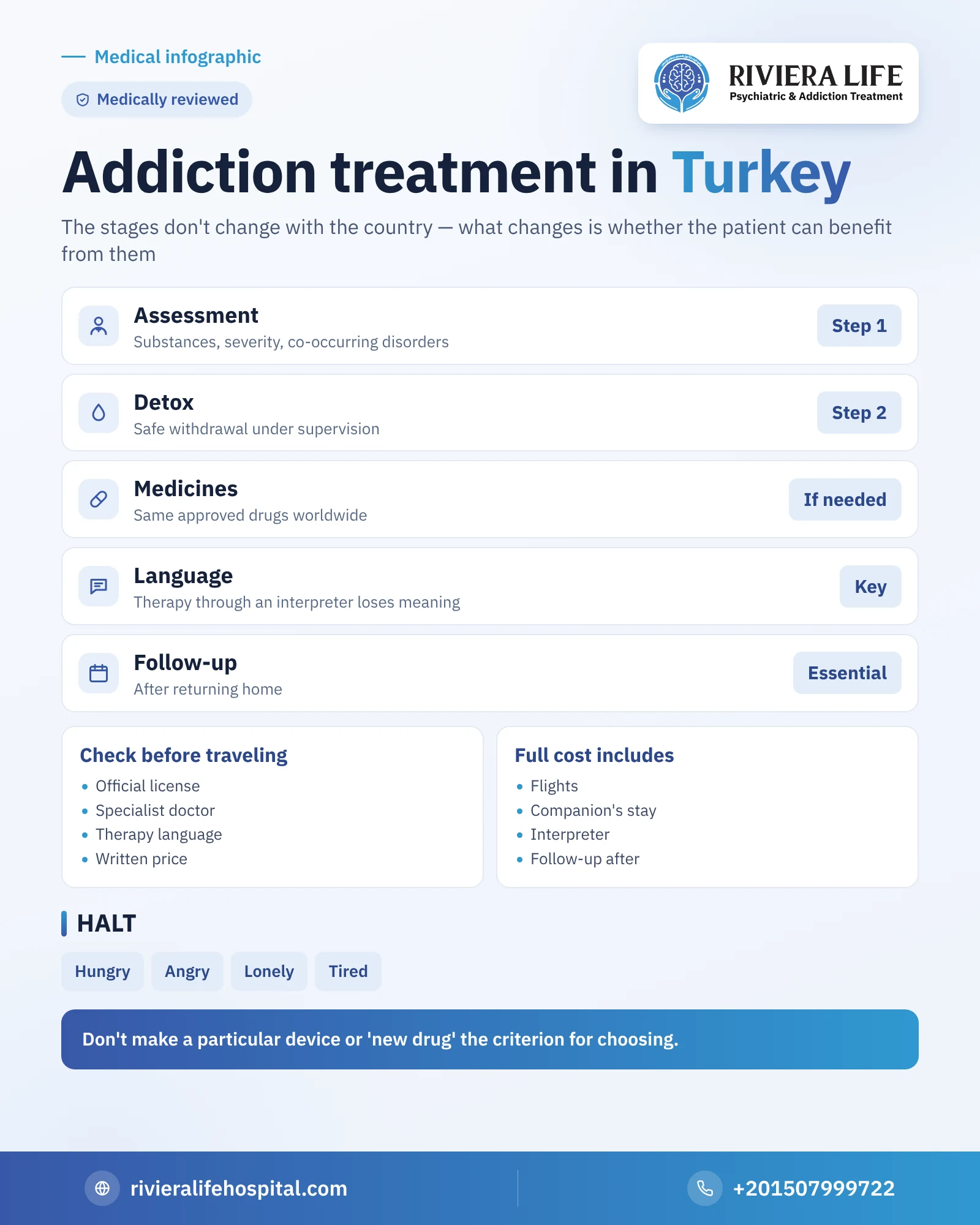
Regardless of the country, integrated treatment goes through successive steps:
- Assessment: a medical and psychological interview and tests to determine the substances, the severity of dependence and accompanying disorders.
- Detox: crossing withdrawal safely under medical supervision.
- Medication treatment when needed: according to the substance and the patient’s condition.
- Psychotherapy and rehabilitation: individual, group and family sessions to build recovery skills.
- Follow-up and relapse prevention: an ongoing plan after discharge.
These stages don’t change with the country. What changes is the patient’s ability to benefit from them, and here language, culture and distance come in. And because many of the families considering Turkey come from Iraq, we have dedicated to them the article on the reality of addiction treatment in Iraq and its alternatives. The stages of addiction treatment themselves don’t change with the country; the difference is in implementation and follow-up.
Language: the factor many overlook
Psychotherapy is based on the patient talking about their fears, relationships and moments of weakness in their own words. When these words pass through an interpreter, part of the meaning is lost, and the patient hesitates to reveal sensitive matters in front of a third person. That is why you should ask any center in Turkey clearly: will the psychotherapist speak with the patient in Arabic directly, or through an interpreter? And how many sessions will actually be in their language?
The same applies to the family; family sessions are part of treatment, and if the mother or father doesn’t understand what the therapist says, they won’t be able to apply it after their son returns home.
Medicines used in addiction treatment
Globally approved medicines are almost the same in most countries, and the doctor chooses between them according to the substance:
- Opioid addiction: buprenorphine and methadone to reduce craving and withdrawal, and naltrexone to block the effect of opioids after withdrawal ends.
- Alcohol addiction: medicines such as naltrexone and acamprosate, and sometimes disulfiram in selected cases.
- Stimulants and hashish: there is still no approved medicine that treats the addiction itself, and treatment relies mainly on behavioral therapy and treating accompanying symptoms.
That is why it isn’t right to choose a place because it advertises a “new medicine” unavailable elsewhere. For details on the role of each medicine with opioids, see opioid addiction treatment.
Do you need advanced brain tests?
Some centers advertise tests such as quantitative brain mapping as an essential part of addiction treatment. In reality, the diagnosis of addiction depends mainly on clinical assessment and tests, and additional investigations may be requested when there is a specific medical reason. So don’t make the presence of a particular device a criterion for choosing, and ask instead about the team’s experience and the quality of psychotherapy.
What do you check before traveling to Turkey?
- The center’s license from the official health authorities, and ask for proof of it.
- The responsible doctor’s specialization in psychiatry and addiction treatment.
- The language of psychotherapy sessions, as we mentioned.
- The details of the program: is it detox only or a full rehabilitation program?
- A written price offer that clarifies what is included and what isn’t.
- The follow-up plan after the patient returns to their country.
The cost of treatment abroad: what do you calculate?
We won’t mention figures, because prices change and differ between one center and another, and can’t be determined accurately without an assessment. But when calculating the cost of treatment in any country outside your own, don’t settle for the price of the program. Add flight tickets, the companion’s stay, an interpreter if you need one, medicines and tests not included, and the cost of follow-up after returning. Then compare the full package between options, not the daily price alone. For the cost items in Egypt in detail, see the cost of addiction treatment in Egypt.
When isn’t travel suitable at all?
Traveling for treatment is a big decision, and doesn’t suit all cases. If the patient is in severe withdrawal, in a psychotic episode, or their physical condition is unstable, the priority is urgent care where they are, then thinking about travel comes after they stabilize. Likewise, if the patient completely refuses treatment, moving them to another country without conviction may end with them leaving the program in its first days. In these cases the first step begins with assessment and dialogue, not with booking a plane.
Drug addiction treatment in Turkey or in Egypt? Comparing the considerations
| Consideration | Turkey | Egypt |
|---|---|---|
| Language of psychotherapy | Need to make sure there is an Arabic-speaking therapist | Arabic is the main language of treatment |
| Cultural closeness | Varies by patient | Close to most Arab families |
| Remote follow-up after returning | Depends on the availability of an Arabic-speaking therapist | Available in the patient’s own language |
| Involving the family | Language may make it difficult | Easier because dialogue is direct |
This isn’t a ranking between two countries, but between the patient’s needs. An Arab living in Turkey who speaks Turkish fluently may easily find suitable treatment there. And if Egypt tips the balance, the steps to start according to your country are explained in the guide to addiction treatment in Egypt for Arab patients.
The family’s role during treatment
The family is an essential partner, even if it is in another country. It needs to understand the nature of addiction, learn how to set limits without cutting off, and take part in sessions dedicated to it. You will find the details of this role in the family rehabilitation program.
How does the patient protect themselves from relapse after returning?
Among the simple, useful tools is a rule known as HALT, which means the patient pays attention to four states that raise craving: hunger, anger, loneliness and tiredness. When they feel one of them, they stop and address it first before it turns into a desire to use. Added to this are regular sleep, physical activity, commitment to follow-up sessions, and a written plan for moments of weakness. And for those who have already relapsed, there is the relapse treatment program.
The right hospital for an Arab patient: how to choose
The right hospital for an Arab patient considering treatment abroad is one that treats them in their language, offers a full program rather than a hotel service, and can follow them after they return home. Ask:
- Is the hospital licensed, and is treatment led by consultants in psychiatry and addiction treatment?
- Are psychotherapy sessions conducted in Arabic directly without an interpreter?
- Does it use globally approved medicines according to the substance, without promises of magic cures?
- Does the program include the family even while it is in another country?
- Is there clear follow-up after returning?
- Is it committed to complete confidentiality?
And beware of any advertisement that guarantees recovery or promises to end addiction in days.
How Riviera Life meets these standards for Arab patients
The details of how Riviera Life applies these criteria are as follows:
- Official license: a hospital licensed by the Egyptian Ministry of Health.
- Treatment in the patient’s language: consultants in psychiatry and addiction treatment who speak with them in Arabic directly.
- Long experience: fourteen years, and thousands of recovered cases.
- Continuous supervision: round-the-clock medical care throughout the stay.
- A family program: sessions for families without a language barrier.
- Aftercare: follow-up after discharge and returning to the home country.
- Complete confidentiality: full protection of the patient’s data.
The first consultation is free, and you can request it from any country around the clock via +201507999722. The hospital is in Sheikh Zayed, Giza.
Read also
- Addiction treatment in Lebanon and relapse prevention
- Addiction treatment in Kuwait and choosing the doctor
- Cognitive behavioral therapy
- The aftercare program
- Addiction treatment in Egypt for Arab patients: a guide by country
Questions many people ask
It may be suitable if there is an Arabic-speaking therapist, an integrated program and follow-up after returning. Relying on an interpreter in sessions weakens psychotherapy.
Globally approved medicines are similar in most countries, such as buprenorphine, methadone and naltrexone. Don't choose a place just because it advertises a new medicine.
Diagnosing addiction doesn't depend on this test; it is based on clinical assessment and tests, and additional investigations are requested when there is a specific medical reason.
It is a reminder of four states that raise the urge to use: hunger, anger, loneliness and tiredness. The patient learns to notice and address them before they turn into craving.
Look for a licensed hospital that treats the patient in their language, offers a full program and provides follow-up after returning. Riviera Life in Egypt meets these criteria.