The short answer
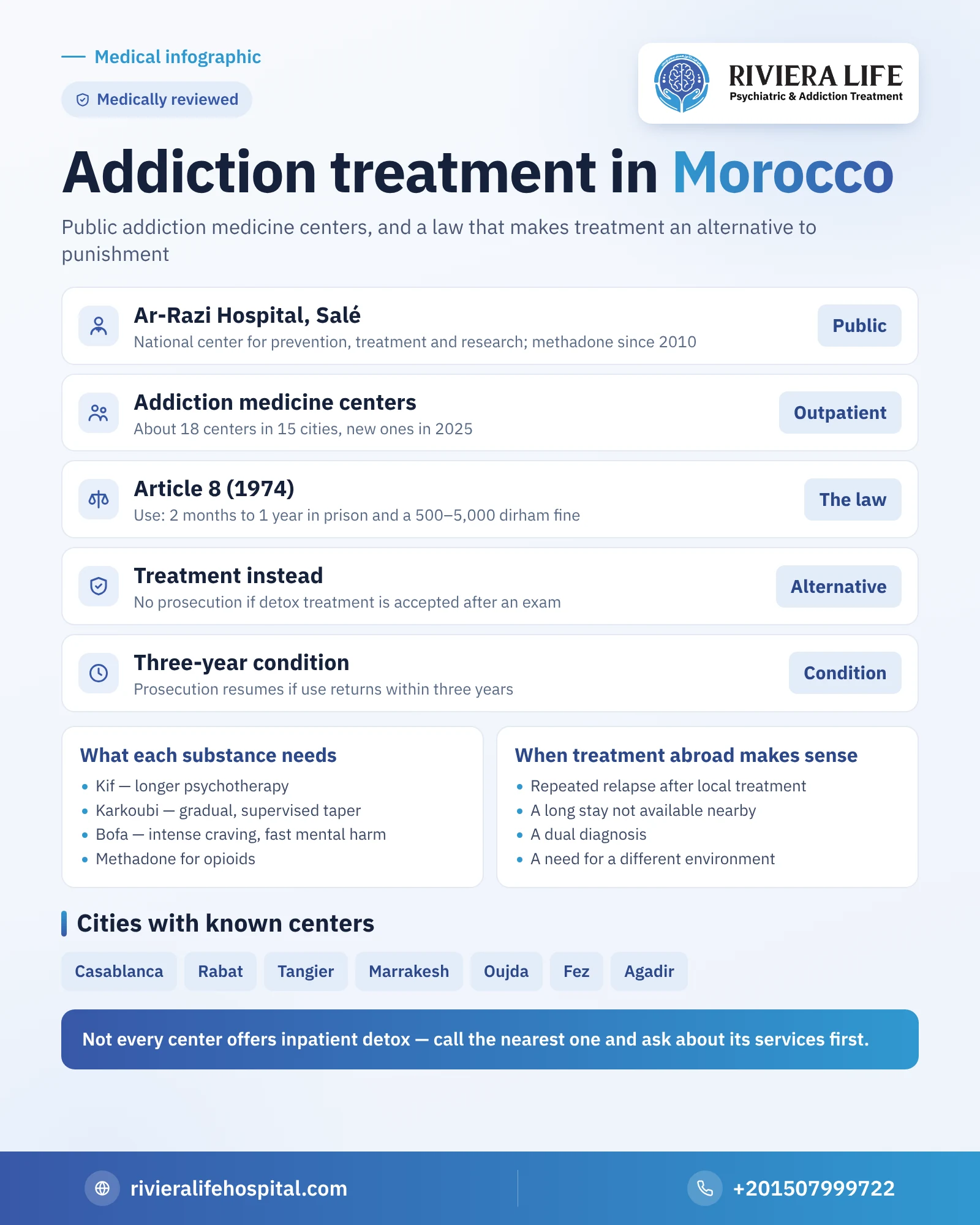
Addiction treatment in Morocco is available through the Ministry of Health’s addiction medicine centers, including the National Center for Prevention, Treatment and Research in Addiction at Ar-Razi Hospital in Salé, with which the methadone treatment program has been linked since 2010, and through a network of addiction medicine centers supported by the Mohammed V Foundation for Solidarity in several cities. The dahir of 21 May 1974 punishes use with two months to a year in prison and a fine, but it allows no prosecution of anyone who agrees, after a medical examination, to undergo detoxification treatment in a treatment institution or a clinic approved by the Ministry of Health.
- Public providersAddiction medicine centers and Ar-Razi Hospital in Salé
- UseTwo months to a year in prison and a fine
- Treatment instead of prosecutionBy accepting detoxification treatment
“Kif” is part of the memory of some Moroccan regions, “karkoubi” is a name that frightens families in the big cities, and “bofa” has entered working-class neighborhoods in recent years. As the substances differ, so do treatment plans. This guide sets out what Morocco offers for addiction treatment, what the law says about treatment instead of prosecution, and when treatment outside Morocco is a sensible option.
Addiction treatment centers in Morocco
Ar-Razi Hospital in Salé
It houses the National Center for Prevention, Treatment and Research in Addiction, one of the first pillars of addiction medicine in Morocco, and is linked with the launch of methadone treatment in 2010 in Rabat, Casablanca and Tangier for patients addicted to opioids.
Addiction medicine centers in the cities
The Mohammed V Foundation for Solidarity, in partnership with the Ministry of Health, supports a network of addiction medicine centers extending to around eighteen centers in fifteen cities, and new centers opened in 2025 in cities including Chefchaouen, Al Hoceima and Beni Mellal. These centers provide assessment, outpatient treatment, and psychological and social support.
Private psychiatric clinics are also available. The rule is that withdrawal from alcohol, sedatives and opioids after long use needs round-the-clock medical supervision. The details of methadone treatment and its alternatives are in our article on methadone.
In which cities are there addiction medicine centers?
Cities with well-known centers include Casablanca (including the Sidi Moumen center), Rabat, Oujda, Nador, Marrakesh, Tetouan and Tangier with more than one center, Fez, Agadir, Meknes and Benslimane, as well as the centers that opened in 2025. Not every center provides inpatient detox: most offer outpatient treatment, psychological support and methadone treatment for those who need it, so call the nearest center and ask about its services and hours before visiting. There is no dedicated national telephone line for addiction.
What does Moroccan law say?
The matter is governed by the dahir of 21 May 1974 on the suppression of addiction to toxic drugs and the prevention of addiction. What matters most to families:
- Article 8 punishes the illicit use of drugs with two months to a year in prison and a fine of 500 to 5,000 dirhams.
- No prosecution takes place if the offender agrees, after a medical examination, to undergo detoxification treatment in a treatment institution or private clinic approved by the Ministry of Health, with an expert doctor following their case until they declare them recovered.
- Prosecution resumes if the person returns to use within three years of their recovery.
- The investigating judge may order treatment after consulting the public prosecutor.
This means the law makes treatment an alternative path to punishment, on condition of seriousness and continuity. Anyone with ongoing legal proceedings should consult a lawyer.
Kif, karkoubi and bofa: what do they mean for treatment?
- Kif is the Moroccan name for hashish and cannabis, and it needs longer psychotherapy for anxiety, insomnia and loss of motivation. Read hashish addiction treatment.
- Karkoubi is a name for “hallucination pills”, most of them sedatives from the benzodiazepine family, which shouldn’t be stopped suddenly after long use. Read Rivotril addiction treatment.
- Bofa is a cheap drug made from cocaine residue, called the “cocaine of the poor”, causing intense craving and rapid psychological harm. Read bofa.
The meanings of the other colloquial names are in drug street names in the Maghreb.
When is treatment outside Morocco a sensible option?
- When relapse recurs after local treatment and the patient needs a different environment.
- When the case needs a long stay that isn’t available close to home.
- When addiction is accompanied by a mental disorder that needs treatment for a dual diagnosis.
If you decide on treatment in Egypt
The journey begins at home: a confidential assessment call with the doctor, in which they learn the type of substance — kif, karkoubi or bofa — and suggest the length of the program. After that the family arranges travel and prepares the reports, and one family member accompanies the patient to the assessment. Before discharge, the team agrees online follow-up with the family after returning to Morocco. To compare options between countries, see addiction treatment in Egypt for Arab patients.
How can Riviera Life help you?
Riviera Life helps Moroccan families understand the difference between treating kif, treating sedative pills and treating bofa, because each has its own plan. It begins with a confidential remote assessment, followed by a treatment program in Egypt for those who decide to travel, and follow-up after returning home. The first consultation is free and confidential on +201507999722.
Read also
- Addiction treatment in Algeria
- Drug street names in the Maghreb
- Addiction treatment for Arabs in Europe and America
- Online addiction treatment
Questions many people ask
Through the Ministry of Health's addiction medicine centers, including Ar-Razi Hospital in Salé, and a network of centers supported by the Mohammed V Foundation for Solidarity in several cities.
Yes. The 1974 dahir allows no prosecution of someone who agrees, after a medical examination, to undergo detoxification treatment in an approved institution or clinic; prosecution resumes if they return to use within three years.