The symptoms of depression in women are essentially the same: persistent sadness or emptiness, loss of pleasure, tiredness, and disturbed sleep and appetite for two weeks or more. But the picture may look different in daily life, hiding behind irritability, headaches or constant exhaustion, and sometimes linked to particular hormonal stages such as the days before the period, pregnancy or the years before menopause. And depression is more common among women than men. Here we explain how you can recognize it, why seeking help is delayed in our society, and what the first step is.
Does women’s depression differ from men’s?
The diagnosis is the same and the criteria are the same, but studies find that women are diagnosed with depression more than men by a clear margin approaching double in some estimates. Part of the difference is biological, linked to hormones, and part psychological and social: double care burdens, higher exposure to some types of stress and violence, and a greater tendency to ruminate on the problem. Women are also more inclined to talk about their feelings, so their depression is sometimes discovered faster, while men’s depression hides behind anger or substances. The full list of general symptoms is in the article on the symptoms of depression.
What does depression look like in a woman’s day?
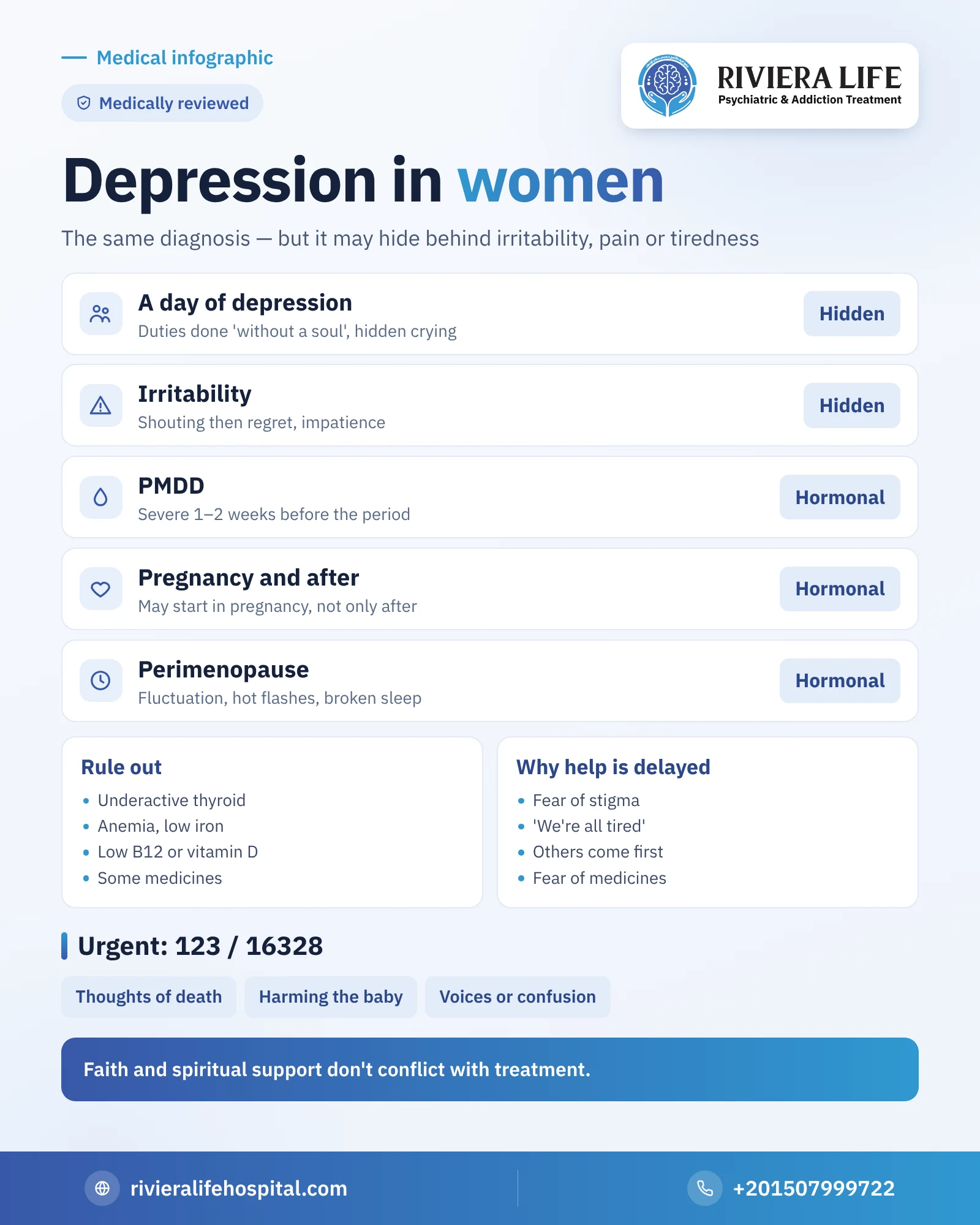
- She does almost all her duties, but “without a soul”, and feels she is playing a role.
- Crying in the bathroom or in the car away from the children.
- Feeling guilty because she is “not a good enough mother” or “a neglectful wife”.
- Exhaustion that doesn’t go away with sleep, and heaviness in the body from the morning.
- A clear increase or decrease in eating, sometimes emotional eating at night.
- Withdrawing from her friends and family occasions with repeated excuses.
- Losing interest in her appearance or in things she used to love.
The hidden forms: irritability and physical complaints
Many women don’t say “I’m sad”. One says: “I’ve started shouting at my children over the slightest thing and then regretting it”, and another says: “I have headaches and pains in my back and stomach, and all the tests are normal”. Excessive irritability, impatience and unexplained physical pains may be the only face of depression. This is where confusion with anxiety happens, a subject we explained in the article on excessive irritability in women. The basic difference is that depression carries with it loss of pleasure, extinguished energy and thoughts of worthlessness, not tension alone. And the two often occur together.
The hormonal stages in which the risk rises
Hormones alone don’t make depression, but big changes in them may reveal an existing predisposition in some women. It helps to link the symptoms to their timing, which helps the doctor a lot.
Premenstrual dysphoric disorder
It isn’t the well-known slight mood swing before the period. In this disorder, severe psychological symptoms appear during the week or two before the period: deep sadness or hopelessness, sharp irritability and arguments, anxiety and tension, and a feeling of losing control, then they improve within a few days of the period starting. The pattern repeats most months and disrupts work and relationships. Diagnosis usually needs daily recording of symptoms for at least two cycles, and it has psychological and medical treatments decided by the doctor.
Pregnancy and after birth
Depression may start during pregnancy itself, not only after it, and is often wrongly interpreted as “pregnancy tiredness”. After birth has its own picture and a separate article explaining the difference between it and the passing baby blues: postpartum depression. Both can be treated with options that take into account the safety of the fetus and breastfeeding.
Perimenopause
The years before periods stop for good, usually in the forties, are a period of clear hormonal fluctuation. The likelihood of depression rises in them even in women who haven’t suffered it before, and it overlaps with hot flashes, night sweats and broken sleep. Many are told that what they are going through is “the change and it will pass”, so the assessment is delayed. The truth is that mood symptoms at this stage deserve a psychological assessment and a gynecologist’s assessment together.
Life stresses that affect women more
Away from hormones, there are experiences that often stand behind a woman’s depression and go unnoticed. Delayed childbearing and its repeated treatments, with the questions and looks of relatives that accompany it. Miscarriage or losing a fetus, a grief whose owner is often asked to “forget it quickly”. Caring for an elderly father or mother for years alongside work and children.
Divorce or widowhood and the financial and social change that follows them. And living in a relationship with constant humiliation or control. Having any of these experiences doesn’t mean the sadness is an illness, but it is an extra reason to take the symptoms seriously if they last or weigh heavily. We explained the difference between normal sadness and depression in the article on sadness vs depression.
Physical causes that should be ruled out
Before confirming the diagnosis the doctor usually asks for simple tests, because some conditions common in women cause symptoms resembling depression: an underactive thyroid, anemia and iron deficiency, and vitamin B12 or vitamin D deficiency in some cases. Some medicines may affect mood in some women, sometimes including hormonal contraceptives, and the doctor assesses this without you stopping any medicine yourself. The factors that raise the risk in general are explained in the article on the causes of depression.
Why are Egyptian women late in seeking help?
- Fear of stigma: worry about being called “mentally ill”, and its effect on marriage chances or the view of the husband’s family.
- Playing down the symptoms: phrases such as “we’re all tired”, “it’s just being spoiled” or “get closer to God and you’ll be fine”.
- Others’ priority: the mother puts the children, husband and family before herself, and postpones until she collapses.
- Financial dependence or needing permission: some women need the family’s approval or funding to go to a doctor.
- Non-medical explanations: linking the symptoms only to envy or possession, and delaying treatment while waiting on them.
- Fear of medicines: the belief that all psychological treatment means a medicine that causes addiction, which isn’t true.
And faith and spiritual support don’t conflict with treatment; many women find support in them during recovery.
What do you do if you feel these symptoms?
- Write down the symptoms for two weeks: sleep, mood, energy, and their link to the timing of the period if any.
- Talk to one person you trust, who doesn’t have to be from the family.
- Ask for an assessment from a psychiatrist, who alone determines the diagnosis, and this can be done in complete confidentiality.
- If you are pregnant, breastfeeding or thinking about pregnancy, tell the doctor, as this changes the choice of treatment.
- Don’t wait to “put up with it” until you collapse; early treatment is usually shorter and easier.
Treatment includes psychotherapy and sometimes medicine, and its details are in the article on depression treatment. And there are options for those who prefer to start without medicines in mild cases, which we explained in the article on treating depression without medication.
Seek urgent help immediately if you have
Call an ambulance on 123 or go to the nearest emergency department, and you can seek guidance from the mental health hotline 16328.
- Thoughts of death or self-harm
- Thoughts of harming the baby after birth
- Confusion, hearing voices or strange thoughts
How do the husband and family support her?
The simplest thing that helps: believe her. Don’t compare her with others, and don’t reduce what she is going through to “household stress”. Take some of the tasks off her in a practical way, such as looking after the children for an hour a day so she can sleep or go out, and go with her to the first appointment if she wants. And ask her how she wants to be helped instead of assuming what she needs.
How does Riviera Life help you?
We know the first step may be the hardest for a woman. At Riviera Life in Sheikh Zayed, the consultant psychiatrists assess the symptoms in the context of the hormonal stage and family circumstances, and set a plan that takes pregnancy and breastfeeding into account when needed, in complete confidentiality. The first consultation is free on +201507999722.
More from the depression guide
- Depression: the complete guide
- Postpartum depression
- Excessive irritability in women
- The symptoms of depression
- Depression in men: the hidden mask of anger, work and substances
- Menopause and mental health: mood swings or depression? And what helps
Questions many people ask
The effect of hormonal changes combines with psychological and social factors such as care burdens and chronic stress. Women also talk about their feelings more, so they are diagnosed faster.
The disorder is much more severe; it causes intense sadness or irritability that disrupts work and relationships in the days before the period, then improves after it starts. Recording symptoms daily for two cycles helps the doctor diagnose it.
Yes, it may start during pregnancy, not only after birth, and it is often thought to be pregnancy tiredness. It can be treated with options that take the fetus's safety into account.
The risk of depression may rise in the years before menopause because of hormonal fluctuation and disturbed sleep. Mood symptoms at this stage deserve assessment, not just the assumption that they will pass.
Yes, irritability and impatience may be the clearest face of depression, especially if accompanied by loss of pleasure and exhaustion. The psychiatrist determines the diagnosis.