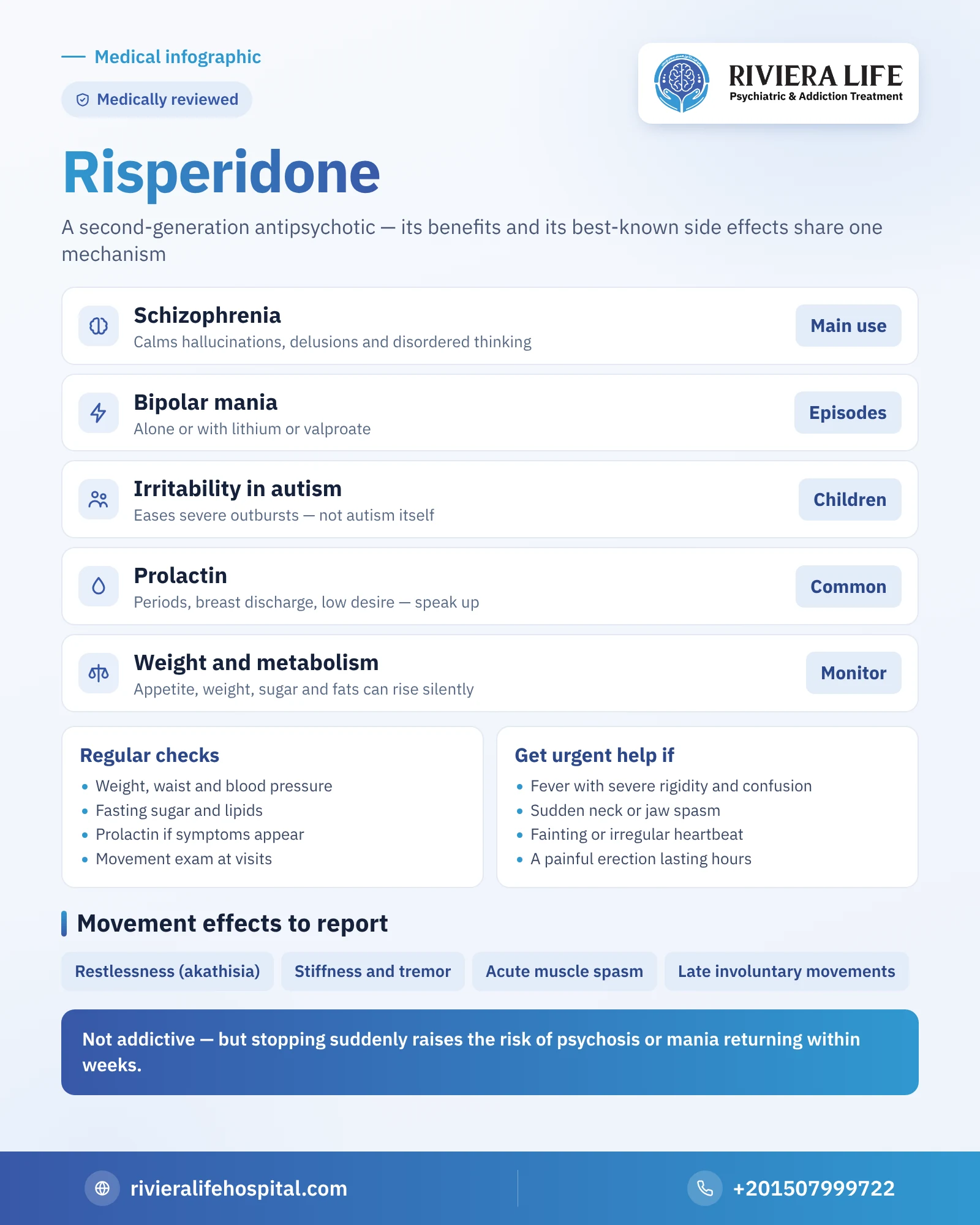
Risperidone is a second-generation antipsychotic, known in pharmacies by its best-known brand name Risperdal and by many equivalent names. A psychiatrist prescribes it mainly to treat schizophrenia, manic episodes in bipolar disorder, and episodes of severe irritability accompanying autism spectrum disorder in children and adolescents.
The medicine works well for many patients, but it has effects that need special attention, most notably raised prolactin, involuntary movements and weight gain. Here we explain who risperidone is prescribed for, how it works, what the family should watch for, and what tests the doctor requests. You won’t find any doses in this article: starting, adjusting and stopping the medicine happen only with the doctor who prescribed it.
What is risperidone?
Risperidone belongs to the family of atypical antipsychotics — the medicines that appeared after the first generation, such as haloperidol, with the aim of treating psychotic symptoms while reducing the stiffness and tremor the older medicines were known for. It comes as tablets, tablets that dissolve in the mouth and a syrup, and there are also long-acting injections given in the clinic at spaced intervals, useful for a patient who forgets or refuses their tablets.
You will find a wider look at this whole family, and the differences between its members, in our article on antipsychotics, while this article focuses on risperidone alone.
What is risperidone used for?
Schizophrenia
This is the main use. The medicine helps calm hallucinations, delusional ideas and disordered thinking, and the positive symptoms usually improve faster than social withdrawal and low motivation. It is part of a plan that includes psychotherapy, rehabilitation and family support, as we explain in our article on schizophrenia treatment.
Manic episodes in bipolar disorder
It is used alone or with a mood stabilizer such as lithium or valproate to control a manic episode: little sleep, pressured speech, impulsivity and inflated ideas. The doctor then decides whether the medicine continues into the prevention stage or is replaced; the details of the full plan are in our article on bipolar disorder treatment.
Irritability accompanying autism spectrum disorder
In some children and adolescents with autism, severe tantrums, aggression or self-harm appear that don’t respond to behavioral methods alone. Here the doctor may turn to risperidone to ease this irritability — not to treat autism itself — while the behavioral and educational interventions that remain the cornerstone continue.
How does risperidone work in the brain?
The medicine blocks type 2 dopamine receptors and a type of serotonin receptor. Blocking dopamine in the pathways linked to psychosis is what calms hallucinations and delusions. But dopamine also works elsewhere: in the pathway that controls movement, and in the pathway that controls the release of prolactin from the pituitary gland. So the two mechanisms behind its best-known side effects are the same mechanism as its benefit, just in different places in the brain.
Risperidone and the hormone prolactin
Among the common antipsychotics, risperidone is one of those that most raise prolactin. This hormone is responsible for milk production, and when it rises outside breastfeeding it can show itself in ways patients are embarrassed by and don’t mention to the doctor:
- In women: disturbed or absent periods, and discharge from the breast.
- In men: breast enlargement, and weak desire or erections.
- In both sexes: lower sexual desire, and in the long term bone building may be affected.
This doesn’t mean every patient will suffer from it, nor that the solution is to stop the medicine. The doctor may request a prolactin test, then choose between adjusting the plan or moving to a medicine with less effect on this hormone. What matters is that you speak up: these are expected symptoms, and they have solutions.
Movement effects: from restlessness to tardive dyskinesia
Although the second generation is gentler than the first in this respect, risperidone can cause movement symptoms, especially at higher doses:
- Akathisia: an unpleasant inner feeling of being unable to sit still, so the patient stands and sits and shakes their feet. The family may wrongly read it as anxiety or relapse.
- Parkinson-like symptoms: slow movement, stiffness, tremor and a face with little expression.
- Acute dystonia: a sudden spasm in the muscles of the neck, eyes or jaw, usually in the first days, which needs rapid medical intervention.
- Tardive dyskinesia: repeated involuntary movements of the mouth, tongue and face that appear after long use, and may continue even after stopping. That is why the doctor checks movement regularly, to detect it early.
Weight gain, sugar and fats
Risperidone increases appetite and weight in many patients, though usually less than some members of its family such as olanzapine. Over time, blood sugar, triglycerides and cholesterol may rise. These changes are silent, so the patient doesn’t feel them until they build up. That is why good monitoring starts before the medicine itself, and continues with regular measurement of weight and waist, with practical advice on eating and movement in which a family member takes part.
Monitoring and periodic tests
| What is monitored | Why |
|---|---|
| Weight, waist circumference and blood pressure | To detect metabolic changes early |
| Fasting blood sugar and lipids | Because the medicine can raise them silently |
| Prolactin when its symptoms appear | To explain disturbed periods, discharge or weak desire |
| A movement examination at almost every visit | To detect akathisia and tardive dyskinesia |
| An ECG when there are risk factors | Because some antipsychotics affect heart rhythm |
| Height and weight in children | To follow growth and appetite |
Special warnings
- Older people with dementia: antipsychotics carry an official warning of an increased risk of death and stroke when used to treat behavioral disturbances linked to dementia.
- Dizziness on standing: blood pressure may drop on getting up quickly, especially at the start, increasing the risk of falls.
- Drowsiness: avoid driving until you know how the medicine affects you.
- A long, painful erection: a rare but urgent effect that needs the emergency department.
- Heat: it can weaken the body’s ability to regulate its temperature, so take care on hot summer days.
- Pregnancy and breastfeeding: a joint decision with the doctor that balances the mother’s stability with the child’s safety.
Among the rare, serious effects is neuroleptic malignant syndrome, a reaction combining fever, severe rigidity and disturbed consciousness.
Get urgent help immediately if you see
Call an ambulance on 123 or go to the nearest emergency department if someone taking risperidone shows:
- A high temperature with severe muscle rigidity, sweating and confusion
- A sudden spasm of the neck or jaw, or difficulty swallowing or breathing
- Fainting or severe, irregular palpitations
- A painful erection lasting hours
- Deep drowsiness or difficulty waking after taking too much
- Thoughts of harming themselves or others
Is risperidone addictive?
Risperidone doesn’t produce a high or drive people to take more, and isn’t known to cause addiction. But stopping it suddenly can cause discontinuation symptoms such as insomnia, nausea and tension, and more seriously it raises the likelihood of psychosis or mania returning within weeks. Many of the relapses we see begin with the sentence “I felt I was fine, so I stopped it.” That is why any reduction is gradual and follows the doctor’s plan.
Risperidone, drugs and alcohol
Alcohol, hashish and sedatives increase drowsiness and dizziness, and more importantly, hashish and stimulants can reignite the psychotic symptoms the medicine is trying to quell. A patient who combines psychosis and substance use needs a plan that treats both together, not each treated in a separate place.
Questions to ask your doctor
- What do we expect to improve first, and when do we judge the medicine?
- Do I need tests before starting, and how often should I repeat them?
- What should I do if restlessness, disturbed periods or weak desire appear?
- Is the long-acting injection suitable for my case?
- How long will I stay on it, and how will stopping work if it is decided?
How can Riviera Life help you?
If your relative is taking risperidone and you don’t feel things are improving, or the side effects have worn them down so they now refuse the medicine, book a free first consultation with a consultant psychiatrist at Riviera Life in Sheikh Zayed. We review the diagnosis, medicines and tests, and set a plan that combines medication, psychotherapy and family support, with round-the-clock medical supervision and complete confidentiality.
More from our psychiatric medicines guide
- Psychiatric medicines: a guide to types and uses
- Antipsychotics: types and side effects
- Quetiapine (Seroquel)
- Schizophrenia: the complete guide
- Sulpiride (Dogmatil): uses, prolactin and warnings
Questions many people ask
It is an antipsychotic, not a sleeping pill, though it can cause drowsiness in some patients as a side effect. It isn't used to treat insomnia or mild anxiety.
Agitation and insomnia may settle within days, while hallucinations and delusions usually take weeks to recede. The doctor assesses the response in stages and doesn't judge from the first days.
Raised prolactin can disturb ovulation or sexual desire, and this usually improves when the plan is adjusted. Discuss your wish to have children with your doctor before any change.
The doctor may prescribe it to ease severe irritability and aggression, not to treat autism itself. The child needs monitoring of weight, height, appetite and movement.
The substance is the same, but the injection is given in the clinic at spaced intervals, so it suits those who forget or refuse tablets. The doctor decides which suits the case.