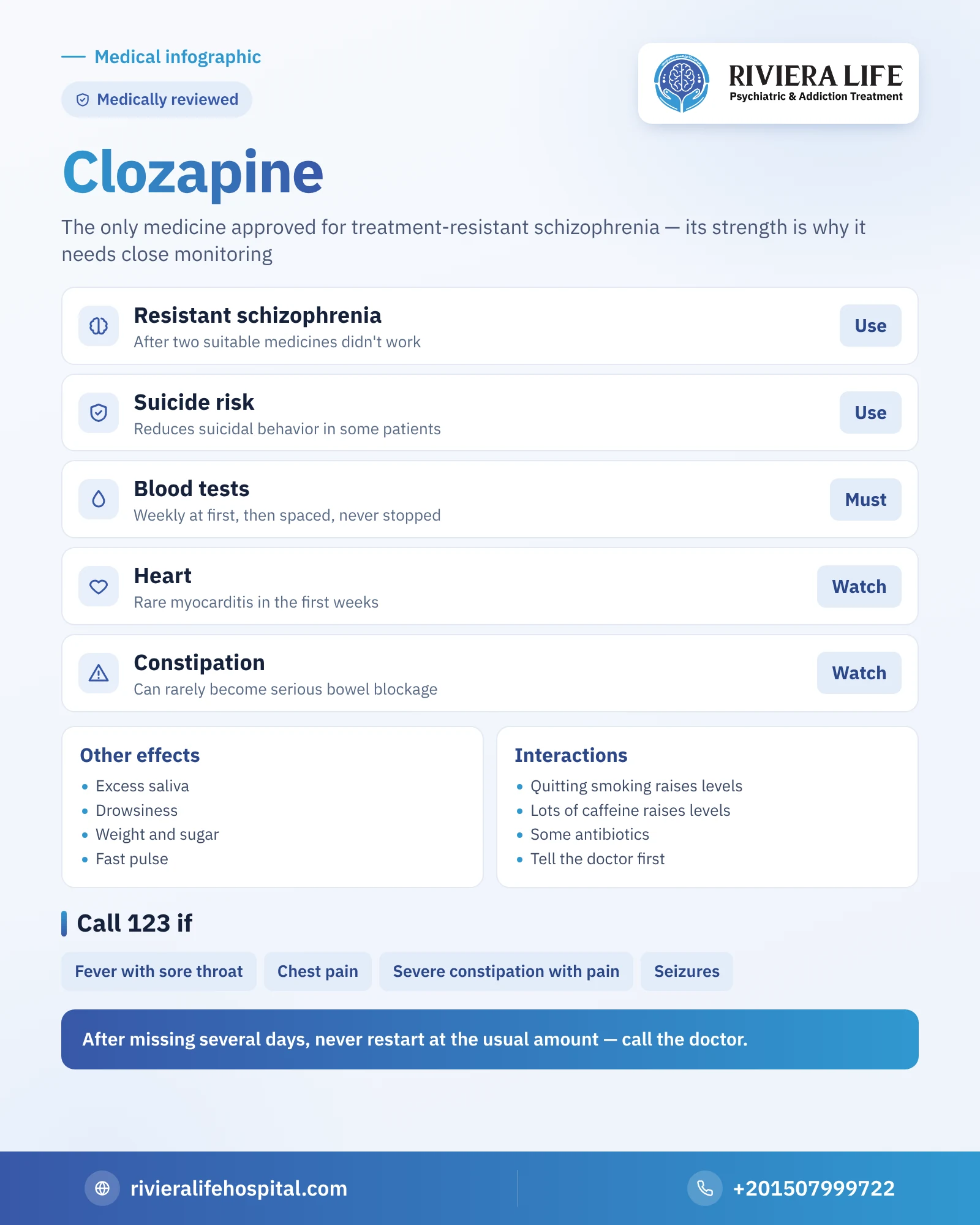
Clozapine is the antipsychotic a psychiatrist turns to when other medicines fail to control schizophrenia, and it is the only medicine approved for what is called “treatment-resistant schizophrenia”. It is known by brand names such as Clozaril and Leponex. It is only prescribed with close follow-up, because it has special requirements, the most important being regular blood tests.
Its particular strength is the reason for all the caution surrounding it: it requires regular blood tests because it has a rare but serious effect on white blood cells, and it needs attention to the heart and bowel. Here we explain who it is prescribed for, what is monitored, and what the patient and their family notice. There are no doses in this article, as every step from starting the medicine to adjusting or stopping it is done under the supervision of the doctor who prescribes it.
What is clozapine and why is it reserved for particular cases?
Clozapine is an atypical antipsychotic, and the oldest of its generation. It didn’t become the first choice for a simple reason: its follow-up requirements. So the doctor doesn’t usually start with it before trying two other antipsychotics for a sufficient period and with sufficient regularity without a satisfactory response. This order is deliberate, as a medicine that requires blood to be drawn every week at first isn’t imposed on someone who could improve with a simpler medicine. If you want the general picture of the whole family, our article on antipsychotics explains the differences between its members.
What is clozapine used for?
Treatment-resistant schizophrenia
When hallucinations and delusions persist despite two suitable medicines taken regularly, clozapine enters the picture. Studies indicate that it helps a considerable proportion of those whom other medicines didn’t help, although the effect appears slowly over weeks or even months, so it isn’t judged from the first days. Schizophrenia itself and its full plan are covered in our article on schizophrenia treatment.
The risk of self-harm in schizophrenia
One of this medicine’s documented uses is reducing the risk of suicidal behavior in some patients with schizophrenia and schizoaffective disorder who have this risk. This is an advantage that other antipsychotics don’t share to the same degree, and it makes the doctor hold on to it despite its difficulties.
Other uses decided by the doctor
Doctors may sometimes use it for psychosis accompanying Parkinson’s disease when other options aren’t suitable, or in resistant manic states. These are specialist decisions taken only by the consultant.
Blood first: why regular tests?
In a small proportion of patients clozapine can lower the number of white blood cells called neutrophils, the first line of defense against germs. If the count falls sharply (what is known as agranulocytosis), the body becomes vulnerable to serious infection. The good news is that this effect can be detected with a simple test before any symptoms appear, which is the reason for the well-known monitoring system:
- A blood test before starting to confirm the baseline count is normal.
- Weekly tests during the first months, because the risk is concentrated then.
- Then the tests are gradually spaced out, but they don’t stop as long as the patient is on the medicine.
If the count falls below the safe limit, the doctor stops the medicine and follows the patient closely, and the count usually returns to normal after stopping. The most important thing for the family is to keep to the test appointment however well the patient seems, and not to neglect any fever or sore throat.
The heart: inflammation of the muscle in the first weeks
Another rare effect is inflammation of the heart muscle, which usually occurs in the first weeks of treatment. It sometimes starts with flu-like symptoms: fever, tiredness, chest pain, palpitations and shortness of breath. That is why in the first stage doctors monitor the pulse and signs of inflammation, and may request heart tests. Someone with previous heart disease needs assessment before starting. Apart from inflammation, the medicine may cause a rapid pulse and a drop in blood pressure on standing quickly, both more common and less dangerous.
Constipation: the effect people underestimate
Contrary to what many think, constipation with clozapine isn’t a marginal nuisance. The medicine slows bowel movement to a degree that may, in rare cases, reach a dangerous bowel obstruction. That is why prevention enters the plan from day one:
- Plenty of fluids, fiber and daily movement.
- Paying attention to how often the bowels open, and not settling for asking “are you OK?”.
- Telling the doctor early so a suitable laxative is prescribed, rather than waiting days in pain.
Other common effects
| Effect | What the patient notices | What can be done |
|---|---|---|
| Excess saliva | A wet pillow at night and pooling saliva | The doctor discusses options that ease it |
| Drowsiness and sedation | Sluggishness in the morning | The doctor may adjust the timing of the medicine |
| Weight gain and raised sugar | Increased appetite and thirst | Regular measurement of weight, sugar and fats |
| Seizures | Rare and linked to high levels | Reported to the doctor immediately |
| Rapid pulse | Palpitations, especially on exertion | Monitoring pulse and blood pressure |
Important interactions: coffee and smoking
The level of clozapine in the blood is sensitive to many habits patients overlook. Smoking speeds up the medicine’s breakdown in the liver, so if a smoker suddenly quits, the medicine’s level in their blood rises and side effects or toxicity may appear. Coffee and caffeine in large amounts may also raise the level, as may some antibiotics and other medicines. The practical rule: tell the doctor before any change in smoking, caffeine or any new medicine, even a prescription for a passing illness. And if the patient wants to quit smoking, which is a good decision, let it be with a medical plan that takes the medicine level into account.
Don’t restart the medicine on your own after a break
If the patient has stopped clozapine for several days, resuming it the same way as before may cause a sharp drop in blood pressure or fainting, because the body has lost its tolerance. So the medicine is adjusted again from the start under the doctor’s supervision. And if the family or the patient forgot the medicine for several days, contacting the doctor first is the right step, not automatically going back to it.
Call an ambulance on 123 immediately if you see
Or go to the nearest emergency department if someone taking clozapine shows:
- High fever with a sore throat or chills
- Chest pain, severe palpitations or shortness of breath
- Severe constipation with bloating, abdominal pain and vomiting
- Seizures or fainting
- Deep drowsiness or difficulty waking after taking an extra amount
- Thoughts of self-harm — for psychological support, also call the mental health hotline on 16328
Does clozapine cause addiction?
No. Clozapine doesn’t give a high and isn’t known to cause psychological dependence. Even so, stopping it suddenly is dangerous in itself: psychosis may return severely, and discontinuation symptoms such as nausea, sweating, insomnia and irritability may appear. Reduction, if decided, is gradual and follows the doctor’s plan. For more on the question of dependence on psychiatric medicines in general, see our article are psychiatric medicines addictive?.
Clozapine with substance use
Hashish and stimulants inflame psychotic symptoms, and alcohol and sedatives double the sedation and increase the risk of depressed breathing and low blood pressure with this medicine in particular. Someone who has both schizophrenia and substance use needs a plan that treats both together; we have detailed this in our article on schizophrenia and addiction.
Questions to ask your doctor
- Why did you choose clozapine for my case after what we tried? And what do we expect, and when?
- Where do I have the test, how will I get the result, and what do I do if it is late?
- What danger signs can’t wait?
- How do I deal with constipation, excess saliva and drowsiness?
- Do I need to adjust coffee, smoking or my other medicines?
How can Riviera Life help you?
Schizophrenia that hasn’t responded to multiple medicines needs a fresh assessment, not despair. At Riviera Life in Sheikh Zayed, the consultant psychiatrist reviews the diagnosis, the previous medicines and the patient’s adherence to them, and the free first consultation is available in complete confidentiality. And when starting a medicine that needs close follow-up is required, round-the-clock medical supervision and the family program lighten the burden for everyone.
More from our psychiatric medicines guide
- Antipsychotics: first and second generation, side effects and follow-up
- Risperidone
- Olanzapine
- Schizophrenia: the complete guide
- Chlorpromazine (Neurazine): uses and side effects
Questions many people ask
Because in a small proportion of patients it may lower the number of white blood cells called neutrophils, an effect that can be detected by testing before symptoms appear. Tests are weekly at first, then spaced out.
It is the most effective in those who haven't responded to two suitable medicines, but it isn't first-line because its follow-up is heavier. The doctor decides this according to the case.
Smoking speeds up the medicine's breakdown in the liver, so if a smoker stops, the medicine's level in the blood rises and side effects may appear. So the doctor is told before quitting to adjust the plan.
They don't restart the medicine at the usual amount on their own, because the body may have lost its tolerance and blood pressure may drop. They contact the doctor, who restarts it gradually.
It isn't known to cause addiction or a high. But stopping it suddenly may bring psychosis back severely and cause discontinuation symptoms, so reduction is gradual under the doctor's supervision.