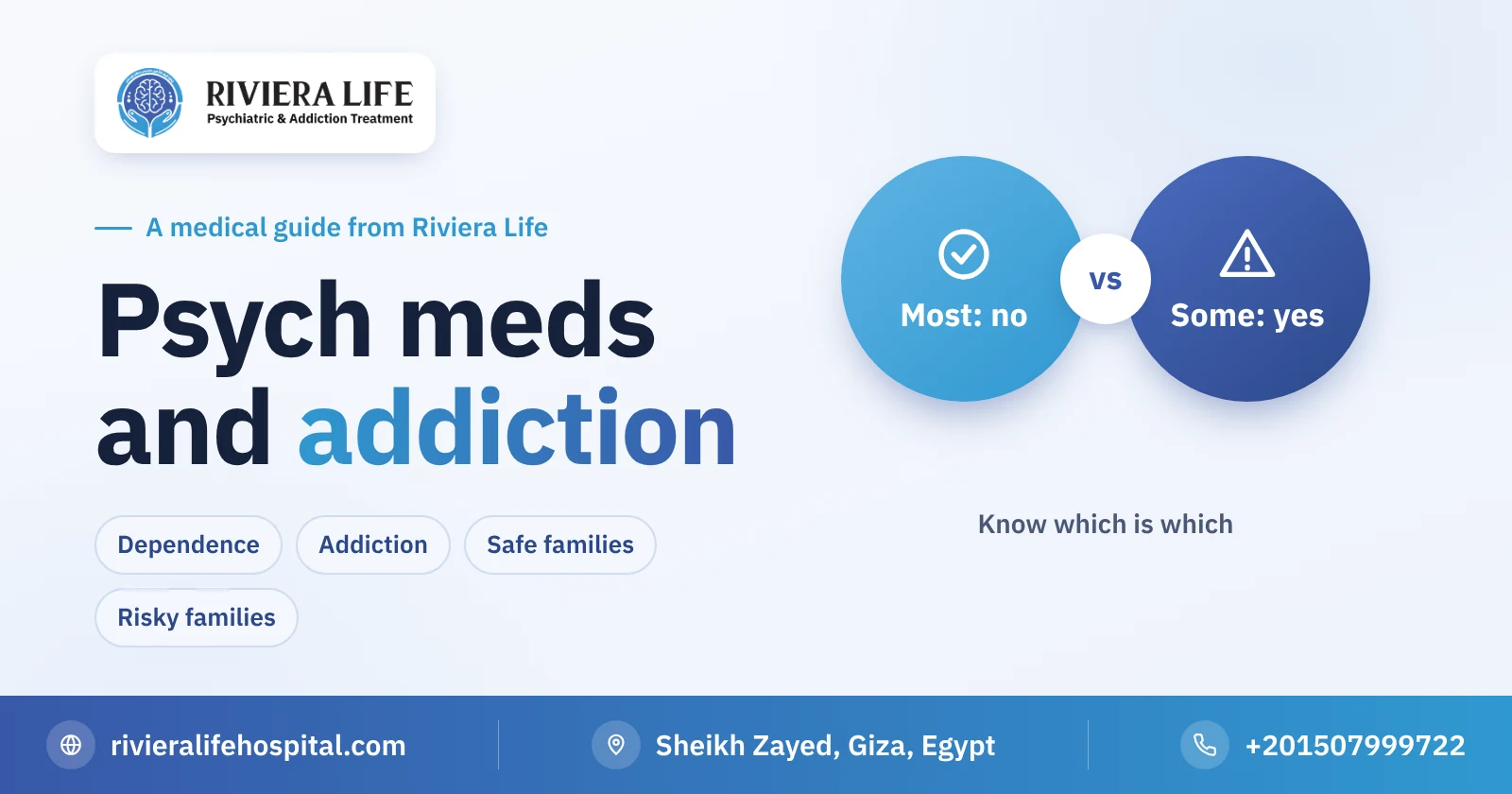
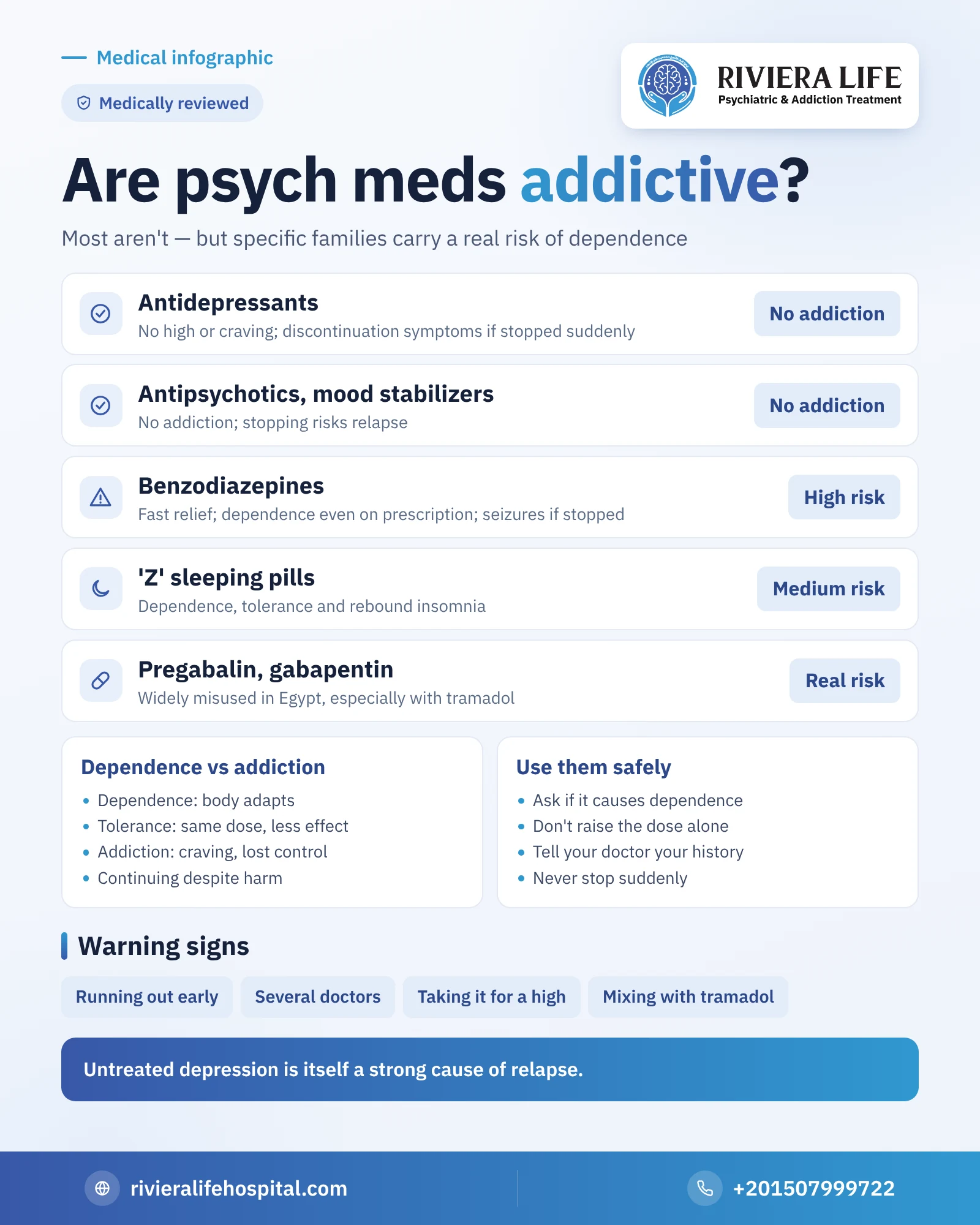
Are psychiatric medicines addictive? The short answer: most aren’t. Antidepressants, antipsychotics and mood stabilizers don’t cause addiction, because they don’t give a high or push toward increasing the amount. But there are specific families that do carry a risk of dependence and addiction: sedatives from the benzodiazepine class, “Z” sleeping pills, stimulants, and pregabalin and gabapentin. And even medicines that are safe in this respect may cause discontinuation symptoms if stopped suddenly, which is something different from addiction. In this article we draw the dividing line clearly, and explain how to use your medicine safely with your doctor.
Why are people afraid of psychiatric medicines?
In many Egyptian homes, the sentence “he’ll get hooked on pills” is said as soon as someone leaves a psychiatrist’s clinic with a prescription. Part of this fear has a real basis; people have seen relatives become attached to sedatives or pregabalin, and heard about young people using prescription medicines. But the mistake is generalizing one family of medicines’ story to everything the psychiatrist prescribes. This generalization leads many patients to refuse safe treatment they need, or abandon it halfway.
The difference between physical dependence and addiction
This is the key to the whole subject, and the source of most of the confusion:
- Physical dependence: a natural adaptation of the body to a medicine taken regularly, so if it stops suddenly, discontinuation symptoms appear. It happens with many medicines unrelated to psychiatry, such as blood pressure medicines and some cortisone medicines.
- Tolerance: the effect of the same amount decreasing over time, so the person needs a larger amount to get the same effect.
- Addiction: a behavioral disorder characterized by craving the substance, loss of control over its use, continuing despite harm, and life becoming taken up with getting it.
A patient who has taken an antidepressant for a year may suffer dizziness if they forget it for days, but they don’t crave it or look for a larger dose. Someone dependent on a sedative, however, may have both dependence and tolerance, and it may develop into full addiction.
Medicines that don’t cause addiction
Antidepressants
Such as sertraline and escitalopram. No high and no tolerance that pushes toward increasing the amount, but stopping suddenly may cause a discontinuation syndrome. Read about it in our article on antidepressant withdrawal symptoms.
Antipsychotics
They don’t cause addiction; in fact many patients dislike their sedating effect and wish they could stop them. We explained their monitoring in our article on antipsychotics.
Mood stabilizers
Such as lithium and lamotrigine, which carry no risk of addiction, but stopping them suddenly may bring back episodes of mania or depression.
Medicines that carry a risk of dependence and addiction
Benzodiazepines
Such as alprazolam (Xanax), clonazepam (Rivotril) and diazepam. They act quickly on GABA receptors and give an immediate feeling of relief, which is exactly what makes them easy to become attached to. Physical dependence occurs with them even when following the prescription if the period is long, and stopping them suddenly after long use may cause seizures. The details are in our guide to benzodiazepines and our article on Xanax addiction.
“Z” sleeping pills
Such as zolpidem, designed to be a lighter alternative to sedatives, but they may cause dependence, tolerance and rebound insomnia on stopping if used for long periods. See our article on zolpidem addiction treatment.
Stimulants
Stimulant ADHD medicines are relatively safe for someone genuinely diagnosed who uses them under follow-up. The real danger lies in using them without a diagnosis to stay awake, lose weight or “boost concentration”, or by routes other than those prescribed.
Pregabalin and gabapentin
Two medicines for epilepsy and nerve pain, and pregabalin is used for anxiety in some countries. In Egypt pregabalin has become one of the most misused medicines, especially with tramadol. They cause dependence and withdrawal symptoms, and combining them with opioids increases the risk of suppressed breathing. The details are in our article on pregabalin addiction treatment.
A grey area: safe medicines that may be misused
The picture isn’t completely black and white. Some medicines not classified as addictive may be misused in certain circumstances, such as some sedating antipsychotics that some people take to sleep or to ease the effect of drugs, some older antidepressants such as Tryptizol, and anticholinergics such as Parkinol. The common factor here is that misuse happens outside the medical prescription, usually in someone with a history of drug use.
Comparison table
| Family | High or craving | Symptoms on sudden stopping | Addiction risk |
|---|---|---|---|
| Antidepressants | No | Yes, usually mild to moderate | No |
| Antipsychotics | No | Sometimes, with a risk of relapse | No |
| Mood stabilizers | No | Risk of episodes returning | No |
| Benzodiazepines | Yes | Yes, and they may be dangerous | High |
| “Z” sleeping pills | Sometimes | Rebound insomnia and anxiety | Medium |
| Stimulants | With misuse | Exhaustion and low mood | Present |
| Pregabalin and gabapentin | Yes, with misuse | Yes | Present |
Signs that use has turned into a problem
- Taking a larger amount than prescribed, or before it is due.
- Moving between more than one doctor or pharmacy to get the medicine.
- Taking the medicine to get “high” rather than for treatment.
- Combining it with alcohol, tramadol or hashish.
- Intense anxiety as the box approaches running out.
- Hiding the real amount from the doctor or family.
And if you notice these signs in a family member with sedatives, our article on benzodiazepine addiction symptoms helps you read the picture.
How do you use psychiatric medicines safely?
- Ask your doctor frankly at the first prescription: does this medicine cause dependence? And what is the expected duration?
- Stick to the amount and timing as the doctor wrote them, and don’t increase on your own when you have a hard day.
- Tell the doctor about any previous history with drugs or alcohol, as this changes their choice of medicine.
- Ask for sedatives and sleeping pills to be for a set period from the start, with a clear plan for afterward.
- Don’t stop any psychiatric medicine suddenly, and don’t make the decision to stop alone.
- Keep medicines that can be misused away from teenagers in the home.
Safe stopping: why isn’t it sudden?
Gradual reduction gives the body time to adapt again. With antidepressants, tapering reduces discontinuation symptoms; with mood stabilizers and antipsychotics, it reduces the risk of relapse; and with sedatives, it protects against serious complications such as seizures. Tapering differs according to the medicine and how long it stays in the body, which we explain in our article on how long psychiatric medicines take to leave the body.
If you are recovering from addiction and need a psychiatric medicine
Many people in recovery suffer from depression, anxiety or insomnia, and fear that any medicine will take them back to square one. This fear is understandable, but leaving depression or anxiety untreated is one of the strongest causes of relapse itself. The solution is careful selection: with these patients the doctor prefers medicines that carry no risk of dependence, such as antidepressants, and avoids sedatives, sleeping pills and pregabalin as far as possible, or uses them for a very limited period and under supervision. It is important for the doctor to know your full history frankly, and for the family to keep the medicine and follow adherence to the prescription in the first months. Our article on depression and addiction explains the link between the two problems.
Call an ambulance on 123 immediately if you see
On suddenly stopping a sedative or sleeping pill after long use, or when combining it with other substances:
- Seizures
- Severe confusion or hallucinations
- Slow or difficult breathing, or blue lips
- Deep drowsiness and difficulty waking
How can Riviera Life help you?
If you fear your medicine will cause you addiction, the free first consultation at Riviera Life answers your question about your medicine specifically. And if dependence on a sedative, sleeping pill or pregabalin has already happened, gradual withdrawal is done in hospital under round-the-clock medical supervision, along with treating the anxiety or insomnia that started the story, in complete confidentiality.
More from our psychiatric medicines guide
- Benzodiazepines: the complete guide
- Psychiatric medicines: types and uses
- Antidepressant withdrawal symptoms
- Pregabalin addiction treatment
Questions many people ask
Yes, they are benzodiazepines that carry a risk of dependence and addiction, especially with long-term use or use outside the prescription, which is why the doctor usually prescribes them for short periods.
No, they are a sign of the body adapting to the medicine. There is no craving or seeking a high, and these symptoms ease with gradual reduction with the doctor.
Medical use under follow-up for someone genuinely diagnosed isn't generally linked to more addiction later; the greater risk is in misuse without a prescription.
Signs include the medicine running out before its time, getting it from more than one doctor, combining it with other substances, and changes in behavior and sleep. A calm conversation and consulting the doctor are better than confrontation.
Sometimes, if the dependence is mild and the medicine is safe to taper. Long-term dependence on sedatives or pregabalin may need monitored withdrawal in hospital.