Depression in men is a real illness that affects millions of men at some point in their lives, but it often passes without its owner or family naming it. Instead of visible sadness you may see it as constant anger, sinking into work, long late nights with alcohol or stimulants, or unexplained physical pain. This article explains how depression hides behind the image of the “strong man”, why men delay asking for help, and what the man himself, his wife or his brother can do today.
Why doesn’t a man’s depression look like the familiar picture?
The common picture of depression is a person crying and saying they are sad. This picture suits some men, but most learned from childhood the phrase “men don’t complain”, so the inner pain turns into outward behavior. One of them says to himself: I’m not sad, I’m just tired and stressed and everyone around me provokes me. And so a month passes, then two, and his personality changes gradually without anyone linking it to depression.
The medical criteria for diagnosis are the same in both sexes, and you will find them in full in the article on depression symptoms. The difference is in the face with which the illness appears, and in society’s view of it.
The signs those around him see
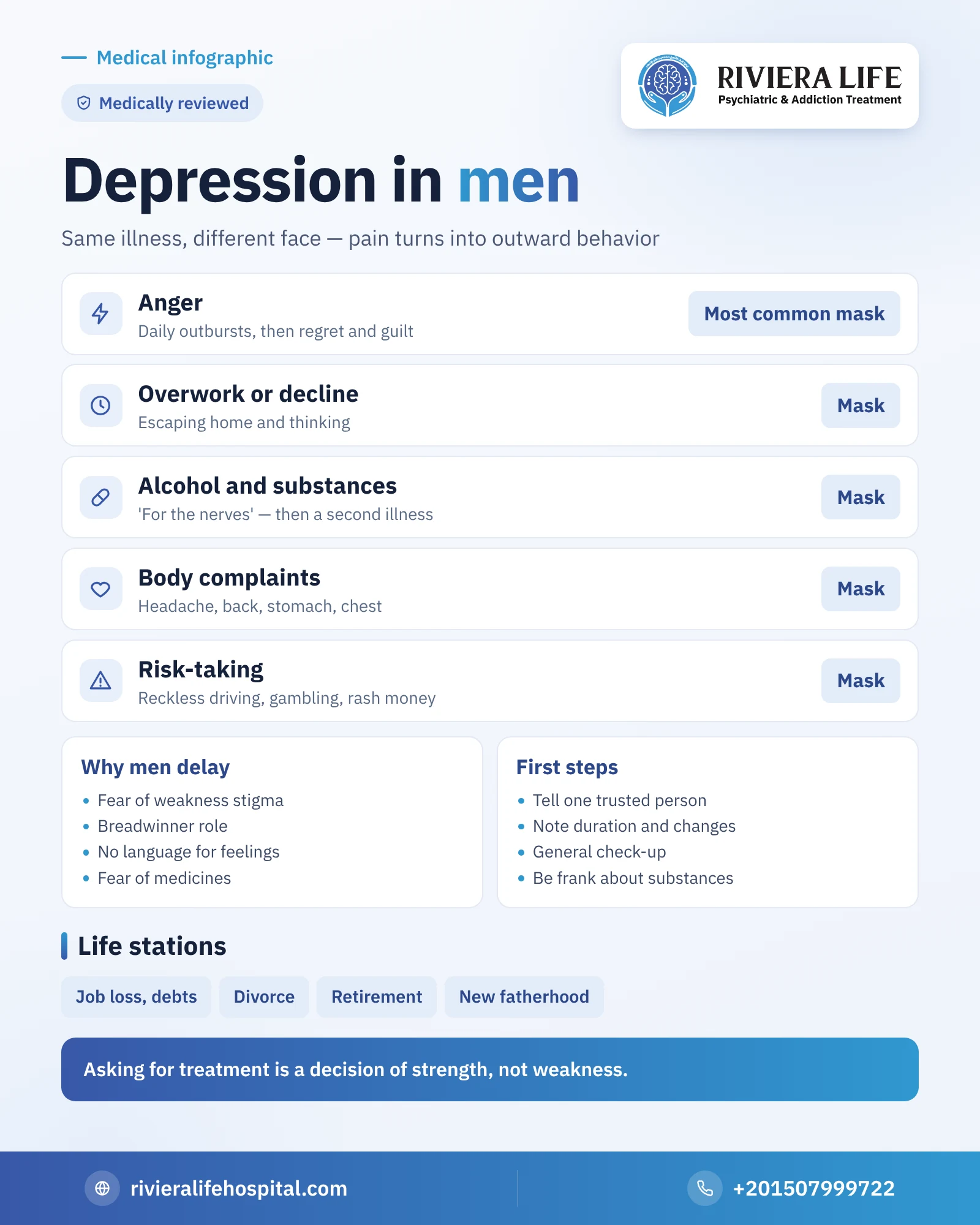
- Irritability and outbursts of anger over small things, then silence and withdrawal.
- Unusual risk-taking, such as reckless driving, gambling or hasty financial decisions.
- Overworking to escape the home and thinking, or the opposite: a clear decline in performance.
- More alcohol, hash or sleeping pills and stimulants “for the nerves”.
- Loss of sexual desire or erection problems with less interest in the relationship.
- Avoiding friends and occasions, and settling for sitting in front of the screen.
- Broken sleep or waking very early, and exhaustion that doesn’t go away.
Anger: the most common mask
Many depressed men don’t know that what they feel is depression, so they call it stress or a sharp temper. But there is a difference between anger with a cause that calms when the cause goes, and anger that comes every day without sufficient reason, followed by regret, guilt and disappointment in oneself. If the man has started to fear hurting his family with his words, and at the same time feels emptiness and indifference, this is a mix that deserves a psychiatrist’s assessment. For practical details on controlling anger see the article on treating excessive irritability.
Alcohol and substances: an attempt at treatment that turns into a second illness
Some men turn to alcohol, hash or sedative medicines because they ease distress for a few hours. Then comes the familiar cycle: the substance weighs down mood the next day, so depression increases, so the need for it increases. After months the addiction becomes an illness in its own right on top of the depression. That is why treating one of them alone usually doesn’t work, which we explained in the article on depression and addiction. If you are in this cycle, integrated treatment of both together is the shortest road to recovery.
The body speaks instead of the tongue
Some men visit internists, orthopedists and cardiologists with repeated complaints: headache, back pain, stomach upset, palpitations, chest tightness, then the tests come back normal. This doesn’t mean the pain is an illusion, as psychological pain is real in the body too, but it means treatment won’t be complete without looking at mood. This phenomenon is general, and we explained its origin in the article on psychosomatic disorders.
Why does a man delay asking for help?
- Fear of stigma: he fears being called weak, “crazy” or unable to bear responsibility.
- The breadwinner role: he sees admitting tiredness as threatening his image in front of his wife, children and work.
- Absence of a language of feelings: he wasn’t trained to describe what is inside him, so he says “I don’t know what’s wrong with me”.
- Believing it will pass: he postpones year after year until the losses accumulate.
- Fear of medicines: he hears they cause addiction or weaken manhood, so he refuses assessment altogether.
The truth is that asking for treatment is a decision of strength, not weakness, that psychiatric assessment is confidential, and doesn’t necessarily mean medicine. And psychiatric medicines don’t mean addiction in most of their types, as we clarified in the article on do psychiatric medicines cause addiction?.
Stations in a man’s life that raise the risk
Depression doesn’t always come from nowhere. In men certain stations recur: losing a job or business setbacks and debts, as providing is a large part of identity for many. Separation or divorce and losing contact with the children. Retirement, when the daily role suddenly disappears. A chronic illness or sexual weakness that touches his image of himself. And also new fatherhood, as some fathers develop depression in the months after the birth, something little talked about. These stations don’t make depression “understandable so it needs no treatment”, but make assessment more useful. To learn about the general causes see the causes of depression.
Physical causes the doctor must rule out
Some physical conditions imitate depression or come together with it in men, including underactive thyroid, vitamin D or B12 deficiency, sleep apnea, diabetes, and low male hormone in some men after middle age. The doctor examining these possibilities is important, but not a reason to postpone psychiatric assessment, as both may exist together. And adjusting hormones alone doesn’t treat existing depression in all cases.
The danger that must not be ignored
In most countries of the world the number of suicide deaths among men exceeds that among women, even though men are diagnosed with depression less. This means silence has a price. Any talk from a man about death or about being a burden on his family is taken completely seriously, and not treated as a joke or weakness. The person concerned can read the article on suicidal thoughts, which explains how to ask for help now.
Ask for urgent help immediately if you see
Call an ambulance on 123 or go to the nearest emergency department, and you can ask for guidance from the mental health hotline 16328. Don't leave the person alone.
- Talk of death, wanting to disappear, or being a burden on those around him
- An unusual farewell, giving away possessions or suddenly arranging papers
- Severe recklessness accompanied by despair, or anger that threatens the family’s safety
- Mixing alcohol or medicines with severe sadness or loss of control
Treating depression in men: how does a man start?
- Name what is happening in one sentence to someone you trust: “I haven’t been well for weeks”.
- Write down how long the symptoms have lasted and what has changed in sleep, appetite and work, as this saves the doctor time.
- Ask for a general check-up including the thyroid and vitamins, then an assessment with a psychiatrist.
- Tell the doctor frankly about alcohol, substances or medicines you use, as this information changes the plan.
- Keep the second appointment even if you feel a slight improvement, as recovery is a journey, not one appointment.
Psychotherapy such as cognitive behavioral therapy, and sometimes suitable medicines, improve the condition of most who commit to them. The details are in the article on depression treatment. No one starts or stops a medicine except under the doctor’s supervision.
How can a wife, brother or friend support him?
Don’t start the conversation during a quarrel, as a man in a moment of anger defends himself and doesn’t listen. Choose a calm moment and say what you saw without accusation: “I’ve noticed you’ve started sleeping little and keeping away from us, and I’m worried about you”. Avoid phrases like “try harder” or “others are worse off”. Offer to accompany him to the appointment, and make sure he knows that no one will shame him for asking for help. And take care of yourself too, as living with a depressed person is exhausting.
How does Riviera Life help you?
At Riviera Life in Sheikh Zayed, Giza, the consultants in psychiatry and addiction assess a man’s condition in complete confidentiality, and examine depression and substances together instead of treating one and ignoring the other. We provide round-the-clock medical follow-up when needed, a family program, and a plan for after improvement. The first consultation is free on +201507999722.
More from the depression guide
- Depression: the complete guide
- Depression and addiction
- Depression treatment
- When do you need a psychiatrist?
Questions many people ask
Yes, but they are diagnosed less because the illness usually appears in them as anger, exhaustion, overwork or substances. That doesn't mean it is milder.
It can, especially if it comes with emptiness, loss of pleasure, little sleep and guilt after the outburst. An assessment with a psychiatrist determines the cause.
The main reasons are fear of the stigma of weakness, the pressure of the breadwinner role, difficulty describing feelings, and believing it will pass on its own.
Not necessarily. The hormone may be low in some men and the doctor assesses it, but it doesn't treat existing depression in all cases and doesn't replace psychiatric assessment.
Choose a calm moment away from quarrels, describe what you saw without accusation, express your concern, and offer to accompany him to the doctor instead of giving orders.