Group therapy is sessions in which a small number of people, usually between six and twelve, meet with one or two therapists to treat a shared or similar problem. It seems strange to anyone who thinks psychological pain is a very private matter, but it is one of the oldest forms of treatment and among the most used in addiction, anxiety and depression. Its strength doesn’t come only from saving time and money, but from the patient seeing themselves in the faces of others. This article explains how the group works, its types, what really helps in it, and when an individual session is more suitable.
What is group therapy?
It is psychotherapy led by a trained specialist, in which the relationships between group members are used as part of the treatment itself. The group meets at a fixed time, usually weekly, and the session lasts between one and two hours. There are announced rules: confidentiality, respect, not interrupting, and committing to attend. This isn’t a chat group or a lecture series; the therapist steers the conversation, protects the members, and links what one says with what another has said.
Why does it work? The therapeutic factors in the group
The psychiatrist Irvin Yalom described factors that recur in successful groups, among the clearest of which are:
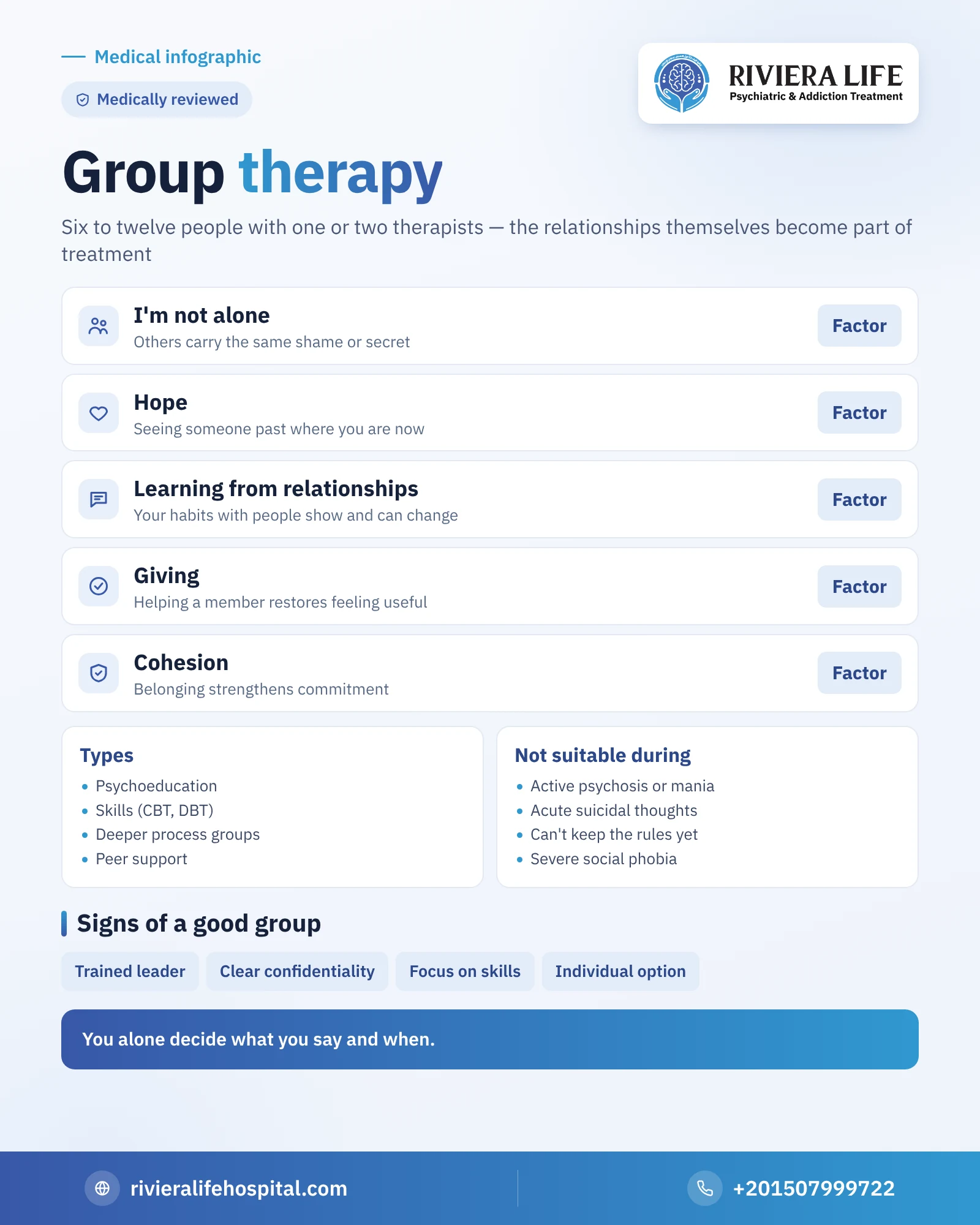
- I’m not alone: discovering that others feel the same shame or hide the same problem eases the burden of the secret.
- Instilling hope: seeing someone who has got past what you are going through now is stronger proof than any advice.
- Learning from relationships: the group is a miniature society; your habits with people, such as withdrawing or attacking, appear in it, so you see them and try them differently.
- Giving: when you help a fellow group member you regain a sense of being useful.
- Cohesion: belonging to a group strengthens commitment, and dropping out of treatment falls with it.
Types of therapy group
Psychoeducation groups
They explain the illness or addiction and what happens in the body and brain, and teach basics such as recognizing triggers. They have clear teaching material and relatively little discussion, and are suitable as a start.
Skills groups
They work like a classroom: a skill is explained, then practised within the session, then given as homework. Among the best-known examples are dialectical behavior therapy groups and cognitive behavioral therapy groups for anxiety and depression.
Deeper psychological groups
They focus on what is happening between members here and now, require more time and relatively stable members, and suit those with recurring problems in relationships.
Support groups and peer fellowships
They are usually led by people who have recovered themselves, such as fellowship groups for people recovering from addiction. They aren’t medical treatment in the full sense, but they are a great support for staying in recovery after leaving hospital.
Group therapy in addiction
Hardly any addiction treatment program is without group work, for a simple reason: addiction lives in secret and grows with isolation and lying. When the patient sits in front of people who understand them without excuses, denial gradually recedes, and it becomes easier to admit craving and thoughts of relapse before they turn into action.
Groups are used at several of the stages of recovery: at the start for motivation, in the middle for learning refusal skills and managing craving, and after discharge to maintain the support network, as the article on the aftercare program explains. Reviews indicate that structured groups can give results close to individual therapy in many cases of substance use, although combining the two is usually best.
Group therapy in anxiety and depression
In depression, isolation lessens and the cycle of withdrawal is broken, and in social anxiety the group becomes a safe training ground for speaking in front of others. Group cognitive behavioral therapy has good evidence in anxiety and depression, with results close to individual therapy in many studies. If social phobia is the problem, you will find in social anxiety treatment how the steps are graded.
What happens in the first session?
You aren’t asked to tell your whole story. It usually starts with a simple introduction, the therapist explains the rules, and each person speaks as much as they are comfortable with. It is normal to feel anxious or want to stay silent, and this doesn’t prevent benefit. Many say that the second or third session is where trust begins. If you fear your secret will be disclosed, ask the therapist clearly about the confidentiality policy before joining, as it is the foundation of the whole group.
Group or individual?
| Aspect | Group therapy | Individual therapy |
|---|---|---|
| Privacy | You share with others under confidentiality rules | A complete space for you alone |
| Peer support | Essential and direct | Absent |
| Personal time | Limited for each member | The whole session is for your case |
| Social training | A real opportunity within the session | Imagined or practised with the therapist |
| Most suitable in | Addiction, isolation, social phobia and learning skills | Crises, heavy trauma and very private details |
And there is no need to choose; many programs combine the two, with individual sessions handling personal details, diagnosis and the medication plan, and group sessions handling skills and relationships.
When isn’t the group suitable?
- During active psychosis, severe mania or agitation, until the condition calms.
- With acute suicidal thoughts that need close individual follow-up first.
- When the person currently can’t keep the rules of respect and confidentiality.
- With severe social phobia, where preparatory individual sessions may come before joining.
An open or closed group?
In a closed group, members start together and continue for a set number of weeks without new members joining, so deeper trust develops and the content progresses in order. In an open group, new members come in and others leave continuously, which is common in addiction centers because entering treatment doesn’t wait for a single start date. Each type has its advantages: the open group gives the newcomer a living example of those ahead of them on the road, and the closed group suits sequential skills.
Common myths
- “I’ll have to reveal all my secrets”: you alone decide what you say and when.
- “Others’ problems will affect me and I’ll get worse”: temporary tiredness may happen, which is why the therapist manages the session and opens discussion about it.
- “Individual therapy is always better”: not necessarily; what one helps with, the other may miss.
- “Group is cheap second-rate treatment”: it is an independent treatment with its own evidence and method.
Signs of a good group
- A trained leader who manages the conversation and doesn’t let anyone be humiliated or cornered.
- Announced rules for confidentiality and attendance.
- A focus on the future and skills, not a competition in telling the worst.
- A group with a shared goal, not one that combines people at stages very far from each other.
- The option of moving to an individual session when needed.
How do you benefit more?
Attend regularly, as repeated absence weakens the whole group. Speak about yourself using “I” instead of generalizing, listen attentively, as that is half the treatment, and don’t offer ready-made advice to others before it is asked for. Write down what catches your attention to discuss later with your individual therapist. And if a situation in the session bothers you, tell the therapist instead of withdrawing silently, as this in particular is a valuable moment of learning.
The family’s role
Families don’t usually attend the patient’s sessions, but they benefit from groups of their own that teach them about the illness, teach them boundaries, and ease their feeling of being alone. A family that understands why the patient comes back from a session tired and why they need regularity makes a real difference.
How can Riviera Life help you?
The consultants in psychiatry and addiction at Riviera Life first assess each case and then determine the intervention best suited to it, and the program includes support for the family and follow-up after discharge. The first consultation is free and confidential on +201507999722.
More from the psychotherapy guide
- Cognitive behavioral therapy
- The aftercare program after addiction treatment
- The relapse treatment program
- Anxiety: the complete guide
- Music and art therapy: how it works, who it suits and its limits
Questions many people ask
Usually between six and twelve members with one or two therapists, a number that ensures a chance to participate and a variety of experiences.
No. You decide what you say and when, and the therapist sets rules of confidentiality and respect; no one is forced to speak.
In many cases the results are close, and combining the two helps, but acute crises and heavy trauma usually need individual sessions.
A therapy group is led by a trained therapist with a plan, while a support group is usually led by peers who have recovered and share experience.
Because addiction feeds on isolation and lying, and the group breaks both and gives hope, support and training in refusal skills.