Dissociative identity disorder is a psychological condition in which a person feels there is more than one identity or self-state within them, and these states take turns controlling their behavior, with memory gaps that can’t be explained by ordinary forgetting. It used to be called “multiple personality disorder”, a name popularized by films that built a frightening image around it that doesn’t resemble reality. Closer to the truth is that it is a very old way in which the mind protects a child from pain they can’t bear, which then stays with them into adulthood. Here we explain what it means, how it differs from schizophrenia, its link with trauma, and how it is diagnosed and treated.
What is dissociative identity disorder?
The disorder belongs to the group of dissociative disorders, conditions in which a person becomes partly disconnected from their memory, their sense of themselves or their surroundings. Dissociation in its mild form is an experience everyone knows: you drive along a familiar road and arrive without remembering the details. In this disorder, however, the disconnection is deep and repeated, and touches identity itself.
Diagnosis requires two or more identity states, each with its own way of feeling, thinking and behaving, repeated gaps in recalling everyday events or important personal information, and clear distress or disruption in life. It isn’t diagnosed if what is happening is an accepted part of a cultural or religious practice. It is relatively rare, but more common among people receiving psychological treatment than people think, and many go through years of misdiagnosis before it is recognized.
How do the “states” form? Early trauma
The evidence indicates that most people with the disorder were exposed in childhood to severe and repeated abuse or neglect, at an age when identity had not yet come together. A child who can’t escape the pain and finds no one to protect them escapes with their mind: “This didn’t happen to me, it happened to another child”. With repetition this device may turn into relatively separate states, each carrying part of the experience or a way of coping with it.
This doesn’t mean everyone who lived through trauma will develop the disorder; it depends on the child’s age, how often the harm was repeated, and the absence of protection and support. Anyone who wants to understand the effect of trauma in general can read our article on psychological trauma and our guide to post-traumatic stress disorder.
How it differs from schizophrenia: a common confusion
The root of the confusion is linguistic: the word “schizophrenia” refers to a splitting of psychological functions such as thinking and perception, not a division of the personality into two. That is why many think a person with schizophrenia has “two personalities”. This is wrong.
| Point of comparison | Dissociative identity disorder | Schizophrenia |
|---|---|---|
| The core problem | Fragmented identity and memory gaps | A disorder of thinking, perception and contact with reality |
| Voices | Usually felt inside the head and attributed to inner states | Voices perceived as coming from outside, with conviction that they are real |
| Delusions | Not the main feature | Common and fixed |
| The usual root | Chronic early trauma | Genetic and neurological predisposition with environmental factors |
| Main treatment | Specialist trauma psychotherapy | Antipsychotic medicines with psychological and social therapy |
Rarely, the two disorders may occur together in one person, but that is for the doctor to decide after a careful assessment. For a comparison with schizophrenia see our article on schizophrenia symptoms.
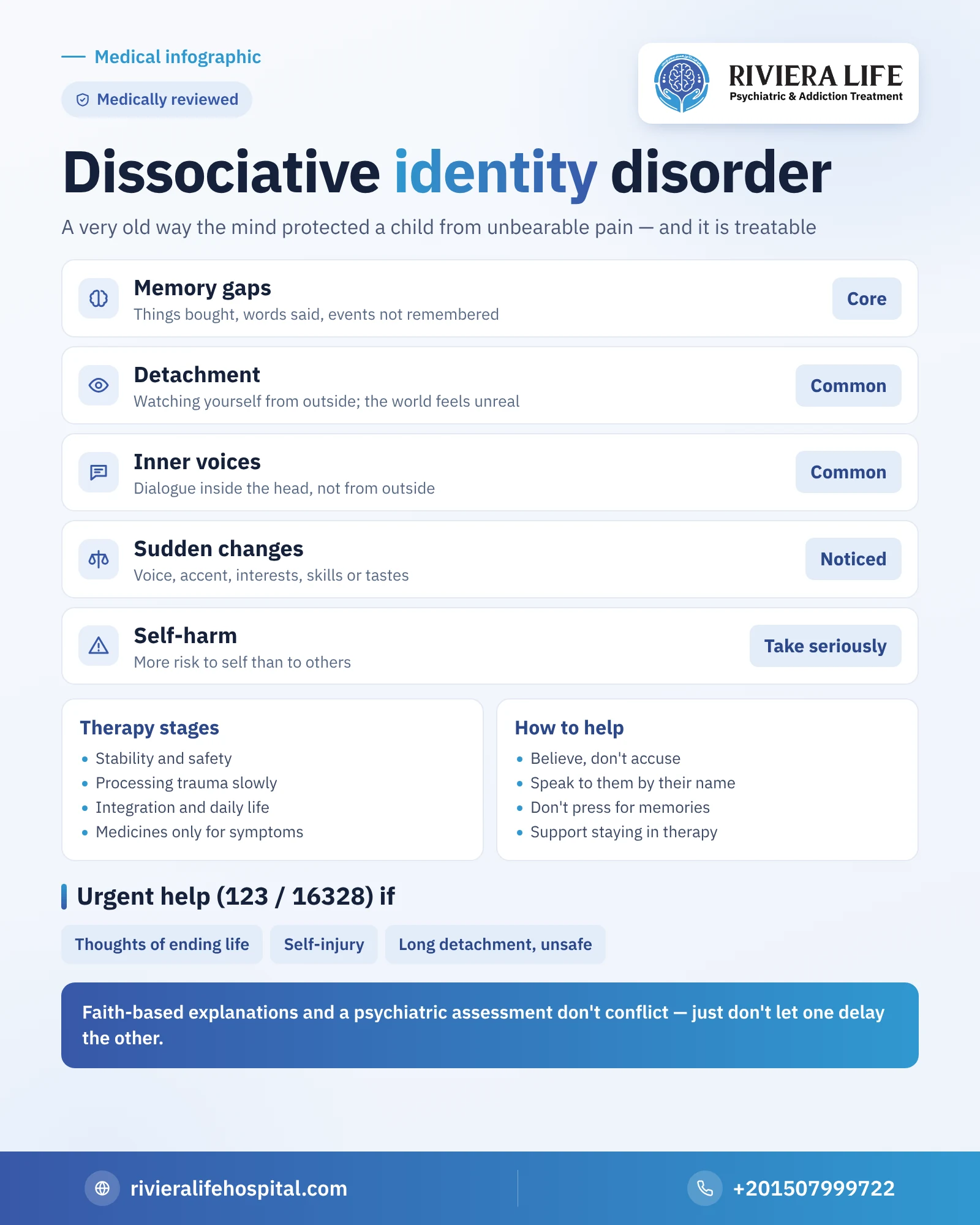
Symptoms: what do the person and those around them notice?
What the person experiences
- Memory gaps: finding things at home they don’t remember buying, being told of conversations they had with people that they don’t remember, or forgetting important events in their life.
- A sense of estrangement from oneself: as if seeing oneself from the outside, or that one’s body isn’t one’s own (depersonalization), or that the world isn’t real (derealization).
- Inner voices: hearing a dialogue in the head or feeling that “someone else” is commenting and directing.
- Sudden changes: in voice, accent, interests, skills, or taste in food and clothing.
- Accompanying feelings: depression, anxiety, nightmares, headaches, and sometimes self-harm.
What family and colleagues notice
Those close to the person sometimes notice that they “change” at certain times: they speak differently, deny having said or done something, or seem for moments not to know them. They are often accused of lying or acting, while in most cases they genuinely suffer from forgetting. And the person often hides what they are going through out of shame or fear of being called mad.
Is it acting? And is it “possession”?
Two questions asked in many homes. As for acting: studies and clinical experience say that most people with the disorder try to hide the symptoms rather than show them, gain nothing from them, and deliberate faking is rare and is detected by a trained examiner.
As for explaining it as possession or being touched by spirits, this is a widespread cultural explanation in our society, and some dissociative presentations take a form that is understood locally in this way. What matters most in practice is that this explanation doesn’t delay a psychiatric assessment for years, and that the patient isn’t subjected to beating, humiliation or pressure in the name of exorcism. A family can keep its religious convictions and at the same time take the case to a psychiatrist; the two don’t conflict.
Fears and misconceptions
- “The person is a danger to people”: not true; the person is more at risk of harming themselves than harming others, and violence isn’t a feature of the disorder.
- “Everyone can tell they are ill”: in fact most cases aren’t visible from the outside, and look like depression, anxiety and forgetfulness.
- “Each state is a complete, independent person”: more accurately, they are parts of one person that haven’t integrated, and the aim of treatment is communication between them, not driving one of them out.
- “It has no treatment”: treatment is possible and takes a long time, and major improvement is common with committed treatment.
How is it diagnosed?
There is no blood test or scan that confirms the disorder. The psychiatrist relies on a long interview, may use standardized dissociation scales, and rules out physical causes such as epilepsy, tumors and the effect of drugs and medicines, as all of these may cause memory gaps. Diagnosis needs patience because the person may not speak freely at first; trust is built over sessions.
Treatment: stages, not a magic pill
The main treatment is specialist trauma psychotherapy, which usually proceeds in three stages:
- Stability and safety: learning calming and grounding skills, managing suicidal thoughts and self-harm, and securing a safe environment.
- Processing traumatic memories: in slow, measured steps, and after the person has become able to bear it, because opening memories too early may make things worse.
- Integration and return to life: strengthening communication between the parts of the self, and building more stable relationships and work.
There is no medicine that treats the dissociation itself, but the doctor sometimes prescribes medicines for accompanying symptoms such as depression, anxiety and sleep disturbance, and the patient changes none of them except under his supervision. Admission to hospital may be needed when there is a risk to the person’s life. Some treatment methods overlap with cognitive behavioral therapy in the skills for dealing with symptoms.
How do you help someone close to you?
- Believe them and don’t accuse them of lying if they forget what they did, and tell them calmly what happened without interrogation.
- Don’t treat every “state” as a stranger you debate or argue with, and address them by their usual name with respect.
- Don’t press them to remember the past or recount its details; this is left to the therapist.
- Encourage them to continue treatment even if it takes long, and help them keep a sleep and eating routine.
- Pay attention to any talk of self-harm and take it seriously. Our article on self-harm explains how to act without blame.
Seek urgent help immediately if you see
Call an ambulance on 123 or the mental health hotline on 16328, or go to the nearest emergency department.
- Thoughts of ending life or self-harm, or a plan for it
- Actually injuring the body, or losing awareness of what the person is doing while at risk
- A long absence from reality with inability to eat, drink or stay safe
When should you ask for a psychiatric assessment?
If memory gaps, the feeling that your body or the world isn’t real, or hearing inner voices keep recurring, especially with a difficult childhood history, book an appointment with a psychiatrist instead of waiting. Tell him the details of what is happening honestly; he is trained to hear what isn’t said to others. Only a psychiatrist or specialist diagnoses this condition after a full assessment. At Riviera Life, consultant psychiatrists assess complex cases in complete confidentiality, the first consultation is free, and the family is with you in the follow-up plan.
More from our guide to dissociative disorders and trauma
- Post-traumatic stress disorder: the complete guide
- Psychological trauma: reactions and what helps
- Schizophrenia symptoms
- Self-harm: how to help without blame
- Schizophrenia vs split personality: a common myth and the medical truth
- Depersonalization-derealization disorder: symptoms and treatment
Questions many people ask
No. Schizophrenia is a disorder of thinking, perception and contact with reality, while dissociative identity disorder is a fragmentation of identity with memory gaps, often after early trauma.
Usually not. Most people with the disorder hide their symptoms out of shame and genuinely suffer from forgetting; deliberate faking is rare and a specialist can tell the difference.
That isn't a feature of the disorder. People with it are more at risk of harming themselves, and any talk of self-harm should be taken seriously.
There is no medicine that treats the dissociation itself. The main treatment is specialist trauma psychotherapy, and the doctor may prescribe medicines for accompanying depression, anxiety and sleep problems.
Major improvement is possible with committed psychotherapy that may take years, aiming at communication between the parts of the self and a stable life.