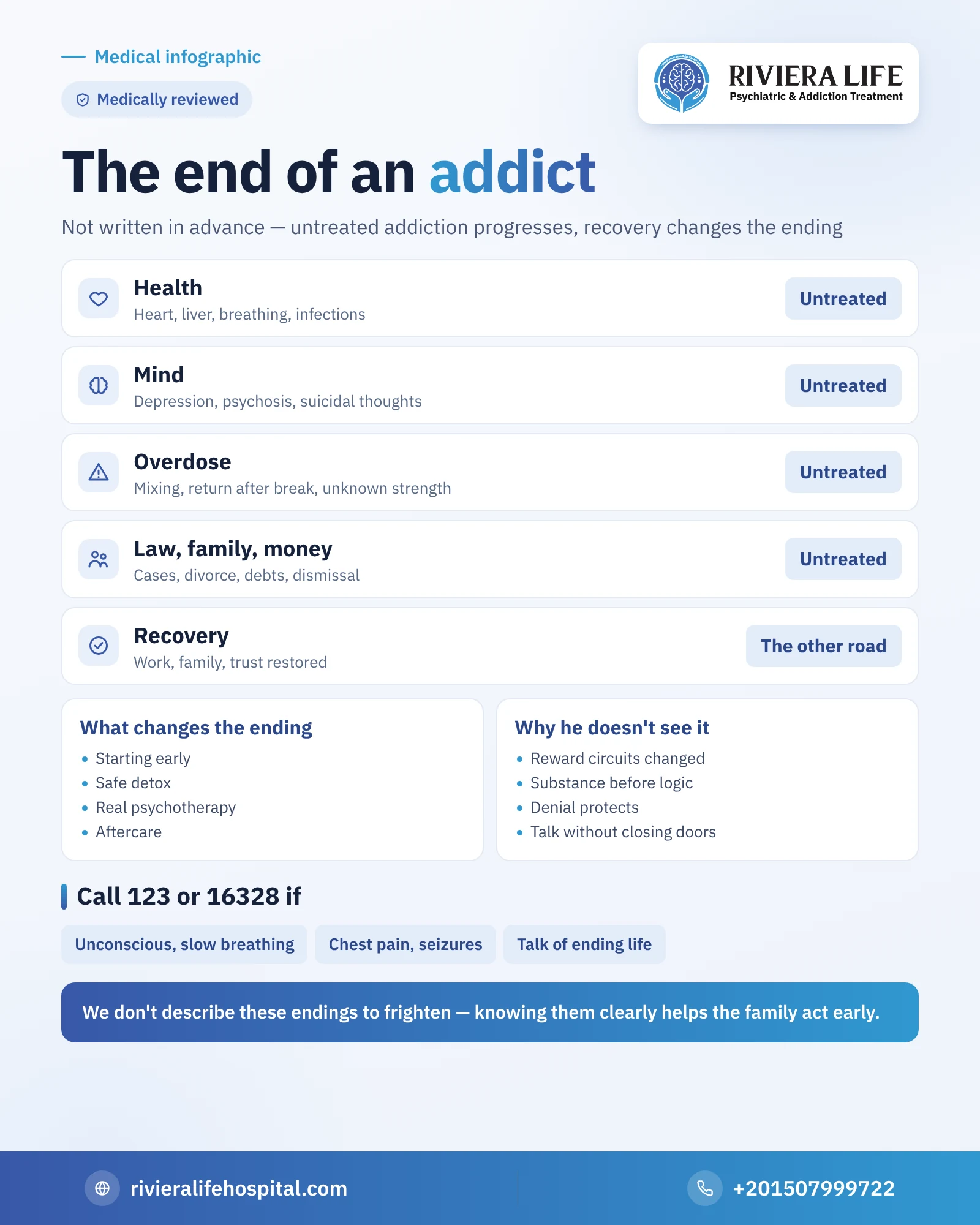
The end of a drug addict isn’t written in advance. If addiction continues without treatment, it tends to progress, and its losses accumulate slowly: in health, the mind, the family, money, work, sometimes before the law, and it may end in an overdose from which there is no return. But this is one road of two. The other road, recovery, is taken by many every day, and usually starts before the “big catastrophe” some wait for. In this article is an honest look, without exaggeration, at where untreated addiction can lead, then at what changes this ending.
Does a drug addict have one ending?
No. Addiction is a chronic illness affected by the substance, method of use, age, mental health and surrounding support. Some deteriorate in months, and some seem “together” for years while their life erodes from inside. What unites these stories is that time doesn’t work in the patient’s favor if they don’t receive treatment.
The idea spreads that an addict won’t stop unless they “hit rock bottom”. This idea is dangerous, because rock bottom may be an overdose or an incurable illness. Research indicates that treatment can succeed even if it starts under pressure from family or work, and doesn’t require the patient to wait for complete collapse.
That is why we don’t present these endings to frighten anyone, but because knowing them clearly helps the family act early, and helps the patient see what denial hides.
Years without treatment: what accumulates?
The end rarely comes suddenly. The usual picture is a chain of small losses: an amount that increases because the body got used to it, then money borrowed, then a lost work day, then a lie to cover an absence, then a friend who moves away. Each loss seems repairable on its own, but their total after years changes the shape of the whole life. The article on drug addiction explains how addiction develops from trying to loss of control, while here we follow what happens after that.
The health ending: the body pays the bill
Each substance leaves its mark on a particular organ. Stimulants such as ice, cocaine and captagon strain the heart and vessels and may cause heart attacks and strokes at a young age. Alcohol destroys the liver and pancreas. Opioids slow breathing and weaken hormones and immunity. And injection opens the door to viruses and heart infections, as the article on the harms of injecting drugs explains.
Added to this is what affects almost all addicts: malnutrition, tooth decay, disturbed sleep, and neglect of chronic illnesses such as diabetes and blood pressure because treatment is no longer a priority. Each substance has a detailed harms guide on the site, such as the harms of ice.
The mind and mental health
Over time the person’s basic mood changes: constant anxiety, depression, swings, and loss of pleasure in everything unrelated to the substance. Some substances, especially stimulants and high-potency hash, may cause psychosis, paranoia and hallucinations. Concentration, memory and the ability to make decisions weaken.
And in those with addiction together with depression, the risk of suicidal thoughts rises. If you notice your relative talking about death or despair, this is a sign that deserves quick intervention, talking with them calmly and asking for specialist help, not ignoring it.
Ask for help immediately if you see
Call an ambulance on 123, or the mental health hotline 16328.
- Unconsciousness or very slow breathing after use
- Chest pain or seizures
- Talk of ending life or an unusual farewell
- Severe agitation or hallucinations pushing them to harm themselves or others
Overdose: the ending with no return
This is the ending everyone fears, and it isn’t rare. It often happens when mixing two substances, when returning to use after a period of abstinence in which the body’s tolerance fell, or with a substance of unknown concentration. And whoever survives it may carry effects in the brain or kidneys. Its signs and what to do until the ambulance arrives are in the article on drug overdose.
The legal ending
Egyptian law criminalizes possession of and trafficking in drugs with severe penalties, and an addict may find themselves facing a case because of an amount they carry for their own use. There are other roads to the courts: driving accidents under the influence of the substance, debts and cheques, theft to fund use, and fights. And any criminal record closes the doors of work and travel for years. On the other hand, the legal framework in Egypt generally allows voluntarily coming forward to seek treatment, and details can be asked of a legal specialist.
The family and social ending
The family is usually the first to pay the price and the last to speak. Trust erodes with every broken promise, the wife carries the home alone, and the children grow up in an atmosphere of tension, fear and secrets. It may end in divorce, estrangement from the family, or complete isolation in which only those who use with the addict remain around them.
Sometimes the family itself falls ill with anxiety and depression, and lives to the rhythm of the patient’s crises. That is why family members need support of their own, not just waiting for him to change.
As for the children, they pay a price that doesn’t appear immediately: they may carry anxiety and low self-confidence into adolescence, and be more prone to using later if they don’t find someone to explain what is happening and protect them from it. And when the father or mother starts treatment, the children are among the biggest winners.
The financial and professional ending
It starts with spending savings, then borrowing from friends, then selling things, sometimes things that don’t belong to them. At work lateness, absence and mistakes repeat, until dismissal comes or the business stops. And with unemployment the emptiness the substance used to fill widens, so the cycle turns faster.
Why doesn’t the addict see their ending on the way to it?
Not because they don’t care. Addiction changes the reward and judgment circuits in the brain, so the substance becomes a priority that comes before logic, and denial seems a way of protection from the pain of admitting it. The article on how a drug addict thinks explains this mechanism, and how the family can talk with them without closing the door.
The other ending: recovery is possible
What came before isn’t a final verdict. Addiction is treatable like other chronic illnesses, and many who went through all these losses live today stable lives, working, raising their children and regaining the trust of those around them. A relapse may happen on the way, and it doesn’t mean failure, but means the plan needs adjusting.
The body also recovers more than people expect: sleep and appetite improve, and many functions regain their ability within months of stopping, even if some harms still need follow-up.
What changes the ending?
- Starting early: every month cut short before treatment means fewer losses.
- Safe detox: under medical supervision, especially with alcohol, sedatives and multiple substances.
- Real psychotherapy: that treats the reasons for use and accompanying disorders, not the symptoms alone.
- A partner family: that learns how to support without protecting the addiction, the essence of family rehabilitation programs.
- Follow-up after treatment: aftercare protects the first months, the most prone to relapse.
- A new life that fills the emptiness: work, routine and relationships far from circles of use.
How does Riviera Life help you?
For fourteen years Riviera Life has seen both endings, and knows that the difference between them starts with the decision to ask for help. We have consultants in psychiatry and addiction treatment, round-the-clock medical supervision, a program for the family and aftercare, and thousands of recovered cases, all in complete confidentiality at a hospital licensed by the Ministry of Health in Sheikh Zayed. The first consultation is free via +201507999722.
Read also
- Drug addiction: definition, signs and methods of treatment
- Can a drug addict quit on their own?
- How does a drug addict think?
- Drug overdose: signs and first aid
Questions many people ask
No, these are possible endings of untreated addiction, not inevitable ones. Many recover and live stable lives after treatment.
No, waiting for rock bottom may mean an overdose or a permanent illness. Treatment may succeed even if it starts under family pressure, and early intervention reduces losses.
Yes, many recovered people return to work and study and gradually regain their relationships. A rehabilitation program and follow-up after treatment help with that.
No, relapse is common in chronic illnesses including addiction. It is a signal of the need to review and strengthen the plan, not to stop trying.
The family can start with a specialist consultation for itself to learn how to talk and set limits. In cases of severe danger the doctor discusses the legally and medically available options.