The harms of injecting drugs go beyond the harms of the substance itself: the needle opens a direct route into the blood for viruses, bacteria and impurities, and delivers the whole dose to the brain within seconds. That is why injecting is linked to HIV, viral hepatitis B and C, abscesses, inflammation of the heart valves, vein damage and a higher risk of overdose. Many of these harms are silent for years, but most can be detected by testing and treated or prevented. This article explains each risk clearly, the tests and vaccines needed, the meaning of harm reduction, and how treatment begins.
Why is injecting the most dangerous method of use?
When a substance is swallowed, part of it passes through the liver before reaching the brain, and the skin and stomach act as a barrier against microbes. Injecting removes all these barriers at once: what is in the syringe reaches the bloodstream as it is, including the drug, impurities and bacteria.
Injecting adds another risk specific to Egypt and the region: injecting medicines designed to be swallowed or used in the eye, such as crushing tablets or injecting eye drops, as happens with Mydrapid eye drops. These preparations contain insoluble substances that may block the tiny vessels in the lungs and eyes. We covered the risks of injecting nalbuphine specifically in its article; here we talk about injecting as a method, whatever the substance.
Blood-borne viruses: HIV and hepatitis B and C
Sharing needles and syringes, or any equipment blood touches, is one of the most efficient routes for viruses to pass between people. An amount of blood invisible to the eye is sometimes enough to transmit infection.
| Virus | What it does | Prevention and treatment |
|---|---|---|
| Hepatitis C | Among the most common infections in people who inject, and may stay silent for years until it causes cirrhosis | No vaccine, but modern medication cures most cases within weeks |
| Hepatitis B | May clear on its own or turn into a chronic infection that threatens the liver | An effective vaccine exists, and chronic cases have treatment that controls them |
| Human immunodeficiency virus (HIV) | Gradually weakens immunity if untreated | No final cure yet, but regular treatment allows a long, almost normal life |
The risk doesn’t stop with the user: these viruses may pass to the wife or partner, and from mother to baby. This is an additional reason for testing to be a fixed part of any treatment plan.
Abscesses and skin infections
The injection complication that most often leads to hospital is infection of the skin and the tissue beneath it. It starts with redness, heat and painful swelling around the injection site, then pus may collect and an abscess form. Over time the infection may spread to the blood and cause life-threatening blood poisoning.
Some rare cases develop quickly into an infection that eats deep tissue, showing as severe pain out of proportion to how the skin looks, with fever and exhaustion. Opening an abscess at home with any tool increases the risk and doesn’t treat it; it needs medical assessment and sometimes an antibiotic or surgical drainage.
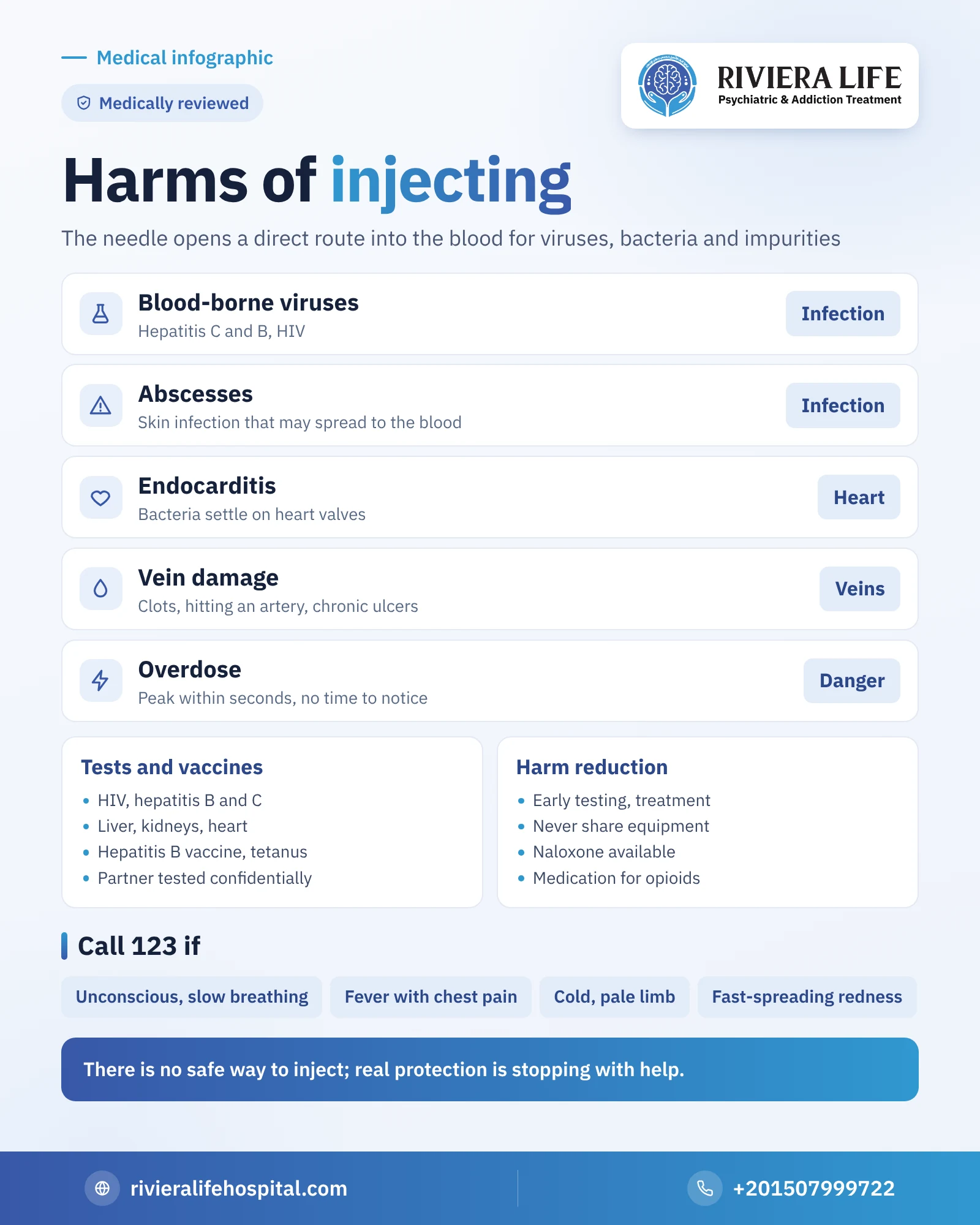
Endocarditis: an infection that reaches the heart valves
When bacteria enter the blood with repeated injecting, they may settle on the heart valves and form clusters that gradually damage the valve. This is called infective endocarditis, and it is one of the most dangerous complications of injecting.
Its early symptoms are misleading: recurrent fever, fatigue, night sweats and loss of appetite resembling flu. Then shortness of breath, joint pain or small spots under the nails may appear. Its treatment usually needs intravenous antibiotics for weeks in hospital, and sometimes surgery to replace the valve, and the infection may recur if the patient returns to injecting.
Damage to the veins and circulation
Repeated injecting wounds and inflames the vein wall, so it shrinks and hardens until it is blocked. The user then looks for other, deeper and more dangerous veins, so the circle of damage widens.
- Clots: a clot may form in the veins of the leg or arm, and if part of it breaks off it may reach the lungs.
- Hitting an artery by mistake: causes sharp pain, coldness and pallor in the limb, an emergency that may end with the loss of parts of it.
- Chronic poor circulation: permanent swelling in the legs and slow-healing ulcers that last years after stopping.
Injecting and overdose
An injected substance peaks within seconds, so there is no time to notice it is stronger than usual. With the unknown content of many substances in circulation, or mixing them with sedatives and pregabalin, injecting becomes the shortest road to breathing stopping. The signs of overdose and what to do until the ambulance arrives are explained in the article on drug overdose.
Other, less well-known harms
- The lungs: insoluble particles from crushed tablets may settle in the tiny vessels of the lung and cause chronic shortness of breath.
- The eye: blood infection may reach the inside of the eye and threaten sight.
- Tetanus and wound infection: contaminated wounds are a suitable environment for dangerous bacteria, especially in someone who hasn’t had their vaccinations.
- The kidneys and bones: spreading infection may reach the bones, joints and kidneys.
Call an ambulance on 123 immediately if you see
Some injection complications turn into a danger to life within hours.
- Unconsciousness or very slow breathing after injecting
- Fever with shivering and shortness of breath or chest pain
- A cold, pale, very painful limb after injecting
- Redness spreading quickly with fever and exhaustion
- Sudden shortness of breath or coughing up blood
Injecting lemon with heroin: a particular danger to the eye and body
Some people who inject heroin use lemon juice to dissolve the powder before injecting, thinking it is a safe natural substance. The problem is that squeezed lemon isn’t sterile, and may carry fungi, most notably Candida, which then enter the blood directly. Among the documented complications of this method is a fungal infection that reaches the inside of the eye, starting with blurred vision, seeing floaters, redness and pain, and possibly ending in loss of sight if treatment is delayed, alongside abscesses and inflammation of the skin, veins and heart valves.
Any sudden blurring of vision or eye pain in someone who injects needs an eye doctor the same day, telling them the method of use so they look for fungal infection specifically.
The tests and vaccines someone who has injected needs
Even if injecting happened once years ago, testing matters because viruses may stay silent. The usual testing generally includes:
- Tests for HIV and hepatitis B and C, repeating some tests after weeks if the exposure was recent.
- Assessing liver and kidney function, and examining the heart when there is fever or an abnormal valve sound.
- Hepatitis B vaccination for those who haven’t had it, and updating the tetanus vaccination.
- Testing the wife or partner when infection is confirmed, in complete confidentiality.
The good news is that hepatitis C has become curable in most cases with medicines taken by mouth, and that Egypt has wide experience in treating it.
What does harm reduction mean?
Harm reduction is a public health concept that aims to save lives and prevent infection in those who haven’t yet been able to stop. It doesn’t mean encouraging use, but rests on a simple idea: a living person can be treated tomorrow. Its elements known worldwide include:
- Early testing, vaccination and treating viruses.
- Not sharing any equipment blood touches with anyone, even the closest people.
- The availability of naloxone to reverse opioid overdose.
- Medication treatment for opioid addiction, such as methadone and buprenorphine, where available under medical supervision.
And the medical truth remains clear: there is no safe way to inject, and real protection is stopping with specialist help.
Treating injecting addiction
Treating someone who injects runs along two parallel lines: treating the addiction, and treating what injecting has left in the body. It starts with a comprehensive assessment of the substance, infection and psychological state, then detox under medical supervision, and suitable medication treatment may be used in opioid addiction. At the same time the doctor follows the treatment of abscesses and viruses in coordination with internal medicine and infectious disease doctors.
After that comes psychological rehabilitation and relapse prevention, because moving to injecting is usually a sign of advanced addiction that needs a full program, not just detox. The article on opioid addiction treatment explains the stages of this program in detail.
How can Riviera Life help you?
At Riviera Life the patient isn’t asked about their past to be judged, but to be treated. Consultants in psychiatry and addiction treatment combine safe detox with round-the-clock supervision, coordinating infection tests, psychological rehabilitation, a family program and aftercare, all in complete confidentiality. Contact us for the free first consultation on +201507999722.
Read also
- Nalbuphine: medical use, addiction and the risks of injecting
- Drug overdose: the signs and first aid
- The harms of heroin to the body, brain and life
- Naloxone and saving someone who has overdosed
Questions many people ask
Yes, the virus is transmitted by a tiny amount of blood. So testing is advised for anyone who has shared injecting equipment even once, even if years have passed.
Some tests don't show infection in the first weeks, so the doctor may ask to repeat them after a while. The doctor sets the right timing according to the type of test and the date of exposure.
In most cases yes, with modern medicines taken by mouth for weeks. But returning to shared injecting may cause a new infection after cure.
Severe pain out of proportion to how the skin looks, fever and shivering, and redness that spreads quickly are signs that call for emergency care. No abscess should be opened at home.
Inflammation and wounds usually improve, but some blocked veins and poor circulation in the legs may remain. Medical follow-up reduces complications and treats ulcers.