The short answer
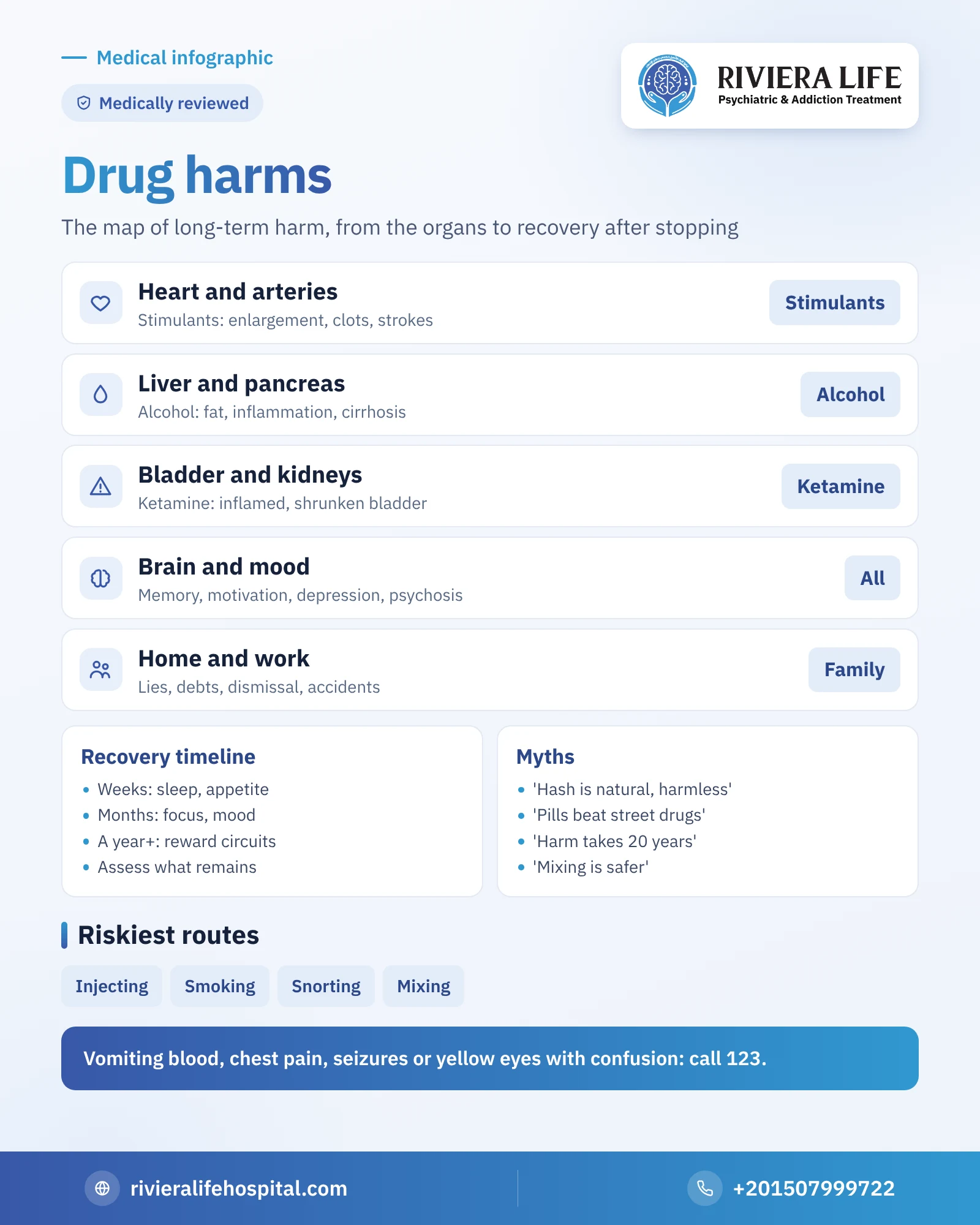
The long-term harms of drugs build up quietly with repetition until they appear in particular organs: stimulants wear out the heart and arteries, alcohol destroys the liver and pancreas, ketamine affects the bladder, smoking of all kinds hurts the lungs, and injecting transmits viral hepatitis and HIV. In the brain, memory, concentration and motivation weaken, and the risk of depression and psychosis rises. The harm extends to marriage, work and money. Many of these harms improve after stopping early, and some become permanent if treatment is delayed.
- Heart, liver and brainThe organs most damaged with continued use
- InjectingThe most dangerous route of use in terms of infection
- Stopping earlyReverses a large part of the harm
Drug harms are what repeated use leaves in the body, the mind and life long after the high has ended. We are talking here about the young man who began complaining of constant palpitations after two years of captagon, the father whose eyes turned yellow after years of drinking, and the family drained by debts and promises. This page explains the harm organ by organ, its long-term effect on the brain and mental health, the differences between substance families, the danger of mixing and of the route of use, the link between drugs and cancer and crime, and what can recover after stopping. What the substance does during the hours of its effect, and how long it shows in a test, belongs in the section The effect of drugs during use.
How does harm build up silently over time?
Most long-term drug harms don't come from a single night, but from repetition that wears out the organ before giving it time to recover. Every time blood pressure rises because of a stimulant, it leaves a small mark in the artery wall; every drink adds a burden on the liver cells; and every late night draws on the store of sleep with which the brain repairs itself. Because these effects are silent at first, the user is reassured that they are "fine" until the problem appears all at once.
The World Health Organization estimates in its 2024 report that alcohol alone was linked to about 2.6 million deaths worldwide in 2019, and that the use of other drugs was linked to about 0.6 million deaths, many of them caused by liver disease, heart disease, cancer and infections that accumulated over the years.
What many users say
- Hash is a natural plant, so it does no harm.
- Medical pills are milder than street drugs.
- The harm only appears after twenty years.
What the medical evidence says
- High-potency varieties clearly raise the risk of psychosis and dependence.
- Tramadol and sedatives cause dependence, seizures and suppressed breathing.
- Teeth, mood and hormones may be affected within a few months.
Drug harms on the body, organ by organ
The heart and blood vessels
Stimulants such as cocaine, shabu and captagon raise blood pressure and pulse repeatedly, and over the years the heart muscle may enlarge and weaken, the arteries harden, and the likelihood of heart attack and stroke increases even in young people in their thirties. Alcohol in large amounts causes heart-muscle disease and rhythm disturbance. Injecting may carry bacteria to the heart valves, which become inflamed.
The lungs and respiratory system
Smoking hash and bango causes a chronic cough, phlegm and repeated inflammation of the airways, and it gets worse when mixed with tobacco, as is common in Egypt. Smoking crack and heroin on foil burns the airways, and makes simple colds turn into pneumonia.
The liver, kidneys and bladder
The liver is the first victim of alcohol: fat, then inflammation, then cirrhosis that may end in failure. Injecting adds the risk of viral hepatitis C and B. The kidneys are harmed by repeated dehydration and the muscle breakdown that may accompany stimulants and synthetic cannabis. Ketamine, however, leaves a special mark on the bladder, making its wall inflamed and shrunken, so the person suffers pain, frequent urination and blood in the urine; the details are in the article What ketamine does to the bladder and kidneys.
The mouth, teeth and digestive system
Shabu users lose their teeth quickly because of dry mouth, grinding and neglected hygiene. Opioids cause chronic constipation that may reach obstruction. Khat wears out the gums and stomach. With alcohol, the pancreas and stomach become inflamed. And there is a repeated-vomiting syndrome that emergency doctors know in people who have smoked hash heavily for years.
Hormones, fertility and pregnancy
Long-term opioid use lowers the male hormone, so desire and erection weaken and fertility falls, and in women the cycle is disturbed or stops, as the article The effect of drugs on the menstrual cycle explains. During pregnancy, most substances reach the fetus, which is why we devoted the article Drugs during pregnancy to ways of getting safe help without blame.
What do drugs do to the brain and mental health in the long term?
The most dangerous drug harms are not seen on scans. The brain adapts to the substance day after day, and this adaptation is the root of much of the harm. Its ability to enjoy ordinary things weakens, so the person seems flat and enthusiastic about nothing. Short-term memory, concentration and the ability to plan decline, so the student stumbles in his studies and the employee in his work. Over time, impulse control decreases, so the decision of "one last time" becomes harder each time.
On the psychological side, long-term use is linked to anxiety and depression, and suicidal thoughts may appear in periods of crash. Stimulants, high-potency cannabis and synthetic cannabis may uncover or trigger psychotic episodes with suspicion and hallucinations, which go away in some people with stopping and persist in others who are predisposed. Chronic alcohol use may cause a deficiency of the vitamin thiamine, leading to a memory disorder that is hard to treat if discovered late.
A table of drug harms by substance family
Drug harms differ from one family to another, although they all share dependence and mood disturbance. The table summarizes the most prominent things we see in the clinic with long-term use:
| Family | Most prominent physical harm | Most prominent psychological and mental harm |
|---|---|---|
| Opioids (heroin, tramadol) | Chronic constipation, hormone deficiency, infection with injecting | Apathy, depression and low motivation |
| Stimulants (shabu, captagon, cocaine) | Heart and arteries, teeth, weight loss | Psychosis, suspicion, anxiety and depression in the crash |
| Natural cannabis (hash, bango) | Airway inflammation, repeated vomiting with excess | Weak memory and concentration, psychosis in those predisposed |
| Synthetic cannabis (strox, voodoo) | Kidneys and heart, seizures | More severe psychosis and sharp mood swings |
| Sedatives and pregabalin | Falls and fractures, especially in older people | Weak memory and a dependence that is hard to wean |
| Alcohol | Liver, pancreas, heart and cancer | Brain shrinkage and memory disorder |
| Ketamine | Bladder and kidneys | Memory disturbance and detachment from reality |
Mixing substances: when harm multiplies
We rarely receive a patient who uses a single substance. More common is a young man combining hash and tramadol, drinking alcohol with cocaine, or taking pregabalin to ease the captagon crash. In this mixing, drug harms multiply instead of adding up: the liver processes more than one substance at the same time, the heart receives contradictory signals, and alcohol with cocaine forms a compound in the body more toxic to the heart than either of them. The details are in the article Why mixing drugs becomes deadly.
Harms linked to the route of use
Part of drug harm comes from the way the substance enters the body, independently of the substance itself:
- Injecting: sharing needles transmits hepatitis viruses and HIV, and abscesses, blocked veins and inflamed heart valves appear. The article The harms of injecting drug use explains this.
- Smoking: heat and smoke hurt the mouth, throat and lungs whatever the substance.
- Snorting: it dries the lining of the nose and may perforate the nasal septum with cocaine.
- Swallowing: it strains the stomach and liver, and makes it easy for the amount to build up unnoticed.
Do drugs cause cancer?
The link between drug harms and cancer differs by substance. Alcohol is classified by the International Agency for Research on Cancer, part of the World Health Organization, as a confirmed carcinogen, and is linked to cancers of the mouth, throat, esophagus, liver, colon and breast. Any smoke inhaled carries carcinogens, and the risk rises greatly when hash is rolled with tobacco. The link between hash alone and lung cancer, however, is not settled by the evidence so far. Another, indirect risk comes from injecting, as chronic viral hepatitis may develop into liver cancer years later.
Drug harms on the family, marriage and work
The family often reaches us before the patient, because the social harms of drugs fall on it first: the wife, the children and the parents before the person with the problem himself.
Inside the home
- Repeated lying that destroys trust between spouses.
- Debts, money disappearing and belongings sold.
- Children living in anxiety, fear and shame.
- Quarrels, irritability and sometimes violence.
At work and in society
- Absence, lateness and mistakes that end in dismissal.
- Road accidents from driving under the influence.
- Legal problems that pursue the person for years.
- Isolation from friends and relatives.
The article What addiction does to married life explains how the relationship can be repaired, while the article Driving under the influence of substances explains what the family can do to protect everyone on the road.
Why is the harm deeper in teenagers and young people?
The US National Institute on Drug Abuse (NIDA) explains that the brain continues to mature until the mid-twenties, and that the areas responsible for judgment and impulse control are the last to be completed. So drug harms at fifteen are not the same as at thirty: the risk is greater to memory and achievement, the chances of turning into addiction are higher, and psychosis is closer with high-potency cannabis. In our clinics we find young people who stumbled academically for two years before anyone noticed the cause. The article Teen addiction explains why they are more vulnerable, and the article Drug prevention offers practical steps for parents.
Drugs and crime: a link, not an inevitability
Not every user is a criminal, and this is a stigma that delays treatment a great deal. But the link exists through several doors: the need for money may push toward theft, some substances such as shabu and synthetic cannabis increase aggression and suspicion, alcohol weakens self-control, and possessing the substance itself breaks the law. Egyptian law opens a door to treatment instead of punishment for those who come forward seeking help, as the article Addiction and the law in Egypt explains.
Do drug harms go away after stopping?
This is the question we hear most from mothers, and the honest answer is: many drug harms improve, some remain, and the deciding factor is usually the timing of stopping, the type of substance and the length of use. A fatty liver recedes, sleep and appetite return, and concentration improves gradually. Brain-imaging studies have shown partial recovery of the dopamine system after long months of abstinence from stimulants. Advanced cirrhosis, severe bladder shrinkage and chronic infections, however, may need ongoing treatment.
- 1The first weeksThe body catches its breath
Sleep and appetite improve, liver function starts to improve, and palpitations decrease.
- 2The first monthsThe mind regains its clarity
Concentration and memory improve gradually, and mood stabilizes with psychotherapy and follow-up.
- 3A year or moreDeeper repair
The reward circuits partly recover, the ability to enjoy returns, and any remaining physical harm is assessed.
The details of this stage are in the article When does the body return to normal after quitting drugs?, and in the answer to the question Does an addict return to normal after treatment?
When does chronic harm turn into an emergency?
Drug harms may remain silent for years and then suddenly appear as a complication that needs hospital at once. Don't hesitate to act if you see one of these signs:
Go to the emergency department or call the ambulance on 123
These signs mean the accumulated harm has reached a dangerous stage:
- Vomiting blood or black stools, or yellow eyes with confusion and a swollen abdomen
- Chest pain, severe shortness of breath, or sudden weakness on one side of the body
- Fever with redness and swelling at the injection site, or blood in the urine with severe pain
- Seizures, psychosis that makes him a danger to himself, or serious talk of ending his life
The signs of poisoning during the effect, such as slow breathing and loss of consciousness, are in the article Overdose and what to do until the ambulance arrives. You can also call the hotline of the General Secretariat of Mental Health and Addiction Treatment on 16328 for advice.
The drug harms article guide: each substance separately
Here are all the drug harms articles in the section, arranged by substance family, then a section for harms that go beyond a single substance, such as pregnancy, marriage and driving.
Opioids and painkillers
4 articlesBreathing, hormones and overdose
- What opioids leave in the body and mind: a look at the whole family.
- The short- and long-term harm of heroin: the body, the brain and life.
- Morphine outside medical supervision: breathing and the heart.
- Tramadol in the long term: seizures and dependence.
Stimulants
7 articlesThe heart, psychosis and the teeth
- Shabu and crystal: the heart, the brain and the body.
- The complications of captagon: the heart, the brain and the mind.
- Cocaine physically and psychologically: and when you need a doctor.
- Amphetamine and the heart: and when to go to the ER.
- Flakka and its most dangerous complications: heat and agitation.
- Bouffa and the lungs: the heart and the mental state.
- Khat and its daily session: the mouth, digestion and the heart.
Hash and synthetic cannabis
9 articlesMemory, psychosis and the kidneys
- Hash and the brain: the heart, the body and mood.
- Marijuana and memory: the heart and mental health.
- Bango on the brain and body: and when to seek help.
- High-potency hydro: why it raises the risk of psychosis.
- Spice, the kidneys and the heart: an unpredictable substance.
- Strox and mental health: the brain and the heart.
- Voodoo and emergencies: the brain, the heart and the body.
- Shadow and the kidneys: the heart, the brain and the mind.
- Chemical and when it becomes an emergency: the brain and the heart.
Sedatives and medicines
4 articlesDependence, memory and breathing
- Benzodiazepines over time: the brain, the body and mood.
- Pregabalin outside the prescription: the dangerous effects.
- Lyrolin in the short and long term: what you need to know.
- Gabapentin and the kidneys: the brain, breathing and first aid.
Alcohol, party drugs and hallucinogens
4 articlesThe liver, the bladder and heat
- Alcohol on the body and mind: short and long term.
- Ecstasy and overheating: the brain and the heart.
- Ketamine and the bladder: the kidneys, the liver and the brain.
- The paper drug and the mind: short- and long-term effects.
Harms beyond a single substance
8 articlesPregnancy, marriage, driving and injecting
- The danger of combinations: the most dangerous kinds of mixing.
- Needles and veins: viruses, abscesses and the heart.
- The signs of overdose for each substance: and what to do until the ambulance.
- The substance and the fetus: and safe help for pregnant women.
- Menstrual disturbance from drug use: and when to see a doctor.
- Addiction and the marital home: what breaks and what can be repaired.
- Driving after drug use: the danger and the law.
- Where untreated addiction leads: and what changes it.
When should you seek help?
Don't wait for drug harms to show in a liver test or an ECG. If you notice a decline in health, study or work, or the signs of drug use have started repeating at home, intervening now preserves what can be preserved, and you can find the stages of addiction treatment explained step by step. At Riviera Life, licensed by the Egyptian Ministry of Health with fourteen years of experience, consultant psychiatrists and addiction specialists assess the case physically and psychologically in complete confidentiality, and the first step begins with a free consultation; call us on +201507999722.
Medical sources and referencesThe information in this article is based on reliable scientific sources