Drug prevention in schools doesn’t mean an annual lecture about the harms of drugs, but a program extending over the years of study that teaches the student real skills: how to manage their stress, how to refuse an offer from a friend, and how to ask for help. It also includes a school with clear rules, a teacher who knows what they notice and how to act, and calm coordination with the family. This article is addressed to teachers, social workers, psychologists and school principals, and to parents who want to know what their children’s school should offer.
What does preventing drugs inside the school mean?
School is the place where children and teenagers spend the longest time outside the home, and where most of their first friendships form. That is why international guidelines, including the international prevention standards issued by the United Nations Office on Drugs and Crime with the World Health Organization, see it as among the most important arenas of prevention. The goal isn’t to prevent the student from hearing the word drugs, but to delay the first experiment as much as possible, reduce the likelihood that experimenting turns into a repeated pattern, and catch the student who has started to stumble early.
As for the home’s role in prevention, protective factors within the family, and how a father talks with his son at each age, we explained them in the article on drug prevention. Here we focus on what happens within the school walls.
Why don’t scary lectures work?
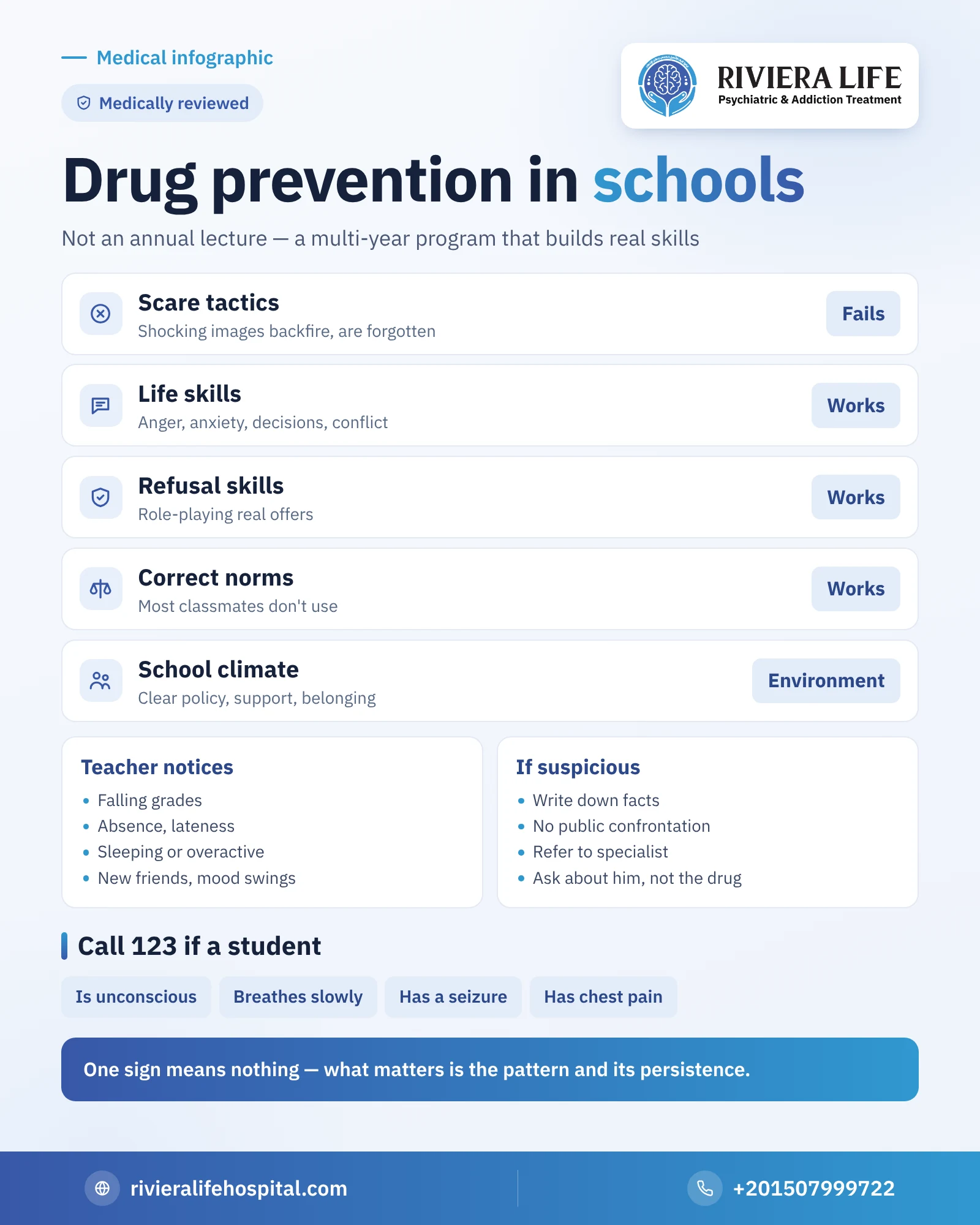
Pictures of damaged organs, stories of sudden death, and a recovered guest telling of his adventures are all common methods, but the evidence doesn’t support them as a means of prevention. A teenager sees classmates who tried and nothing in the pictures happened to them, so they conclude the talk is exaggerated and lose trust in the whole source. And the recovered person’s story may unintentionally carry the message that a person can use for years then survive and become a hero on stage. And a single event a year, however powerful, is forgotten within weeks.
This doesn’t mean hiding information, but presenting it accurately and calmly, within a wider program that changes skills and convictions, not just information.
The shape of an evidence-based school program
The programs that have shown results in studies share similar elements:
- Personal and social skills: dealing with anger and anxiety, decision-making, resolving disputes, and communicating with confidence.
- Refusal skills: practical training by acting out real situations, such as being offered an e-cigarette on a trip or a stimulant pill before an exam.
- Correcting the false impression: many teenagers think most of their classmates use, while the truth is usually that the number is much smaller than they imagine. This impression alone pushes some of them to try.
- An interactive style: discussion, small groups and role-play, not one-way instruction.
- Successive sessions: a series of meetings during the year, with booster sessions in the following years.
- A trained teacher: the program is delivered by someone trained in it, not someone assigned to it at the last minute.
Prevention by school stage
Primary stage
Almost no talk about drugs here. The focus is on an organized classroom, controlling behavior through encouragement, and teaching the child to name their feelings and deal with them. A child who learns early how to calm down and ask for help enters adolescence with better tools.
Preparatory stage
This is usually the age of the first offer: a cigarette, a vape or a substance a classmate shows off. Training in refusal, understanding peer pressure, and correcting the idea that everyone tries suit it.
Secondary stage
In it the pressure of studies and private lessons increases, and someone appears looking for pills to stay up or calm down. Talking about managing tension and sleep, the danger of medicines circulating among students, and exposing the advertisements of websites and influencers that glamorize use suit it. The effect of vaping at this age we explained in the article on e-cigarettes.
The school environment itself is part of prevention
The program inside the classroom isn’t enough if the school itself says the opposite message. Among the elements of a protective environment:
- A written and announced policy on smoking and substances, known to students, parents and teachers, and applied to everyone the same way.
- Penalties that are graduated and combined with support, not immediate expulsion that pushes the student onto the street.
- An easily accessible social worker or psychologist who keeps what is said to them.
- Sports and arts activities that make the student feel they belong, as a student connected to their school is less susceptible to use.
- Serious handling of bullying, because an isolated or humiliated student looks for another place that accepts them.
What does the teacher notice?
The teacher sees the student for hours every day, and may notice a change before the family. No teacher can judge that a student is using, but a pattern of changes deserves attention:
- A clear decline in grades after a steady level.
- Repeated absence, morning lateness or skipping classes.
- Sleeping in class or unusual overactivity for them.
- A sudden change of friends or moving away from old classmates.
- Irritability, withdrawal or mood swings that weren’t in their nature.
- A repeated strange smell, unexplained tools, or more money than usual.
One sign means nothing, as it may be depression, a problem at home, a sleep disorder or bullying. What matters is the pattern and its continuation.
How does the teacher act if they suspect a student?
- Write down what you saw: specific facts with their dates, not conclusions.
- Don’t confront them in front of classmates: public accusation closes the door and creates a stigma that follows them.
- Refer the matter to the specialist: they are the one who talks with the student privately and assesses the situation.
- Ask about how they are, not about the substance: a phrase such as “I’ve noticed you’ve been tired lately, is everything all right?” opens a conversation, not an investigation.
- Don’t search them yourself: dealing with any substance found follows the school’s regulations and administration.
If an emergency happens inside the school
A student may take a pill or unknown substance during break or in the toilet, and dangerous symptoms appear within minutes. Here there is no place for punishment or investigation, and the priority is their life.
Call an ambulance on 123 immediately if there appear
In a student after taking an unknown substance or pill:
- Loss of consciousness or difficulty waking them
- Very slow or intermittent breathing or blue lips
- Seizures
- Chest pain or severe palpitations
- Very high fever and severe agitation or hallucinations
Stay beside them until the ambulance arrives, put them on their side if they are unconscious and breathing, and keep any packet or remains to hand to the medical team, then inform the family.
Coordination between school and parents: a meeting, not a trial
The hardest moment is contacting the family. The way this contact is made determines whether the parents will cooperate or defend their son against the school. Some steps make the meeting fruitful:
- Start with the shared concern for the student, not with accusation.
- Present the written observations as they are, and let the family add what it sees at home.
- Agree on one clear step, such as an assessment by a psychiatrist, and a follow-up date.
- Respect privacy, so that only those who need to know the details know them.
For parents who receive this call there is a guide in the article on how do I know if my son is using, and a wider picture of this age in the article on teen addiction.
Returning to school after treatment
A student who has received treatment needs a school that welcomes them, not one that watches them with a look of suspicion. They benefit from a schedule that gradually makes up for what they missed, one teacher or specialist who follows them calmly, and protection from rumors among classmates. A stumbling return to the old group is among the biggest threats to recovery, which is why new activities help build different friendships.
Mistakes schools make
- Settling for one seminar a year and then considering the file closed.
- Relying on frightening and shocking pictures.
- Immediate expulsion without referral to treatment, so the student is left without school or supervision.
- A humiliating search in front of classmates.
- Random tests of all students as a prevention program, which the evidence doesn’t support for this purpose.
- Ignoring the insomnia, anxiety and concentration medicines circulating among secondary students.
How does Riviera Life help you?
If the meeting between school and family ends with the need for an assessment, the first consultation at Riviera Life is free and confidential. The consultants in psychiatry and addiction treatment assess the student, distinguish between passing experimenting, regular use and an accompanying mental disorder, then suggest the suitable level of care, including the students and teenagers treatment program. The parents take part in the family program, and aftercare continues after the return to study. The hospital is licensed by the Ministry of Health, has fourteen years of experience, and is located in Sheikh Zayed, Giza. To get in touch around the clock: +201507999722.
More from the prevention guide
- Drug prevention
- Parenting mistakes and addiction
- Teen addiction
- The students and teenagers treatment program
Questions many people ask
No. Scattered events are quickly forgotten, and what has an effect is a successive program that builds the student's skills in dealing with pressure, refusal and decision-making over the years of study.
It starts in primary school with skills for dealing with feelings and controlling behavior, then direct talk about substances and refusal is added in preparatory and secondary school.
They write down their observations and refer them calmly to the social worker or psychologist, without confronting the student in front of classmates or searching them themselves.
Immediate expulsion without referral to assessment and treatment leaves the student without supervision; better is a graduated penalty with a support plan and cooperation with the family.
The evidence doesn't support blanket random tests as a means of prevention, and they may harm trust between students and the school. Testing belongs in medical assessment when there are reasons.