“How do I know if my son is addicted to drugs?” The answer is that the likelihood grows when changes come together in more than one area of his life for weeks: a sudden drop in school performance, new friends he refuses to let you know, a phone that has become a locked secret, and sleep, eating and mood that have changed in a way that isn’t like him. Adolescence alone explains some of this, but it doesn’t explain a simultaneous collapse at school, at home and in health. This article is for a father or mother standing in the difficult space between excessive reassurance and hasty accusation: how to tell the difference, what to watch, and how to talk with him without losing him.
Is it adolescence or drugs?
This is the first question every parent asks, and it is a legitimate one. A normal teenager has mood swings, asks for more privacy, spends more time with friends, and may rebel against some rules. The difference is in degree, speed and breadth:
| An expected adolescent change | A change that deserves worry |
|---|---|
| Mood swings that pass within hours or days | Sharp irritability or flatness lasting weeks |
| Wanting privacy and closing the bedroom door | Complete secrecy and anger at any ordinary question |
| Changing some friends over time | Dropping all his old friends suddenly without explanation |
| A slight drop in one or two subjects | A collapse in grades and attendance together |
| Staying up during holidays | Reversed sleep on school days with difficulty waking |
| New interests replacing old ones | Loss of interest in everything with nothing replacing it |
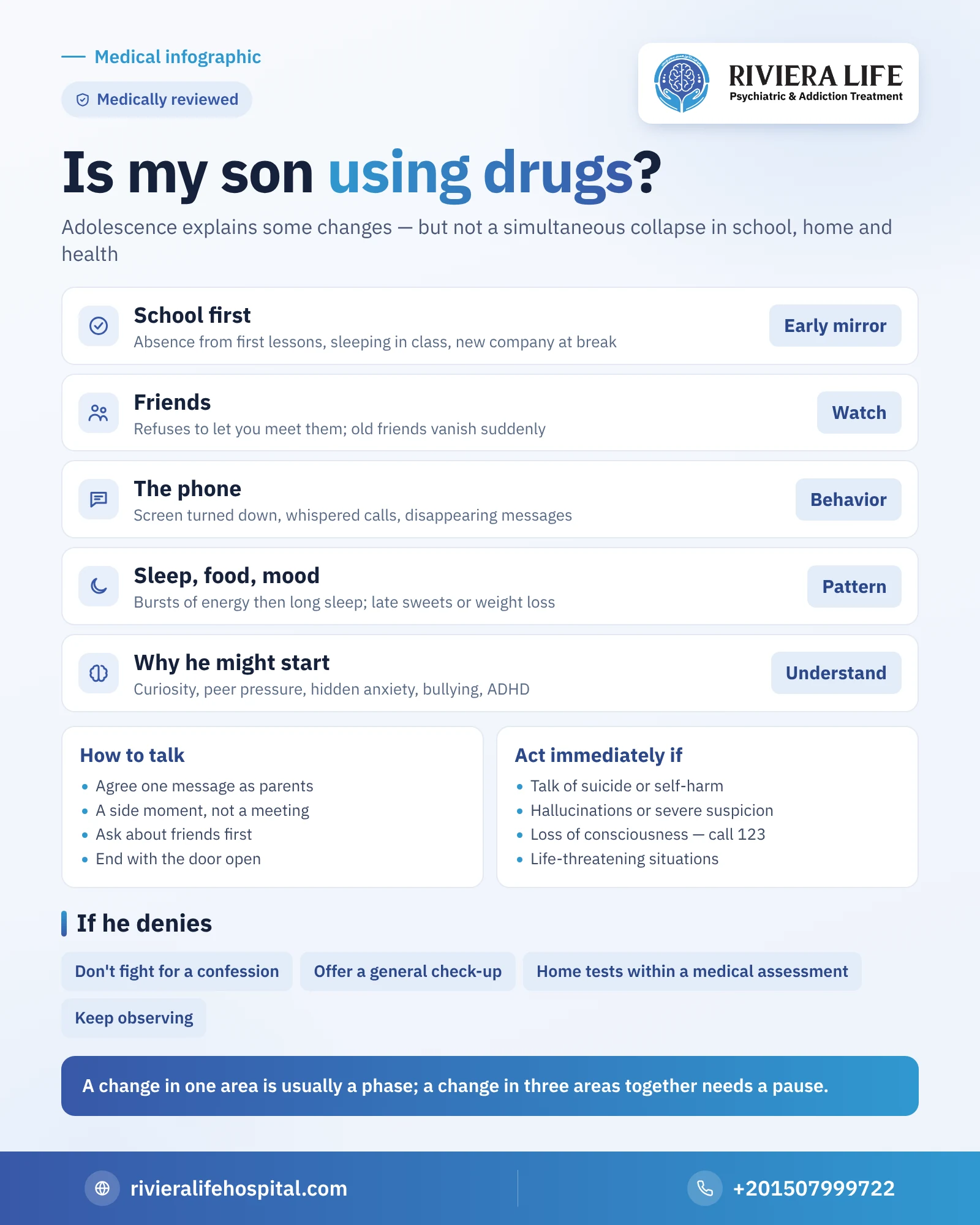
The rule, simply: a change in one area is usually a phase, and a change in three areas together needs a pause.
What does the school or university say?
School is an early mirror. Ask about attendance before grades, as repeated absence from first lessons or slipping out in the middle of the day shows up before results decline. Ask also about sleeping in class, fights, and a change in the group he sits with at break.
Contact a counselor or teacher you trust without revealing all your suspicions, and only ask for their observations. At university the picture is harder, but absence warning letters and endless requests for money for “notes” and “courses” are indicators worth following.
New friends: when are they a sign?
Not every new friend is a danger. But pay attention if your son completely refuses to let you meet them, if you don’t know their full names or families, if they are clearly older than him, or if he spends long hours with them in places he won’t specify. Clearer than new friends appearing is old ones disappearing: the friend who has visited since childhood and then suddenly stopped may have pulled away because he noticed something.
The phone: between privacy and safety
Secretly searching the phone may reveal something, but it carries a price: if your son discovers it, you will lose much of his trust at the time you need it most. Watch the behavior around the phone rather than its contents:
- He turns the screen face down whenever you enter the room.
- He answers short calls outside the house or in a very low voice.
- Messaging apps that delete messages automatically, or more than one account.
- He gets disproportionately angry if you hold his phone for a moment.
With a young son, you have the right to set open rules for phone use, and an open rule is far better than hidden monitoring. If you hear words you don’t understand, our article on drug slang explains the best-known ones.
Sleep, food and mood
Notice contradictory patterns: days of exaggerated energy, fast talk and little sleep, followed by days of lethargy and long sleep. Or a sudden craving for sweets late at night, or loss of appetite with weight loss. It is important to know that these same signs may be symptoms of depression, anxiety or a physical health problem, which is why the matter needs an assessment, not a home diagnosis. The look of the eyes, face and skin is detailed in our article on the appearance of a drug user, and the general household signs of money and equipment in how to know if there is a drug addict in your home.
Why might your son start using?
Understanding the motive changes how you talk to him. Some teenagers start out of curiosity and group pressure, some are looking to calm anxiety or sadness they don’t know how to express, and some suffer bullying or trauma they haven’t told anyone about. Behind it there may be an undiagnosed psychiatric disorder such as depression or attention-deficit hyperactivity disorder. When you know the motive, your conversation becomes about his real problem, not just the substance.
How do you talk to him without him shutting the door?
First, agree with the other parent on a single message, as a teenager quickly picks up disagreement between his parents and uses it. Then choose a side moment, not a formal meeting: a car ride, or a late moment in the kitchen. Teenagers talk more when they aren’t required to look you in the eye.
- Start with an open question: “I’ve noticed you’ve been very tired lately — what’s going on with you?”
- Ask about his friends before asking about him: “Do you know anyone at school trying pills or hashish?” Answering about others is easier.
- Acknowledge that the pressure is real: “I know everyone around you is trying things, and I won’t shout — I just want to understand.”
- End the conversation with the door open, even if he admits nothing.
If you reach the stage of persuading him into treatment, the detailed steps are in our article on how to help an addicted person and persuade my son into treatment.
If he denies completely
Denial is expected, and doesn’t necessarily mean he is lying or that you are wrong. Don’t enter a battle to extract a confession. Instead, suggest a general health check with a doctor, presented as concern about his tiredness, sleep and decline. Many teenagers accept “the doctor” when they refuse “addiction treatment”. To understand what goes on in his head during denial, read how a drug addict thinks.
And what about a drug test at home?
Imposing a home test on a teenager without preparation may win you a result and lose you your son, and a negative result doesn’t always rule out use. If you need a test, let it be part of a medical assessment; the details are in our guide to drug testing.
How can parents and school cooperate without scandal?
Many parents fear that someone outside the home will find out and that it will become a stigma that follows their son. But complete isolation deprives you of extra eyes that see him six hours a day. Share with the school counselor or school specialist to a limited extent: ask for their observations on attendance, concentration and company, without asking for a search or punitive measure.
At home, divide roles clearly between father and mother: who follows schoolwork, who follows pocket money and times, and who is closest for conversation. Neither of you should discuss suspicions in front of his younger siblings, as that puts him in the position of the accused in front of the whole household.
When do you act immediately?
Don’t wait for weeks of observation if he talks about suicide or harming himself, shows hallucinations or severe suspicion, loses consciousness, or gets involved in a situation that endangers his life. In medical emergencies call an ambulance on 123, and otherwise ask for an urgent psychiatric assessment.
A teenager’s personality changing: when is it growth and when is it a warning?
Personality in adolescence isn’t fixed: a quiet son may become sociable, a cheerful one may lean toward seriousness, and tastes, jokes and dreams change. This change comes gradually and the core of the person remains familiar to you. What calls for attention is a sudden reversal that makes you feel you are facing a different person.
Examples that recur in families:
- A warm son has become cold and harsh with his siblings and mother.
- Lying about small things that don’t need lying about.
- Outbursts of anger or crying for no apparent reason, then complete indifference.
- Exaggerated suspicion that someone is watching him or talking about him.
- Giving up a hobby he loved for years without replacing it with anything.
Don’t jump to drugs alone, as these same changes appear with depression, anxiety, bullying and study pressure. Read about teen depression and its signs and the difference between normal mood swings and a disorder before you judge.
It is more useful to write down what you have noticed with dates and examples instead of general statements, then talk with your son at a calm time, and present the matter to a doctor if the change lasts for weeks. Our article on teen addiction and how parents protect their children gathers the risk and protective factors of the growing years.
One thing parents overlook is empty bottles of cough syrup in their son’s room without a cold, which may point to misuse of cough syrup containing dextromethorphan.
How can Riviera Life help you?
Treating a teenager differs from treating an adult in every detail: in the way of talking, the role of the parents and dealing with school. That is why we offer a special program for students and teenagers in which the parents take part, under the supervision of consultants in psychiatry and addiction treatment and in complete confidentiality. Start with a free first consultation on +201507999722.
Read also
- Signs of a drug addict at home: pocket money, equipment and a changed daily routine
- Dealing with a hashish addict and persuading them into treatment
- Drug prevention: how to protect your family
- The family rehabilitation program for addiction treatment
Questions many people ask
Not necessarily. Irritability and isolation may come from adolescence, depression or a problem at school. Worry grows when they come together with changes in study, friends, money and sleep for weeks.
Secret searching may cost you his trust if he discovers it. It is better to set open rules for phone use, watch the behavior around it, and ask for a specialist assessment if suspicions grow.
Experimenting may start in middle or high school years, sometimes earlier, often with cigarettes, hashish or pills passed around among friends.
Present the visit as a check on his tiredness, sleep and decline, not as addiction treatment; go with him, and let the doctor handle talking about the causes.
You can share with the school counselor to a limited extent to ask for their observations on attendance, concentration and company, without revealing all the details or asking for punitive measures.