Bullying isn’t “a heavy joke” or “a phase that passes”; it is repeated aggressive behavior by a person or group towards someone weaker or less able to respond, intended to hurt or humiliate. It happens in the classroom, on the club’s playing field, at work and on a phone screen at three in the morning. Its effect doesn’t stop at tears: it may leave anxiety, depression and academic decline, and may last for years after the situation itself has ended. In this article we explain the forms of bullying, the signs that a child or adult is being bullied, the role of parents and school, how to deal with cyberbullying, and when psychological intervention becomes necessary.
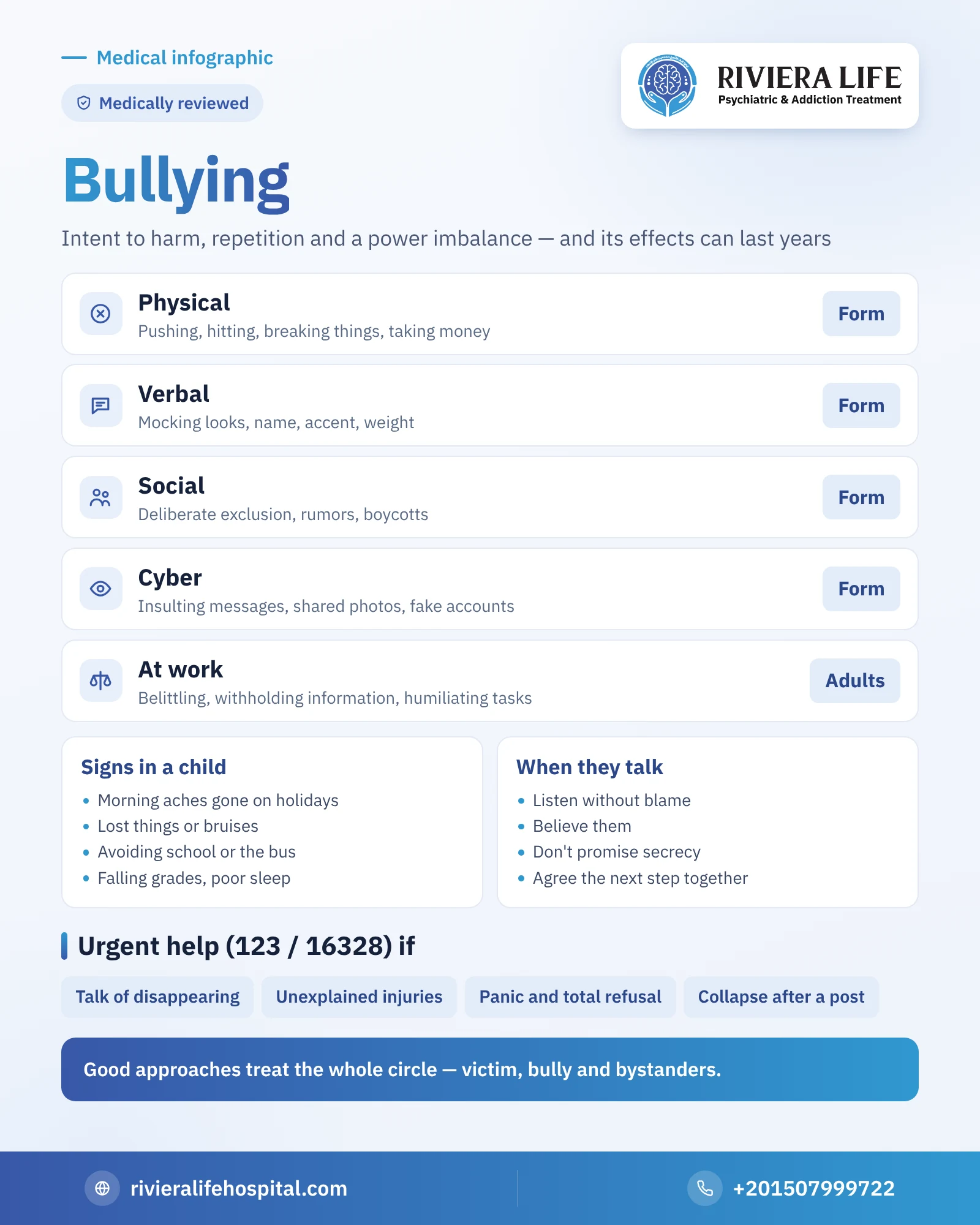
Seek urgent help immediately if you see
If someone who has been bullied says they want to disappear or harm themselves, don't postpone it or treat it as exaggeration. Stay with them, and call an ambulance on 123 or the mental health hotline on 16328, or go to the nearest emergency department.
- Talk of death or wanting to disappear
- Harming the body, or finding signs of unexplained injuries
- Complete refusal to go out, to school or to work, with crying and panic
- A sudden collapse after an offensive message or post
What makes behavior bullying?
Not every disagreement between two children is bullying. A passing fight between equals differs from a situation where harm is repeated and one side is unable to defend themselves. Specialists talk about three elements together: intent to harm, repetition or the likelihood of repetition, and an imbalance of power, whether that power is physical, numerical, social or even technical.
This distinction matters in practice. If we describe every friction as bullying, the word loses its weight. And if we play down real bullying and call it “joking”, we leave the victim alone.
Forms of bullying
- Physical: pushing, hitting, breaking belongings and taking pocket money by force.
- Verbal: mocking someone’s appearance, name, accent, weight or financial situation, and hurtful nicknames repeated in front of others.
- Social (relational): deliberate exclusion from the group, spreading rumors, and inciting others to boycott someone. This is what most escapes adults’ eyes.
- Cyber: insulting messages, embarrassing pictures posted without permission, groups opened to exclude someone, or fake accounts that pursue them.
- At work: repeatedly belittling an employee’s effort in front of colleagues, withholding information from them, humiliating tasks, and veiled threats to their position.
Signs that a child is being bullied
A child rarely says “I’m being bullied”. They are ashamed, or fear it will get worse, or think they deserve what is happening. That is why changes speak for them:
- Morning physical complaints, such as stomach ache or headache, that disappear in the holidays.
- Lost belongings, torn clothes or bruises they don’t explain.
- A sudden change in the route to school or refusing to take the bus.
- A decline in grades and loss of enthusiasm for activities they used to love.
- Irritability at home, crying for no clear reason, or disturbed sleep and eating.
- Distress when a notification arrives on the phone, or hiding the screen when someone approaches.
These signs may also mean other things, such as anxiety or depression, but they all deserve a calm conversation. To learn about the wider pictures of illness in young people, see our article on mental illness in children.
What does bullying do to the mind?
Humans are social beings, and read repeated humiliation from others as a judgment on their worth. Over time this judgment may seep inside and become a voice repeating “I’m weak” and “no one loves me”. Researchers link being bullied to a higher likelihood of anxiety, depression and isolation, sleep problems and physical complaints, and sometimes thoughts of self-harm. It is enough to read about social phobia symptoms to see how a repeated experience of humiliation can turn into fear of people.
And the victim isn’t the only one affected. A child who bullies others is sometimes a victim elsewhere, grows up in a home dominated by violence, or tries to build status by force. And a child who watches and doesn’t intervene may carry a feeling of guilt and helplessness. That is why a good approach treats the whole circle, not just the victim.
How do you talk with your child if you suspect they are being bullied?
Choose a calm time, and don’t start with interrogation. A sentence such as “I’ve noticed you’re less keen on school lately, and I’m with you if something is bothering you” opens the door more than “who bothered you? Tell me now”. And when they talk, do the following:
- Listen to the end without interrupting or blaming, and don’t ask them “why didn’t you respond?”.
- Believe them and tell them clearly that what happened isn’t their fault.
- Don’t promise them what you can’t deliver, such as “I won’t tell anyone”, as you may need to involve the school.
- Agree together on the next step instead of imposing it on them.
- Avoid the advice “hit him” or “always ignore it”; the first may increase the danger, and the second isn’t enough if the harm continues.
The role of the school and parents
Communication with the school should be in writing and with facts: when the situation happened, who was present, and its effect. Keep pictures of messages and posts before they are deleted. Ask for a meeting with the social counselor or administration, ask about the school’s published procedures, then follow up. A school that takes the matter seriously protects the child and deals with the bully together, rather than just moving one of them to another class.
At home, help your child regain their confidence: an activity they are good at, one safe friendship is enough at first, and a fixed sleep routine. If long withdrawal or persistent sadness appears, read teen depression to know the difference between distress over a situation and an illness that needs treatment.
Cyberbullying: what is different?
Abuse on a screen doesn’t end when the school day ends. It follows the child into their room, is seen by a wider audience, and can be captured and reposted. The child often hides it because they fear their phone will be taken away, fears the bully exploits. Therefore:
- Reassure them that the phone won’t be a punishment for what happened.
- Take screenshots of the messages before deleting them, then block the account and report it to the platform.
- Close the accounts or make them private temporarily, and review friend lists with them.
- Tell the school if the bully is a classmate; those with legal standing can also turn to the competent authorities if the messages include threats or blackmail.
Bullying in adults and at work
Bullying doesn’t stop at adolescence. At work it may appear as constantly belittling someone in front of the team, excluding them from meetings, or blaming them for others’ mistakes. Adults usually feel ashamed and blame themselves, so they keep it to themselves and it turns into anxiety and exhaustion. If this is your situation, write down the incidents with dates, talk to someone you trust, refer to the company’s policies or human resources, and remember that asking for psychological support isn’t weakness. And if exhaustion turns into loss of enthusiasm and constant depletion, our article on burnout may help you.
When does psychological treatment become necessary?
Ask for an assessment by a psychiatrist or specialist if any of these signs appear: sadness or anxiety lasting weeks, panic attacks, nightmares and strong avoidance of particular places, a noticeable change in sleep and eating, isolation from everyone, or any talk of self-harm.
Treatment here targets the effect, not just the situation: psychotherapy, including cognitive behavioral therapy, which helps change hurtful thoughts about the self, work with the family, and medicine in certain cases decided by the doctor. If bullying has left the mark of trauma, our article on psychological trauma explains what may happen and how it is treated. And if self-harm is present, there is a dedicated article on self-harm and how to help someone you love.
And what about the teenager who bullies others?
If you discover that your son is the one hurting others, don’t automatically defend him or crush him. Ask him to describe what he did in his own words, talk about its effect on the other person, set clear limits and logical consequences, and look for the motive: anger, a sense of inferiority, or imitating what he sees at home or among his friends. If bullying is combined with substance use, severe rebellion or violence, the teenager may need a specialist assessment, and at Riviera Life you will find a program for students and teenagers.
How can Riviera Life help you?
If bullying has left a psychological mark on your child or on you, you can ask for a free first consultation with a consultant psychiatrist at Riviera Life, in complete confidentiality, to assess the case and set a plan suited to the age that involves the family. The hospital is licensed by the Ministry of Health in Sheikh Zayed, Giza, and you can get in touch on +201507999722.
Read also
- Mental illness in children
- Self-harm: how to help someone you love
- Loneliness and social isolation
- Mental illnesses: symptoms, types and treatment
Questions many people ask
Bullying is repeated harmful behavior intended to hurt, with an imbalance of power, while a fight is a disagreement between usually equal parties that is followed by making up.
Watch for morning physical complaints, lost belongings, refusing to go to school, falling grades and changes in sleep or mood, then open a calm conversation without interrogation.
That isn't advised because it may increase the danger and expose them to punishment. It is better to train them to walk away and ask an adult for help, and to involve the school.
Save screenshots of the messages, block the account and report it to the platform, tell the school if the bully is a classmate, and reassure your child that the phone won't be taken away as a punishment.
When sadness or anxiety continues for weeks, or there are panic attacks, complete isolation, sharp changes in sleep and eating, or any talk of self-harm, immediately.