Drug users’ slang is ordinary-looking words and phrases that some users give a special meaning when they talk about their state, their urge to use, or their tiredness when the drug is absent. A phrase like “fix my head” or “my body is broken” may pass the family by unnoticed, and in a certain context it may be a sign worth stopping at. This article explains the most common of these expressions in everyday speech, what they usually mean, and why they aren’t enough on their own as evidence of anything. The aim is for you to understand what you hear, not to become an investigator in your own home.
What is drug users’ slang, and how does it differ from drug names?
There are two kinds of words that many people confuse. The first is street names given to the substances themselves, such as bango, shabu and strox, which we explained in detail in our article on drug street names among young people in Egypt. The second kind, the subject of this article, is the language of conversation itself: how a user describes their feeling, how they express their need, and how they refer to the matter without naming it. Because nicknames differ from country to country, we have a separate article on common drug names among young people in Saudi Arabia.
This language changes from neighborhood to neighborhood and generation to generation, and much of it is words everyone uses in their simple meaning. So there is no final list; what we present here is the most common in Egyptian speech, with an explanation of the context that makes a word worrying.
Why does a user speak a special language?
- Concealment: a general word like “the thing” lets them talk in front of others without anyone understanding.
- Belonging: sharing the same vocabulary creates a sense of group, and makes leaving it harder.
- Softening: saying “I’m just unwinding a bit” is easier on the self than admitting to using.
- Normalizing: with repetition of playful words, use becomes an ordinary part of the day in the user’s eyes.
Understanding these motives helps you read the speech calmly: special language is a symptom of a situation, not a crime in itself.
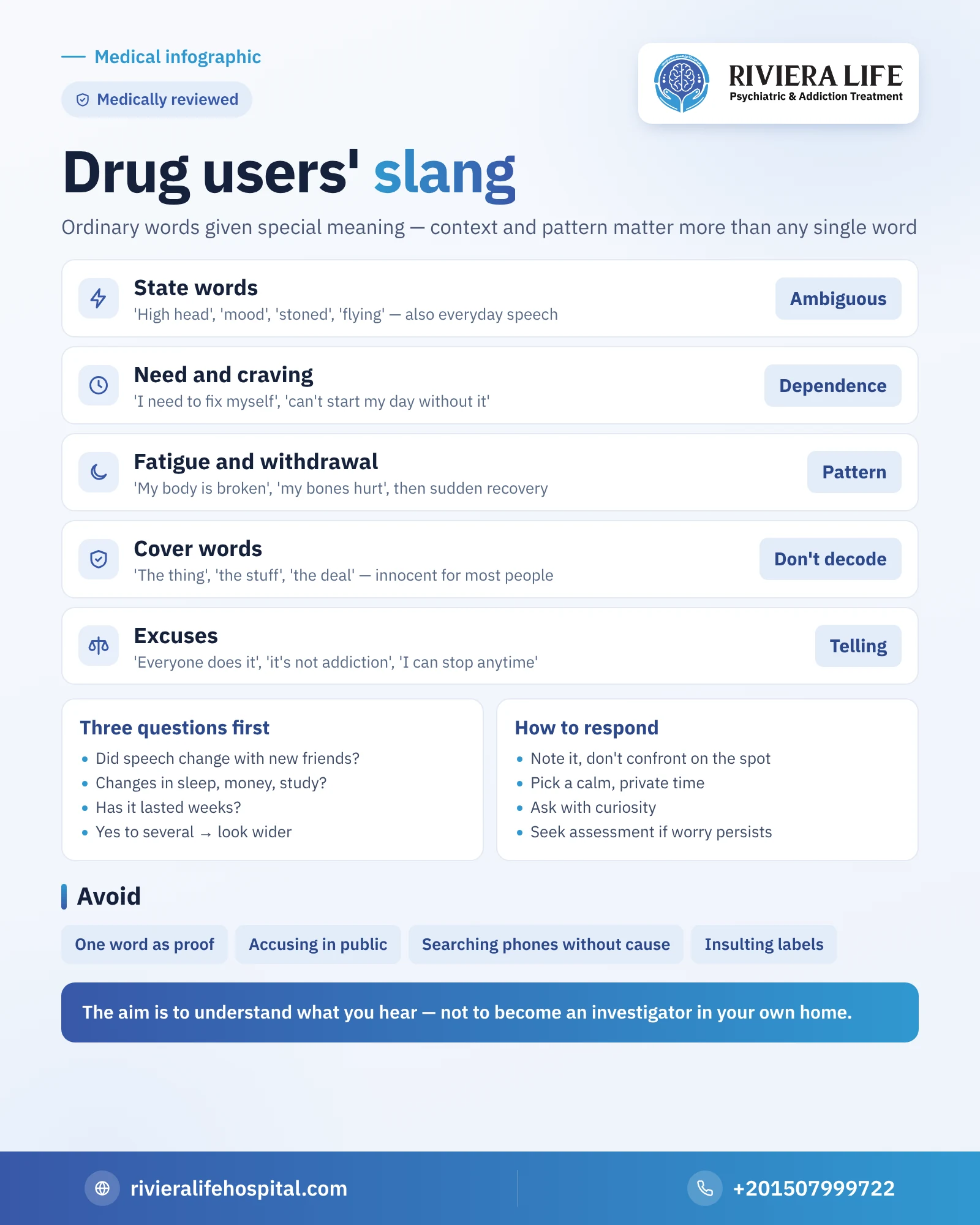
Words that describe the state and the effect
These are the most common expressions, and at the same time the most ambiguous, because most are part of ordinary speech:
| Expression | What the user may mean | Why it isn’t enough alone |
|---|---|---|
| “Head” / “his head is high” | That he is under the influence of a substance | Also said about a good mood or tiredness |
| “Mood” / “kaif” | The state of the high, or wanting it | Two common words about coffee, tea and late nights |
| “Mastool” / “satlan” (stoned) | Drugged and slow to respond | May be used jokingly about someone absent-minded or sleepy |
| “Rayeq” / “fasel” (chilled, disconnected) | Disconnected from pressures by a substance | Originally means calm and relaxation |
| “Tayer” (flying) | A strong effect or excessive energy | Also said about great joy |
The word means nothing on its own here. What makes it worrying is repetition together with other signs, such as red eyes, unusual sleepiness or continuous sleeplessness.
Phrases that reveal craving and need
When use turns into dependence, phrases appear in speech showing that the person can no longer get through their day without the substance:
- “I need to fix myself” or “I have to sort my head out”: wanting to use before a task or after stress.
- “I can’t start my day without it”: an early sign of dependence.
- “Something’s missing” or “I’m not right today”: a vague discomfort that goes away after they go out and come back.
These phrases matter more than words about the effect, because they reflect a loss of control, which is the essence of addiction. Even so, someone may say them meaning cigarettes or coffee, so context decides.
Words that describe tiredness and withdrawal
Some users express the symptoms of the substance’s absence in simple physical words: “my body is broken”, “my bones hurt”, “I’m dried out”, “I can’t sleep”, “I can’t get up”. These complaints may come with a runny nose, yawning and sharp irritability, then suddenly disappear. This pattern, severe tiredness followed by a quick improvement with no clear reason, is more telling than any word. You’ll find this stage explained medically in our article on drug withdrawal symptoms.
An important warning: don’t try to ease these symptoms with medicines from home or the pharmacy without a doctor, as some withdrawal states need real medical supervision.
Cover words and indirect references
Here the most neutral words are used to cover the subject: “the thing”, “the stuff”, “the deal”, “the matter”, “our friend”. All are words that sellers, students and employees use every day in completely innocent meanings. So they shouldn’t be treated as a code; trying to decode every word drives the family to suspect everything, and ruins trust for no benefit.
What deserves attention is the pattern, not the word: short, repeated calls followed by sudden going out, conversation that stops when you enter the room, or requests for money with no convincing explanation.
Words of justification and minimizing
One of the clearest signs of the problem is the language used to defend it. Phrases like “everyone does it”, “it’s not addiction, it just helps me unwind”, “these are nerve pills, not drugs” and “I can stop whenever I want” recur often in someone who has started to lose control. They aren’t always deliberate lies, but part of a way of thinking that protects the person from facing the truth; we explained its mechanisms in our article on how a person with addiction thinks.
Responding to these phrases with argument rarely helps. It is better to describe what you see calmly: “I’ve noticed you aren’t sleeping, you’re angry all the time, and I’m worried.”
How do you tell an innocent word from a worrying one?
Ask yourself three questions before drawing any conclusion:
- Did the way they talk change suddenly along with a change of friends or places they stay out at?
- Do the expressions come with changes in sleep, appetite, money or study?
- Has the pattern repeated over weeks, not just once?
If the answer is yes to more than one question, move from listening to wider observation, as in our guide on how to know if someone at home is using drugs. But if the word alone is all you have, it most likely means nothing.
What about symbols and short messages?
Some young people use emojis and abbreviations in messages, and their meanings change very quickly. We won’t publish a list of them, for two reasons: they become outdated within months and mislead more than they help, and publishing them may teach non-users ways to hide things. What helps families more is following the general digital behavior of younger children, such as new hidden accounts or constantly deleted chats, while respecting the privacy of older ones and setting clear house rules.
How should you respond when you hear a word that worries you?
- Note what you heard and when, without confronting at that moment.
- Choose a calm, private time, when the person is in their normal state.
- Ask with curiosity: “I heard you say such-and-such; what did you mean?”
- Listen without mockery or threats, because threats close the door to conversation.
- If the worry continues, ask for a specialist assessment rather than relying on guesswork.
And avoid the recurring mistakes: treating a single word as evidence, accusing in front of others, searching the phone without serious cause, and describing the person in insulting terms such as “addict” or “good-for-nothing”, because these labels push them toward denial instead of asking for help.
How do you talk with your son about these words?
Start early, before there is a problem. Ask him what he hears at school or online, explain that cute names hide substances of unknown composition, and that “everyone does it” isn’t true. And give him a safe way out: if he gets into a dangerous situation, he should call you, and the talk about consequences will come later. If signs appear that go beyond words, our article how do I know if my son is addicted to drugs? helps you plan the next step.
How can Riviera Life help you?
Words open the door to the question, and a medical assessment is what answers it. At Riviera Life in Sheikh Zayed, consultants in psychiatry and addiction treatment carry out a confidential assessment that determines whether there is actually use, at what level, and what the right step is; the first consultation is free on +201507999722. And if you see loss of consciousness, slow breathing or seizures, call an ambulance on 123 immediately.
Read also
- Drug street names among young people in Egypt
- The traits and appearance of a drug user
- How can I help someone with addiction?
- Ways to prevent drug use
Questions many people ask
No. Most of these words are part of ordinary speech and spread online. What deserves attention is their repetition together with changes in sleep, money and friends over several weeks.
It may mean wanting to use to regain balance before a task or after stress, one of the phrases that reflect dependence. But it may be said about coffee or cigarettes, so context decides.
No. Vocabulary changes between areas and generations and shifts within months, so relying on old lists misleads more than it helps.
It is better to note what you heard, then choose a calm time when he is in his normal state, and ask with curiosity what he meant, without accusation or threats.
Because their meanings change very quickly, and publishing them may teach non-users ways to hide things. Following general digital behavior helps families more than decoding symbols.