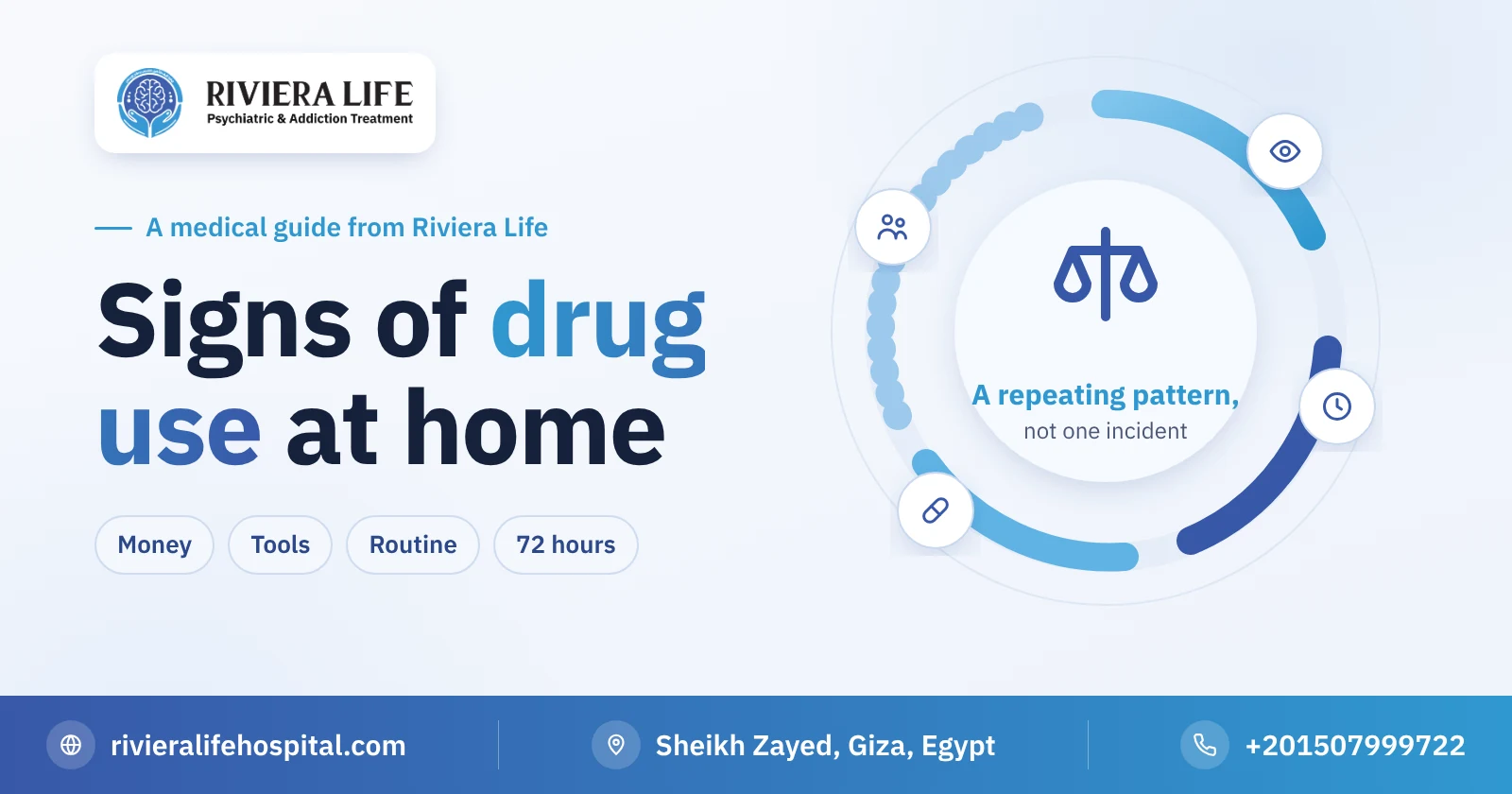
How do you know if there is a drug addict in your home? From a pattern that repeats inside the home itself, not from a single incident: money disappearing without explanation, things sold or lost, a daily routine that changes, strange tools appearing in a room or car, and medicines going down in the drawer. One sign isn’t enough to judge, but three or four together for weeks is reason enough to act. In this article we set out what you can notice inside the home in particular, how to handle what you find safely, and the first steps in the three days after the discovery.
How to know if there’s a drug addict at home: where does observation start?
The home reveals more than the person’s face. A user may manage to hide their features from you for minutes, but can’t hide their effect on things, money and schedules for months. So focus on four sources: routine, money and belongings, tools and physical traces, and the medicine cabinet.
The physical features of eyes, skin and weight have a separate article, the appearance of a drug user, and if the person you suspect is a teenage son, you will find the signs at school, with friends and on the phone in our article how do I know if my son is addicted to drugs.
Changed routine: what is different in the household’s day?
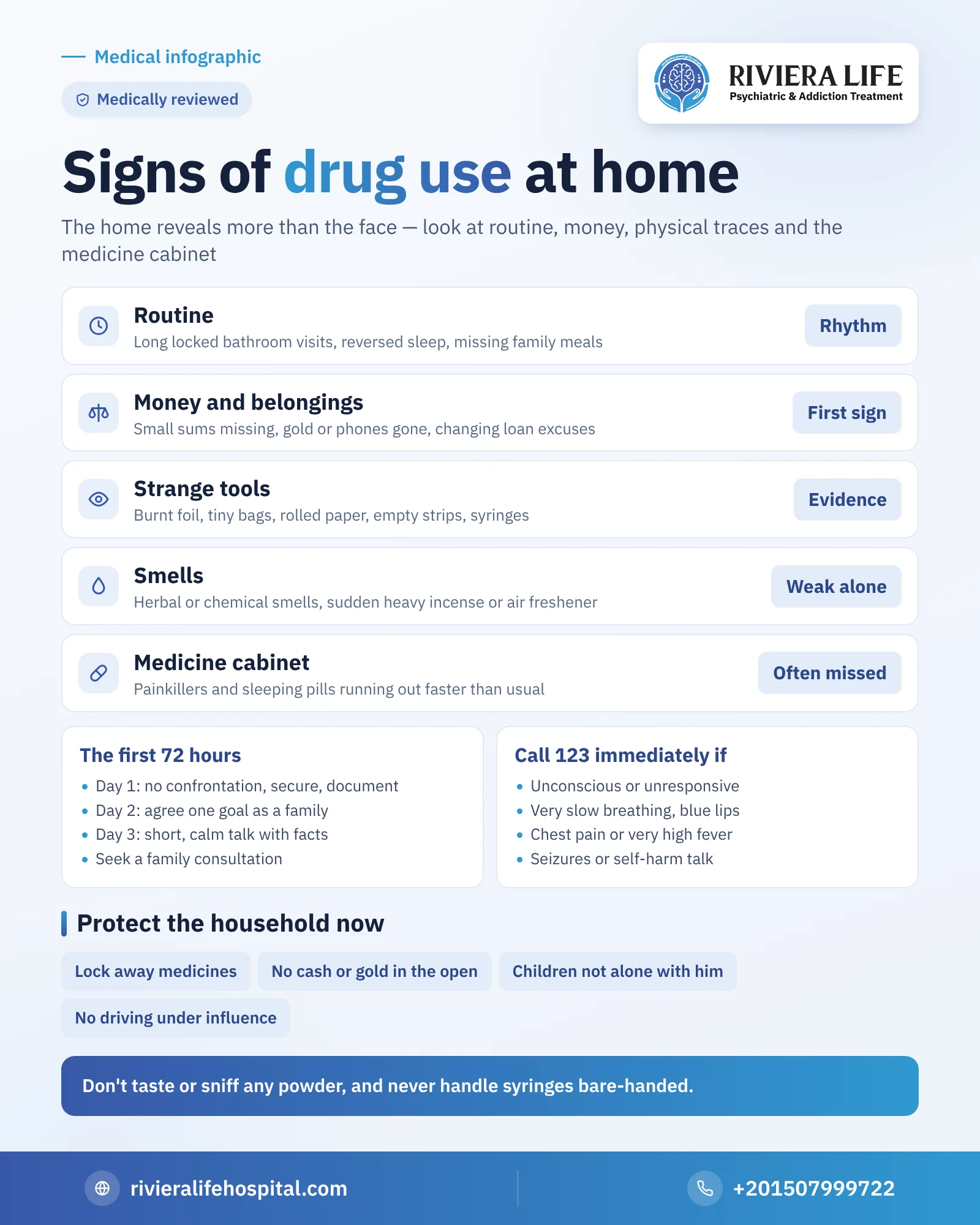
Watch the rhythm, not the moment. Do they now spend a long time in the bathroom with the door locked and the fan or water running? Do they suddenly go out for a quarter of an hour after a short call and come back in a completely different mood? Has their room become a closed zone no one enters, even to clean it?
- Reversed hours: staying up until dawn and sleeping long in the day, or days of almost no sleep followed by heavy sleep.
- Absence from family rituals: avoiding family lunch and visits, and eating alone at strange times.
- Dropped responsibilities: unpaid bills, postponed errands, and children waiting for them who don’t come.
- Guests you don’t know: people who stop quickly at the door and don’t come in.
Money and belongings: the clearest trace in the home
Drugs need a regular supply of money, which is why the problem usually shows in the accounts before anywhere else. You may notice the cash in your wallet or the housekeeping drawer going down in small, repeated amounts, or that gold, an old phone or an electrical tool has disappeared, or that they are selling personal belongings they used to treasure.
Less obvious signs include asking for loans with reasons that change every time, messages from friends demanding debts, and pocket money running out in a few days without visible purchases. Record the dates and amounts calmly; these figures will be stronger than any accusation when the time comes to talk.
What if you find strange tools?
Some ordinary things turn into tools for using, and finding them together in one place is what draws attention:
| What you might find | What it might point to |
|---|---|
| Silver (aluminum) foil burnt on one side, or spoons blackened underneath | Smoking or heating substances such as heroin |
| Very small bags, rolled paper strips, or cards with powder on the edges | Dividing or snorting a powder |
| Pierced water bottles or cans, lots of rolling papers, multiple lighters | Smoking hashish or strox |
| Empty strips of medicines not prescribed to them by a doctor | Misuse of medicines such as tramadol or pregabalin |
| Syringes, rubber bands, or stained cotton | Injecting, the most dangerous |
How do you handle what you find safely?
Don’t taste any powder or sniff it closely, and don’t touch syringes with bare hands; put on a glove and place them in a hard, closed plastic container. Photograph what you found where it was, and keep it away from children. Most importantly: don’t throw the substances in their face at the moment of discovery; physical evidence is more useful in an assessment than in a confrontation. To understand strange words you may hear in their calls, our article on drug slang and its meanings will help.
Smells and traces in the space
A pungent smell like burnt grass in the room, clothes or car, or a strange chemical smell, or a sudden exaggerated use of incense and air fresheners. You will also find small burns in carpets, car seats or clothes, and windows opened in the cold. Don’t base a judgment on smell alone, as ordinary cigarettes and shisha may mix with it.
The smell of drugs at home: what it indicates and what it doesn’t
Smell is weak evidence that needs caution: it varies with the substance and method of use, mixes with tobacco, incense and shisha, and many substances give off none at all. The practical rule is that smell prompts you to observe but isn’t enough for an accusation.
- Hashish and marijuana: a sharp, heavy herbal smell that clings to curtains and clothes and lingers after smoking ends.
- Strox and synthetic substances: a sweet or chemical smell that differs from one batch to another.
- Ice: a pungent chemical smell that may resemble burning plastic when smoked.
- Pills and injections: no notable smell, so evidence comes from tools and behavior, not the nose.
Pay attention to a smell being suddenly covered up: incense, air freshener or strong perfume appearing at a particular time of day for no understandable reason, or changing clothes right before entering the house. These are patterns that repeat; a one-off smell means nothing.
If the smell persists along with changes in money, sleep and mood, read about the behavior of hashish users or ice addiction symptoms, depending on what you are facing.
The medicine cabinet: the place many forget
In Egyptian homes, a large part of addiction begins in the home drawer: a strong painkiller prescribed for a grandmother, a sleeping pill for a mother, or nerve tablets for a father. If you notice the number of tablets going down faster than usual, a whole strip disappearing, or boxes being returned to their places empty, this is a sign worth attention. Count the tablets calmly for two weeks before concluding anything.
Where drugs are hidden at home: where are they usually kept?
Someone hiding a substance or tools doesn’t put them in plain sight, but chooses places no one searches. Knowing these places helps the family understand, but doesn’t mean turning into a daily search team; repeated searching destroys trust and pushes the person to more secrecy.
- Pockets of old clothes, shoes, backpacks and wallets.
- The car: storage boxes, under the seats and door pockets.
- The room: behind wardrobes, inside charger boxes and old devices, and in air vents.
- Places out of sight: the roof, storeroom, garage and a rarely used bathroom.
- Ordinary-looking containers, such as empty medicine boxes and drink and food cans.
More important than the place is repetition: finding the same thing in several places, its location changing every week, or it appearing alongside signs in money, sleep and mood. A single strange object may have another explanation, so don’t judge by it alone.
If you find something, handle it with the caution described above, and photograph it before moving it. After that, move on to the steps in how to help an addicted person instead of an angry confrontation, and if the person you suspect is your son, read how do I know if my son is addicted to drugs.
When does suspicion become reasonable certainty?
The practical rule is: a continuing pattern, not an incident. Write your observations in a notebook or on your phone for two or three weeks: the date, what happened, and who noticed it. If you have an effect on money, a change in routine and a physical object you found together, you are facing a picture that needs a specialist assessment, even if you don’t yet know exactly what the substance is.
You may be tempted to buy a test strip from the pharmacy to settle the doubt. A home test may give a false result in both directions, doesn’t detect many synthetic substances, and imposing it by force destroys trust. The details are in our guide to drug testing.
How do you protect the rest of the household now?
- Medicines: gather all sedative and painkilling medicines in a box locked with a key.
- Money and belongings: don’t leave cash or gold in open places, and use direct payment instead of cash.
- Children: don’t leave young children alone in their care until the picture is clear.
- Car keys: no driving if they show any influence, drowsiness or disturbance.
The first 72 hours after the discovery: what do you do?
Day one: no confrontation. Calm down, secure the medicines and money, and document what you found.
Day two: sit with one or two family members you trust, and agree on one goal: reaching a confidential medical assessment, not punishment or scandal. On this day you can also ask for a consultation for the family alone before any step with them.
Day three: choose a time when they are sober and calm, and start a short conversation with the facts you recorded. The method of persuasion itself, and how to respond to refusal, is the subject of our article on how to help an addicted person and persuade them into treatment. If they meet you with denial and anger, don’t be surprised; our article on how a drug addict thinks explains why.
If you know the type of substance
Each substance has a relatively different way of being handled, which is why we have prepared separate guides for the family: dealing with a hashish addict, dealing with a heroin addict, and dealing with an ice addict.
When should you never wait?
Call an ambulance on 123 immediately if you see
If you find a member of the household in this state, don't wait for them to come round, and stay with them until help arrives.
- Loss of consciousness or no response to calling and shaking
- Very slow or irregular breathing, or blue lips
- Severe chest pain, or a very high temperature with agitation
- Seizures
- Hallucinations or aggression threatening their safety or others’
- Open talk of self-harm or suicide
If the person themselves is ready to talk, they can answer the drug addiction test based on diagnostic criteria; its result indicates the level of severity and makes the treatment decision easier.
How can Riviera Life help you?
You don’t need to be completely sure to contact us. The family can present what it has noticed to an addiction consultant in a free and confidential first consultation, to help it read the picture and decide the next step. Riviera Life’s team in Sheikh Zayed, with fourteen years of experience and round-the-clock medical supervision, is available on +201507999722.
And if your suspicions are confirmed, don’t delay contacting an addiction treatment hospital for a confidential assessment before the condition develops.
Read also
- The appearance of a drug user in the face and body
- How do I know if my son is addicted to drugs?
- How to help an addicted person and persuade them into treatment
- How does a drug addict think, and why do they deny?
- My father is addicted to drugs — what do I do? A guide for children on protection and support
Questions many people ask
The problem often shows in money first: cash going missing in small amounts, repeated requests for loans with changing reasons, and things sold or disappearing, before other signs become clear.
It is a strong indicator worth attention, but not a diagnosis. Collect it safely and document it, link it to what you notice in behavior and money, then ask for a specialist assessment before any accusation.
It is better to postpone confrontation a day or two until you calm down and the family agrees on one goal, and to choose a time when he isn't under the influence of any substance.
Don't touch it with bare hands; put on a glove and place it in a hard, closed plastic container away from children, and ask the pharmacy or hospital how to dispose of it safely.
Yes, for a while, especially at the beginning or with substances taken at long intervals. But the effect on money and routine usually shows with continued use.