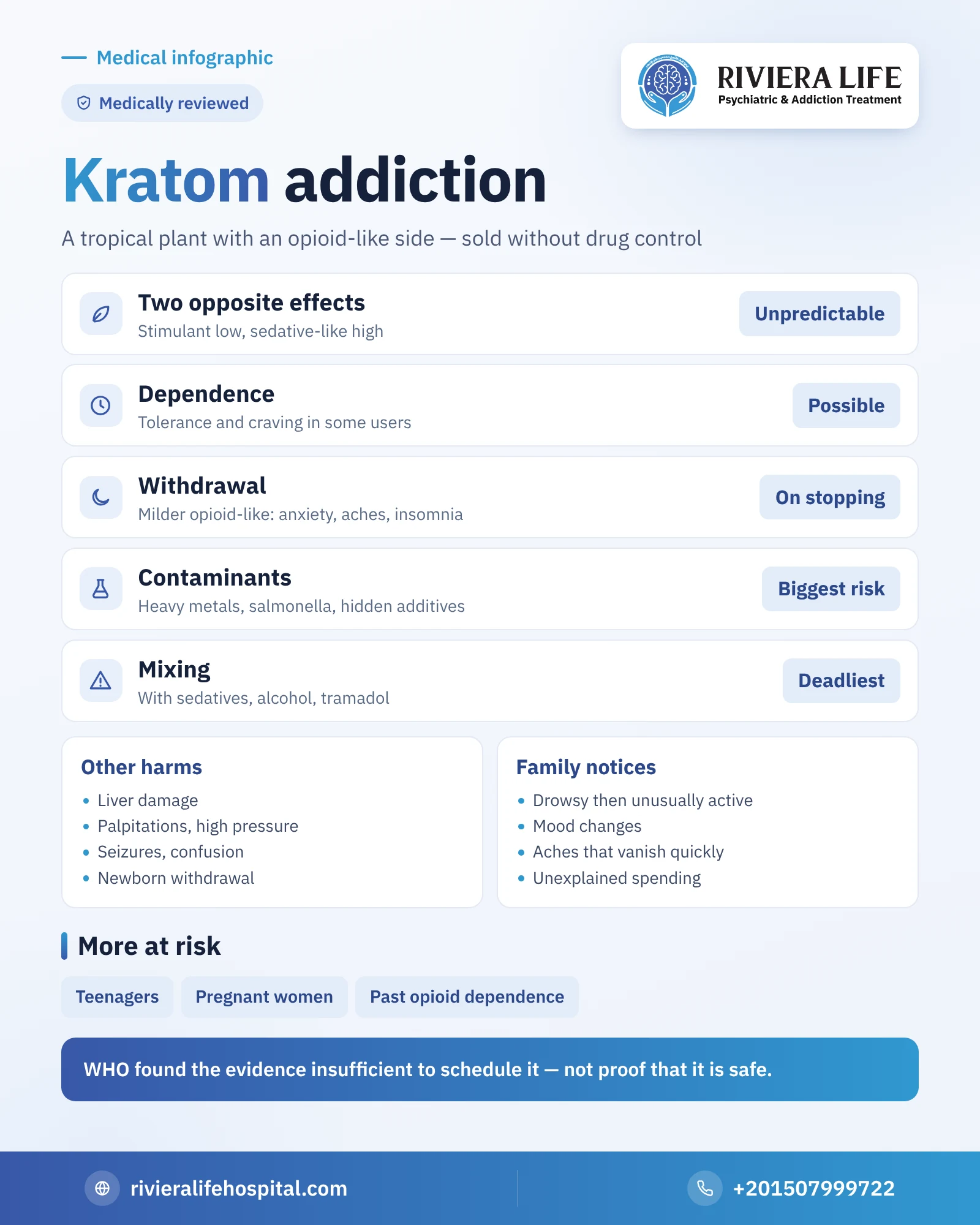
Kratom addiction is possible, even though many think of it as an innocent plant because it is “natural”. Kratom is a tropical plant from Southeast Asia whose leaves and products are used as a mild stimulant, painkiller and sedative, and it is marketed in some markets as an alternative to painkillers. Its effect resembles opioids in one respect, and its products aren’t subject to drug control, so their content may differ from pack to pack and may carry contaminants or added substances. Dependence and withdrawal symptoms happen in some users and vary in severity, and in this article we explain what is known and unknown and when a doctor is needed.
What is kratom and why does it cause two opposite effects?
The plant’s leaves (scientific name Mitragyna speciosa) contain active alkaloid compounds, the most important of which are mitragynine and 7-hydroxymitragynine. These compounds appear to bind to opioid receptors in the brain, but in a different way from morphine, and they also affect other receptors. That is why users describe an effect resembling stimulants with light use, of activity and alertness, and an effect resembling sedatives and painkillers with heavier use, of relaxation and numbness. This variation makes the effect unpredictable, and it depends on the product, its concentration and the state of the body.
Why do people think it is safe?
Three ideas spread among young people. The first is that it is “a plant”, and we have discussed in other articles that a plant origin doesn’t guarantee safety; opium itself is a plant. The second is that it “helps you quit painkillers”, as some people quitting opioids try it to ease withdrawal, so they move from one dependence to another without medical supervision.
And the third is that it is “legal in some countries”, which is true in limited places, but it doesn’t make a product of unknown origin safe, and doesn’t mean it is permitted in your country. And don’t forget that not being listed in international conventions doesn’t mean the absence of danger; the World Health Organization reviewed the evidence in 2021 and found it insufficient to list it, not that it proved its safety.
Does kratom cause addiction?
Research is still limited, and current evidence comes mostly from surveys and small studies. But what is known is that some users develop tolerance to the substance so their response weakens and they need a larger amount, that some suffer on stopping from symptoms ranging from mild to moderate, and that some lose the ability to do without it despite the harm.
Doctors don’t agree on officially listing it among the disorders in the standard classifications, but this changes nothing for someone actually living the problem. More importantly, the severity of dependence increases with daily use and concentrated products. And if you have a previous dependence on opioids or tramadol, the likelihood of attachment is higher, which we explain in the article on the harms of opioids.
Withdrawal symptoms: what is noticed?
On stopping suddenly after regular use, symptoms resembling opioid withdrawal to a lighter degree may appear: anxiety and irritability, insomnia, muscle and joint pains, a runny nose and sweating, stomach upset, and low mood and an urgent craving. Not everyone suffers from them, and they aren’t of the same severity, but whoever experiences them and goes back to using to ease them has entered a cycle of dependence. For a comparison between these symptoms and those of classic opioids you can read opioid withdrawal symptoms.
Contaminants and unknown products: the biggest risk
Kratom isn’t sold in regulated pharmacies in most parts of the world, but appears in products of various forms marketed without reliable lab analysis. Contaminants such as heavy metals and salmonella bacteria have been found in some of its products, and health bodies have warned of concentrated products containing large amounts of the more potent compound, and of products mixed with other substances the buyer didn’t know about. You can’t know what is inside the pack from its appearance or what is written on it. This puts the user in front of three risks together: an active substance of unknown concentration, contaminants, and hidden additives.
Mixing with sedatives and opioids: the most dangerous scenario
Most of the deaths linked to kratom in medical reports happened with other substances such as opioids, benzodiazepines and alcohol. The explanation is simple: they all depress breathing, and combining them multiplies the risk. In Egypt, combining kratom with tramadol, pregabalin or sedative medicines adds an extra risk of seizures and breathing failure. The article on mixing drugs details why some combinations become deadly.
Other documented harms
- The liver: cases of liver damage have been described in some users, starting with jaundice, dark urine and severe tiredness.
- The heart: palpitations, high blood pressure and heart rhythm disturbance in some cases.
- The brain: seizures, hallucinations and mental confusion, increasing with large amounts or mixing.
- The mind: anxiety, mood swings and sleep disturbance, and sometimes psychosis in those with a predisposition.
- The fetus: the newborn may suffer withdrawal symptoms if the mother used it during pregnancy.
How does the family know the problem has started?
There are no signs specific to kratom alone, but the family notices a mix of changes: intermittent drowsiness or lethargy followed by unusual activity, a change in mood and patience, physical pains the person complains of that disappear “quickly” after a little time alone, nausea, loss of appetite and weight loss, and repeated spending on products they don’t explain. And if severe anxiety appears on them and they ask about “alternative painkillers”, this is an indicator that dependence has started. For the general picture of addiction to opioid painkillers in Egypt see types of opioid painkillers.
Call an ambulance on 123 immediately if you see
After using kratom, especially with sedatives, alcohol or painkillers, these signs call for urgent intervention.
- Very slow breathing or intermittent stopping of breathing
- Deep drowsiness from which the person can’t be woken
- Seizures or loss of consciousness
- Yellowing of the eyes or skin with continuous vomiting
- Hallucinations or severe agitation with strong palpitations
A question many ask: should I stop suddenly?
Someone who has used kratom regularly for weeks or months shouldn’t cut it off suddenly without consultation, especially if they take painkillers or sedatives with it or have a history of seizures. The reason is that withdrawal may overlap with other symptoms so it is hard for the person themselves to tell what belongs to kratom and what belongs to something else. At the same time, caution doesn’t mean continuing to use endlessly; what is needed is a plan set by the doctor after knowing the full picture. And it is best to tell the doctor everything, including the products and other substances, as they treat and don’t judge.
Teenagers and pregnant women: two more vulnerable groups
A teenager who hears that kratom is “a natural painkiller” may try it to improve mood or concentration or to ease exam stress, without knowing that the product is of unknown composition. And the teenager’s brain is more sensitive to the effect of substances on mood and sleep. As for a pregnant woman, she is advised to stay away from it completely, because some active substances reach the fetus, and reports have described cases of withdrawal in newborns. If this happens, follow-up by the obstetrician and pediatrician is necessary and isn’t postponed.
Treatment: how do doctors deal with dependence?
The doctor starts with assessment: what does the person use? Since when? Are there other substances? And what is the state of the liver, heart and mind? If the dependence is mild, outpatient follow-up with treatment of symptoms and psychological support may be enough, but if use is daily, or with other substances, or with a history of seizures, medical supervision in a hospital is safer.
Doctors treat withdrawal symptoms according to what appears, and may rely on the principles of treating opioid dependence if the dependence is severe, without that meaning one prescription suits everyone. After that comes psychotherapy to deal with the reasons for starting, especially chronic pain or anxiety, and a plan to prevent relapse. Stopping or reducing the products used is done under the doctor’s supervision, not by individual decision. The article on opioid addiction treatment explains similar treatment stages.
How does Riviera Life help you?
If you have started trying kratom to ease a pain or to quit another painkiller, or noticed that your son can’t do without it, early medical assessment saves a lot. Riviera Life, licensed by the Ministry of Health with fourteen years of experience, offers assessment by consultants in psychiatry and addiction, round-the-clock medical supervision, complete confidentiality, a family program and follow-up after treatment. The first consultation is free on +201507999722 in Sheikh Zayed, Giza.
More from the opioids guide
- Opioids: the complete guide
- Opioid withdrawal symptoms
- The harms of opioids and the risks of overdose
- Mixing drugs: why do combinations become deadly?
Questions many people ask
It can cause dependence, tolerance and withdrawal symptoms ranging from mild to moderate in some users, and research is still limited.
It isn't a classic opioid, but its compounds bind to opioid receptors in the brain in a different way, so it gives a similar effect in one respect.
Because opioids, benzodiazepines, alcohol and tramadol all depress breathing, and combining them multiplies the risk of breathing failure and loss of consciousness.
No, they aren't subject to the usual drug control, and contaminants such as heavy metals and salmonella have been found in them, as well as highly concentrated products.
It is better to consult the doctor first, especially with daily use or mixing with other substances, so they can set a plan that reduces the symptoms and protects against complications.