A nervous breakdown is a common expression people use for a moment when someone suddenly can’t go on: crying that won’t stop, trembling and panic, complete withdrawal to their room, or incoherent speech. But it isn’t a medical diagnosis, and you won’t find it in any diagnostic manual for psychiatrists.
When someone says “he had a nervous breakdown”, they may mean an acute reaction to a shock, a panic attack, severe depression that reached its peak, or, less often, the start of psychosis. This article explains what may hide behind the word, its signs, what to do in the moment itself, what recovery looks like, and when the situation is an emergency.
Why is a “nervous breakdown” not a diagnosis?
The word is old, from a time when it was believed that nerves “tire” and collapse as muscles tire. Today we know that the nerves themselves don’t collapse in these conditions, and that what happens is that the load exceeded the person’s ability to cope, so symptoms of a specific psychological disorder appeared with sudden clarity.
The problem with the term is that it covers very different conditions under one name. Treating a passing panic attack is nothing like treating severe depression or psychosis. That is why the first thing the psychiatrist does is ask: what exactly happened? Since when? And what preceded it?
What does a nervous breakdown mean medically?
Behind this popular word there is usually one of the following conditions:
| Condition | What it looks like | What distinguishes it |
|---|---|---|
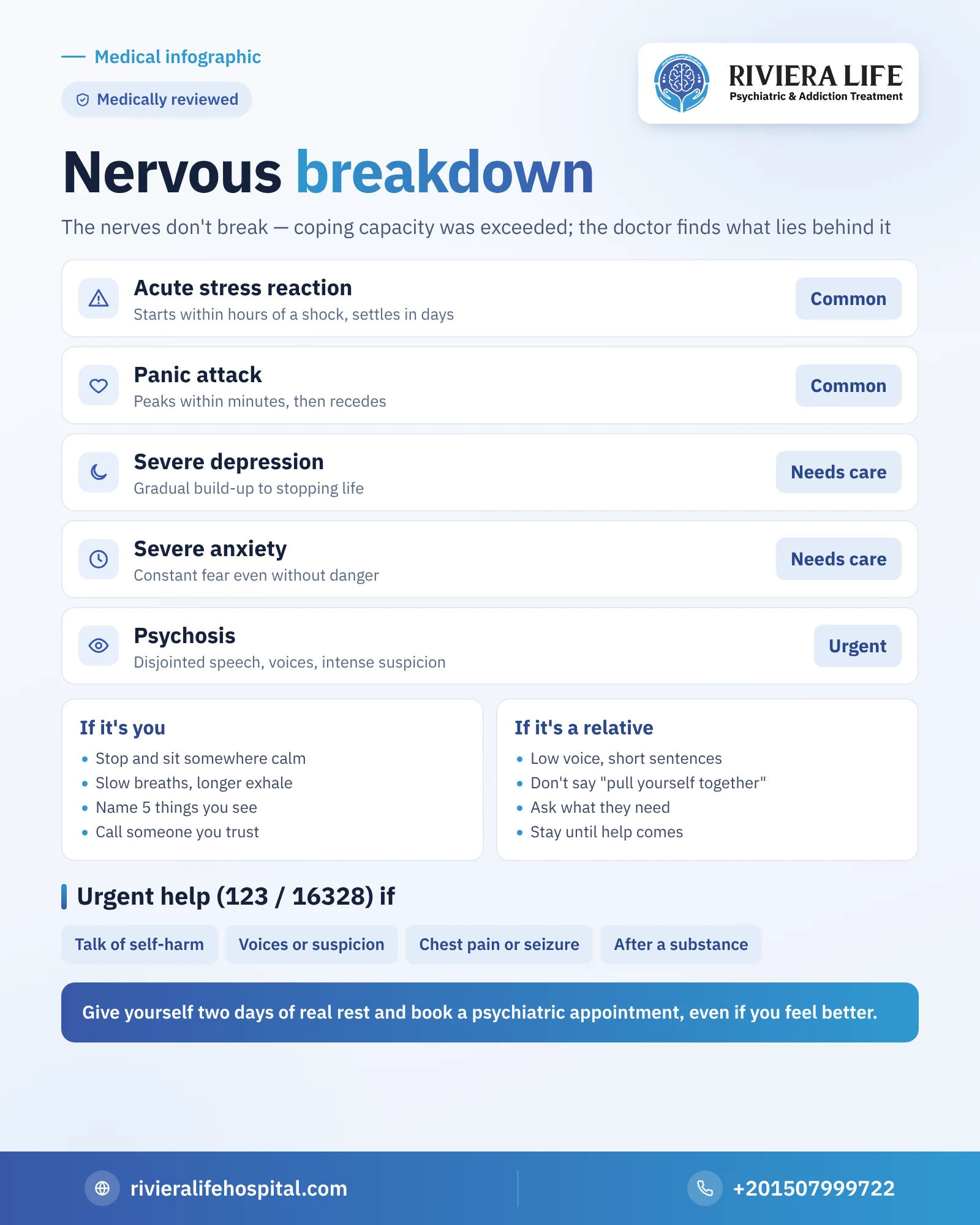
| Acute stress reaction | Daze, crying or confusion after a shocking event such as a death or an accident | Starts within hours of the event and usually settles within days |
| Panic attack | Palpitations, shortness of breath, trembling and fear of dying or going mad | Peaks within minutes, then recedes |
| Severe depression | Inability to leave bed, work or eat after weeks of sadness | A gradual build-up reaching the point of cutting off from life |
| Severe anxiety disorder | Tension that won’t settle, insomnia, bouts of crying and inability to concentrate | Continuous fear even without clear danger |
| Psychosis | Incoherent speech, intense suspicion, or hearing voices | Detachment from reality; needs urgent assessment |
Behind the condition there may also be withdrawal from a drug, alcohol or a sedative, recent use of a stimulant, or a physical cause such as a blood sugar or thyroid disorder. That is why it isn’t enough to call it a breakdown and leave it there.
Signs that precede or accompany a breakdown
A breakdown rarely comes out of nowhere. It is usually preceded by weeks or months of signals the person or those around them ignore:
- Escalating insomnia, or long sleep without rest.
- Crying for small reasons or without a clear reason.
- Irritability and outbursts of anger unlike the person.
- Withdrawal from work and friends, and neglect of appearance and eating.
- Repeated physical symptoms: headache, palpitations, stomach upset, constant fatigue.
- A feeling that things are out of control, or of detachment from oneself and the place.
- More cigarettes, sedatives or alcohol to hold on.
Many of these signals resemble the signs of burnout; the difference is that a breakdown is the moment of rupture itself, while burnout is a long path that may lead to it.
What do you do in the moment itself?
If you are the one going through it
- Stop what you are doing, and sit somewhere calmer if possible.
- Breathe slowly: a calm inhale, then a longer exhale, for a few minutes.
- Ground yourself in the place: name five things you see and four you can touch.
- Call someone you trust and simply tell them: “I’m not OK and I need you”.
- Don’t make big decisions now, and don’t take pills or alcohol to calm down.
If your relative is the one going through it
- Approach calmly, and speak in a low voice and short sentences.
- Don’t tell them “pull yourself together” or “it’s not that bad”.
- Ask them what they need: water, silence, or for you to sit beside them.
- Move dangerous objects out of their reach if they are very agitated.
- Stay with them until they calm down or help arrives.
If strong physical symptoms such as palpitations and shortness of breath appear, our article on panic attacks explains how to tell them apart from a heart problem.
When is the situation an emergency?
Seek urgent help immediately if you see
Call an ambulance on 123 or the mental health hotline on 16328, or go to the nearest emergency department, and don't leave the person alone.
- Talk of self-harm or ending life
- Incoherent speech, hearing voices or intense suspicion of those around
- Aggression or threats to harm others
- Chest pain, fainting, a seizure or severe confusion
- Disturbance after using a substance or suddenly stopping a sedative or alcohol
In these situations don’t wait for it to “settle on its own”. Some causes of an apparent breakdown need a physical and psychological examination the same day.
Can a nervous breakdown cause death?
A nervous breakdown in itself doesn’t kill. Palpitations, shortness of breath, trembling and the feeling that the person is going to die are terrifying symptoms, but they are mostly a physical response to stress and severe anxiety that settles with time. This doesn’t mean the situation is without risk; the real danger comes through three doors:
- Thoughts of self-harm: they may accompany the severe depression that is called a breakdown, and they are enough reason to seek urgent help the same day.
- A hidden physical cause: chest pain or fainting may come from a heart problem or something else, so don’t attribute them to nerves before an examination.
- What the person does to calm down: excessive alcohol or sedatives, or going without food and sleep for days, adds a real physical risk.
After the moment calms: the following hours and days
Many feel ashamed after the situation calms, so they try to return to work the next day as if nothing happened. It is better to give yourself two days of real rest, tell someone close what happened, and book an appointment with a psychiatrist within a few days, even if you feel better. What happened is a message from your body and mind that the load is greater than your capacity, and ignoring it makes a repeat more likely.
Who is more at risk?
- Those going through chronic, accumulated pressure at work, in the family or with money.
- Those who have lost a loved one or recently been through a shocking event.
- Those with a history of depression, anxiety or bipolar disorder.
- Those suffering from chronic insomnia, because lack of sleep weakens endurance.
- Those who use drugs or misuse sedatives.
- Those who live alone without a support network.
How is what happened assessed?
The psychiatrist starts with the story of what happened from the person and from someone close to them. He asks about the duration of symptoms, sleep, appetite, thoughts, substances used and physical illnesses. He may request simple tests to rule out a physical cause. The aim is to turn the vague word “breakdown” into a clear diagnosis with a clear treatment.
How long recovery from a nervous breakdown takes and the steps to recovery
Recovery depends on the cause. An acute stress reaction usually improves within days to weeks with rest and support. Severe depression or an anxiety disorder needs structured treatment that may continue for months, usually combining psychotherapy, such as cognitive behavioral therapy, and medicine that the doctor decides on when needed.
There are elements almost everyone needs:
- Real rest: leave from work if needed, without feeling guilty.
- Regular sleep: because it is the first thing to be disturbed and the first that must be fixed.
- A gradual return: to work and responsibilities step by step, not all at once.
- Dealing with the source: the pressure that led to the breakdown will return if it stays as it is.
- An early warning plan: a list of the signs that preceded the breakdown, so the person and their family can act when they appear again.
Common myths
- “A breakdown means madness”: not true; most cases are anxiety, depression or a stress reaction, and are treated well.
- “Whoever breaks down is weak”: a breakdown strikes the strongest people when the load exceeds any human being’s capacity.
- “Two days of rest are enough”: sometimes they may be, but a recurring or severe condition needs assessment.
This confusion between anxiety and depression and “madness” is fed by an old popular division explained in our article on the difference between psychological and mental illness.
How can Riviera Life help you?
You can call us in the moment itself or afterwards. Consultant psychiatrists assess what happened, and determine whether outpatient treatment is enough or the condition needs a short stay under round-the-clock medical supervision until it stabilizes, involving the family in the return plan. The first consultation is free and confidentiality is complete.
Read also
- Panic attacks and what to do during them
- Burnout
- The behavior of a mentally ill person and how the family responds
- Mental illnesses: symptoms, types and treatment
- Midlife crisis: the signs, causes and how to get through it
- Adjustment disorder: when does a reaction to a crisis become a disorder?
Questions many people ask
The suffering is real, but the term is popular, not a diagnosis. The psychiatrist determines what lies behind it, such as an acute stress reaction, depression or severe anxiety.
An acute stress reaction usually settles within days, but if depression or an anxiety disorder lies behind it, it needs treatment that may extend for months.
No, the nerves aren't damaged in these conditions. What happens is that pressure exceeded the person's ability to cope, so psychological and physical symptoms appeared.
Not always. A short stay is advised if there is a risk to oneself or others, psychotic symptoms, or complete inability to look after oneself.
By treating the cause, regulating sleep, reducing sources of pressure, and making a list of early warning signs to act on when they appear.