Adjustment disorder is an exaggerated or prolonged psychological reaction to a specific stressful event, such as losing a job, a separation, moving to a new country or an illness diagnosis. It begins within about three months of the event, and appears as sadness, anxiety, irritability or a change in behavior, stronger than the circumstances would lead you to expect, or disrupting study and work. It isn’t a weakness of character, it is one of the most common psychiatric disorders, its treatment through talking and support usually succeeds, and improvement is the rule. In this article we explain its signs and types, the difference between it, depression and trauma, and when it calls for help.
What is adjustment disorder?
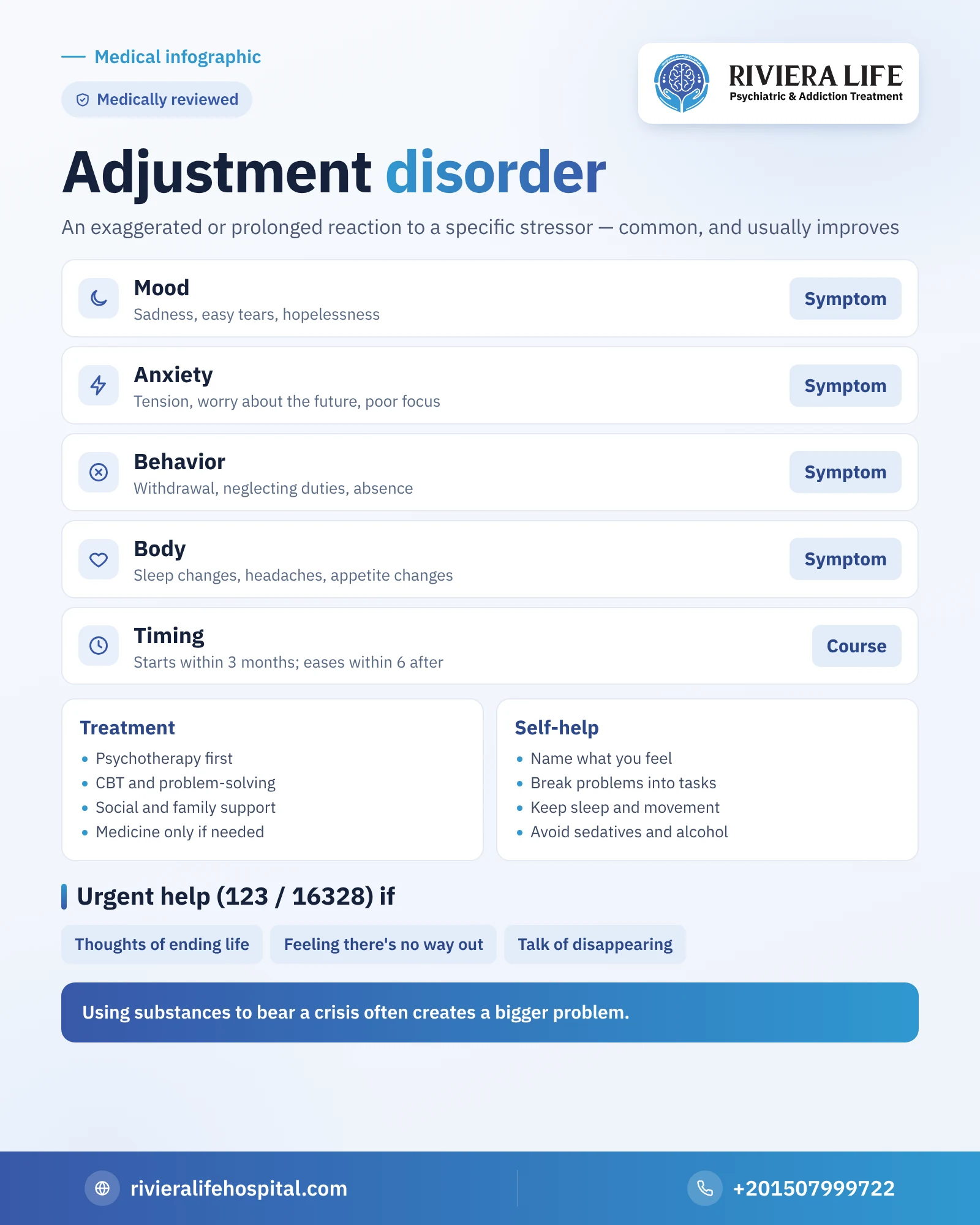
Everyone is affected by crises, and this is natural. It becomes adjustment disorder when the reaction goes beyond the expected limit in severity or duration, or disrupts functioning at work, in study and in relationships. According to the diagnostic manual, symptoms begin within three months of the stressor occurring, and are expected to settle within six months after it ends or after adjusting to its consequences. So by its nature it is linked to a clear cause and a time period.
It affects children, teenagers, adults and older people alike. The event needn’t be huge: the stressor may be single, such as a divorce or the death of a relative, multiple, such as work pressures, debts and family disputes together, or recurring, such as a whole year of exams or an ongoing dispute.
The symptoms: what does it look like?
- Mood: sadness, crying easily, and a feeling of emptiness or loss of hope.
- Anxiety: tension, irritability, fear of the future and difficulty concentrating.
- Behavioral: withdrawal from people, neglecting responsibilities, absence from work or school, and in teenagers behavioral problems, defiance or rule-breaking may appear.
- Physical: insomnia or excessive sleep, headaches and muscle aches, changes in appetite, and palpitations or stomach tightness.
Types by dominant picture
Doctors classify the disorder by its most prominent symptoms: a type dominated by depressed mood, a type dominated by anxiety, a mixed type of the two, a type dominated by disturbed behavior, a type combining emotion and behavior together, and an unspecified type. This division helps choose treatment and isn’t a classification of the person themselves.
What causes adjustment disorder?
The direct cause is the stressor, but why is one person affected more than another by the same event? Here several factors come in:
- The nature of the stressor: its size, its duration and how much it can be controlled.
- Personal predisposition: mood sensitivity, thinking style and childhood experiences.
- Lack of support: loneliness and having no one to confide in double the effect.
- Accumulated stress: a small event against a background of long exhaustion may be the last straw.
- A previous psychiatric disorder: someone with anxiety or depression is more vulnerable.
The difference between adjustment disorder, depression and trauma
| Aspect | Adjustment disorder | Depression | Post-traumatic stress disorder |
|---|---|---|---|
| Cause | A specific stressor, not necessarily severe | There may be no visible cause | A traumatic event threatening life or safety |
| Symptoms | Sadness, anxiety or disturbed behavior linked to the situation | Low mood, loss of pleasure and multiple symptoms together | Reliving the event, nightmares, avoidance and hypervigilance |
| Duration | Usually settles within months after the stressor ends | At least two weeks, and may last longer | Continues for more than a month |
| Treatment | Support and short psychotherapy | Psychotherapy and medicine depending on severity | Specialist trauma therapy |
The boundaries between the conditions aren’t always clear, and adjustment disorder may turn into depression if it lasts and worsens. Learn about depression symptoms, the difference between sadness and depression and PTSD symptoms. To understand stress in general, read psychological stress, and for work exhaustion, burnout.
When is it normal, and when isn’t it?
Accepting sadness after a loss or setback is a natural part of life. Ask yourself: can I carry out my basic tasks despite the tiredness? Do I feel gradual improvement over the days? Does what I feel match the size of what happened? If the answers are no, a month has passed and you are getting worse, or you have started turning to smoking, sedatives, alcohol or drugs to ease the pain, seek an assessment. Using substances to bear the crisis often creates a bigger problem.
Seek urgent help immediately if you see
Adjustment disorder may be accompanied by thoughts of self-harm and shouldn't be underestimated however simple the cause seems. Call an ambulance on 123 or go to the nearest emergency department, or call the mental health line on 16328.
- Thoughts of ending life or self-harm
- A feeling that there is no way out and no hope
- Preparing to self-harm, or talking about wanting to disappear
Talk to someone you trust and don’t stay alone, and read about suicidal thoughts and how to ask for help.
How long does adjustment disorder last?
Usually the symptoms ease gradually as the stressor ends or the person gets used to it, within about six months after it ends. But if the stressor is ongoing, such as a chronic illness, a long financial crisis or an endless dispute, the symptoms may last longer. Here treatment becomes more important, because the disorder continuing without help may pave the way for depression, chronic anxiety or addiction.
How is it diagnosed?
The doctor or therapist listens to the whole story: what the event was and when, what the symptoms are and when they began, and how they affected functioning. Then they rule out other disorders such as severe depression, generalized anxiety, PTSD, or the effect of a substance or a physical illness such as the thyroid. There is no test or scan that confirms the diagnosis; it is clinical, relying on the history and psychological examination.
Treatment: talking first
- Psychotherapy: the foundation. It helps understand what happened, regulate emotions, and build a practical plan for dealing with the stressor.
- Cognitive behavioral therapy: re-examines negative thoughts and trains problem-solving.
- Social support: individual, group or family sessions that ease the feeling of loneliness.
- Relaxation skills and lifestyle: regular sleep, movement, contact and following a daily routine.
- Medicine when needed: not the first line of treatment, but the doctor may prescribe short-term treatment for severe insomnia, anxiety or accompanying depression. It isn’t started or stopped except under the doctor’s supervision.
Learn how cognitive behavioral therapy and its sessions work.
Adjustment disorder in children and teenagers
In young people the effect shows in behavior more than words: academic decline, a return to behaviors younger than their age such as bedwetting or clinging tightly to their mother, new outbursts of anger, repeated complaints of stomach ache and headache, or refusing to go to school. The usual causes are parents separating, changing school, the birth of a new sibling, losing a relative, or bullying. It helps to explain what is happening to them in simple, honest language, to keep their routine, and to seek an assessment by a child psychologist if the change lasts more than a few weeks.
How can you help yourself and your family?
- Name what you feel instead of denying it, as acknowledging pain is the first step.
- Divide the problem into small tasks, and start with the easiest.
- Keep up sleep, eating and movement, even at a minimum.
- Don’t isolate yourself, and pick one or two people to talk to regularly.
- Stay away from smoking, sedatives and alcohol as a way of getting rid of pain.
- With a teenager: listen before advising, and avoid punishing behavior that appeared during the crisis before understanding its cause.
How can Riviera Life help you?
The consultant psychiatrists at Riviera Life assess your case, distinguish between adjustment disorder and depression or anxiety, and set a suitable psychotherapy plan for you, in complete confidentiality. The first consultation is free, and you can call on +201507999722.
More from our depression and anxiety guide
- Depression: a complete guide
- Anxiety: a complete guide
- Psychological trauma: normal reactions and what helps
- Psychological stress: its signs and effect on the body
Questions many people ask
Normal sadness matches the size of the event and eases gradually without disrupting your life. In adjustment disorder the reaction is stronger or longer than expected, or disrupts work, study and relationships.
Its symptoms begin within about three months of the stressor, and usually settle within six months after it ends. If the stressor itself continues, symptoms may last longer, and here treatment helps.
This may happen if it lasts and worsens, and it is then diagnosed as depression if its symptoms are complete. That is why seeking help shouldn't be delayed when the state continues.
Psychotherapy is the foundation, and medicine isn't a first choice. The doctor may prescribe short-term treatment for severe insomnia or anxiety, and it isn't started or stopped except under their supervision.
Yes, and in them it usually shows in behavior: academic decline, anger, excessive clinging or physical complaints after an event such as parents separating or moving to a new school.