Treating excessive irritability begins with a simple question many ignore: why am I so irritable? Constant agitation usually isn’t a fixed trait, but a symptom of something deeper, which may be chronic stress, anxiety, depression, lack of sleep, drug use or a thyroid imbalance.
Once the cause is known, treatment becomes clear: practical skills to control anger as it happens, daily changes that reduce the fuel that ignites it, organized psychotherapy, and medication in specific cases decided by the doctor. In this article we explain this step by step for men and women alike, while the hormonal side specific to women is in our article on excessive irritability in women.
When does irritability become a problem that needs treatment?
Anger is a natural and sometimes useful feeling; it alerts us to injustice or a line being crossed. The problem begins when the reaction becomes much bigger than the situation, faster than your ability to think, or so frequent that those around you have started to avoid you. An employee who replies sharply to every email, a father who shouts at his children then spends the night regretting it, and a wife who has felt for months that “everything provokes her”: these are pictures of irritability that has gone too far.
Ask yourself frankly: do you often regret what you said in a moment of anger? Have you lost a relationship or a job because of your temper? Do you feel constant inner tension even on calm days? Has it reached the point of breaking things or pushing someone? Answering yes to more than one question means the matter deserves an assessment, not more patience.
Why have I become irritable all the time? The most common causes
Chronic stress and exhaustion
When the body lives under psychological stress for a long time, the alarm system stays on alert, so a small spark is enough to ignite a big reaction. Debts, work pressure and caring for a sick person at home are among the things we most often see behind this state.
Anxiety
Anxiety doesn’t always appear as fear. In many people it appears as tension, quick arousal and intolerance of interruption or noise, because the mind is busy all the time with bad expectations.
Masked depression
Especially in men and teenagers, depression may appear as anger and irritability rather than sadness and crying. Loss of pleasure, fatigue and changed sleep together with irritability are an important sign that shouldn’t be ignored.
Lack of sleep
One or two nights of poor sleep are enough to reduce the brain’s ability to restrain emotion. And someone suffering from chronic insomnia lives all their days on a short fuse.
Substances and withdrawal
Stimulants such as captagon and ice raise aggression directly, and alcohol weakens the brakes. And withdrawal from tramadol, hashish, sedatives or even nicotine and caffeine is well known for causing intense irritability in the first days.
The thyroid and other physical causes
An overactive thyroid causes tension, palpitations, weight loss and irritability, and may be misdiagnosed as anxiety. Other physical causes include low blood sugar when hungry, chronic pain, some medicines such as cortisone, and sometimes neurological changes in older people.
ADHD
An adult with ADHD may complain of impulsivity and quick explosions followed by quick calm, with a long history of forgetfulness and leaving tasks unfinished. Treating the disorder itself greatly eases the irritability.
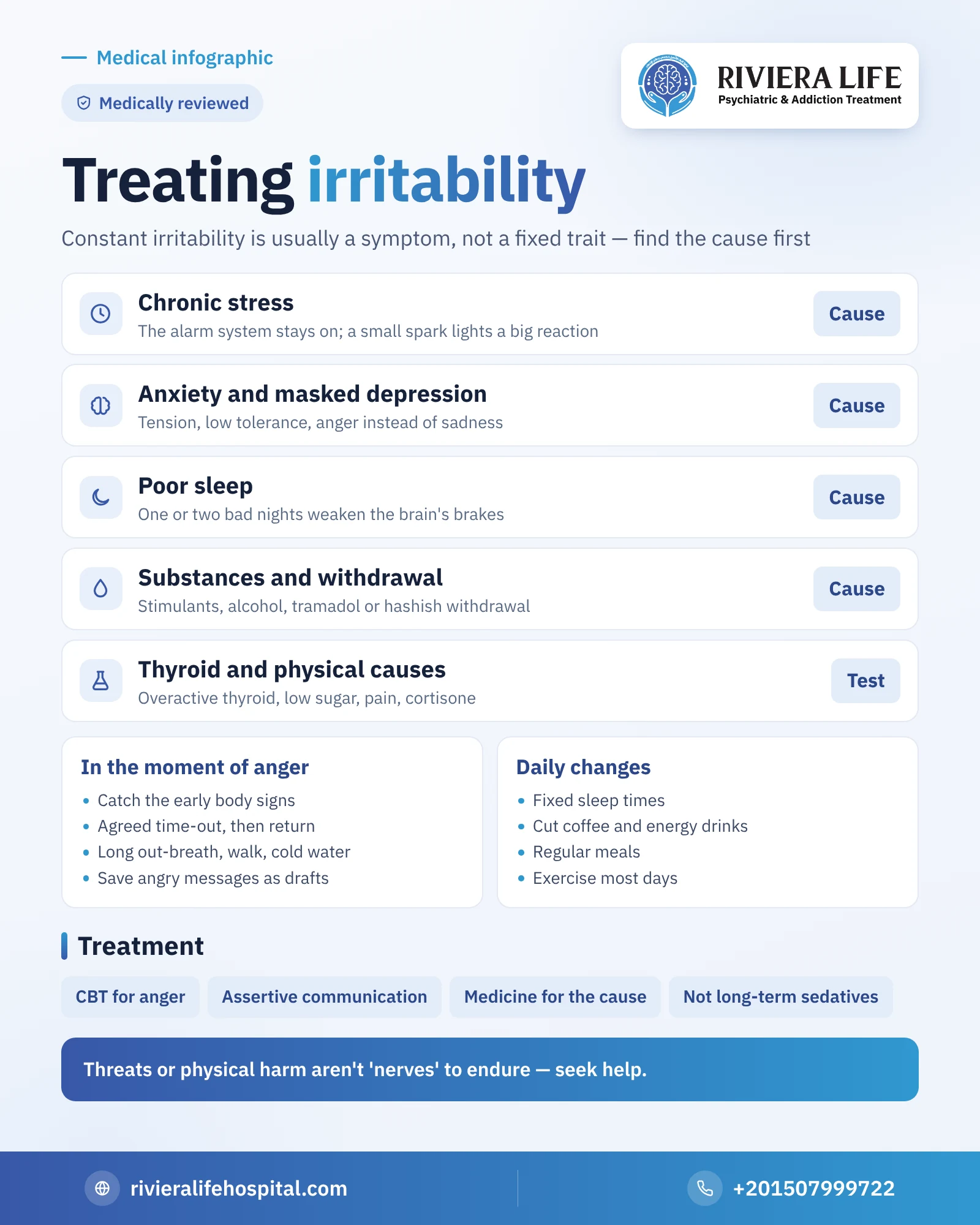
The first step in treatment: knowing the cause
There is no point treating irritability with general advice if its cause is a thyroid imbalance or undiagnosed depression. So the psychiatrist starts with a detailed interview: when did the irritability begin? Does sadness, anxiety or insomnia accompany it? What medicines do you take? Is there drug use or recent stopping of a substance? They may request simple tests such as thyroid function, a blood count and sugar. It helps a lot for someone close to attend, because an irritable person usually minimizes the size of the problem or sees it as a natural reaction to “other people’s provocation”.
Practical steps to control irritability in the moment of anger
Anger follows a curve: it starts with physical signals, then rises quickly, then settles if it isn’t fed. The aim is to intervene before the peak:
- Catch the early signals: heat in the face, a tight jaw, a clenched fist, a rising voice. This is your golden moment.
- Ask for an agreed time-out: a short sentence such as “I’ll be back in twenty minutes so we can continue”, then actually step away. A time-out isn’t running away if you come back to talk.
- Slow your body down: an out-breath longer than the in-breath for two minutes, a brisk walk, or cold water on the face.
- Postpone the written reply: don’t send an angry message now; write it and save it as a draft until the morning.
- Review the thought that set you off: “he is deliberately insulting me” may be “he is busy and didn’t notice”. Changing the interpretation changes the size of the reaction.
Daily changes that reduce irritability at its roots
What you do in the calm hours determines how much you will explode in the hard ones:
- Fixed times for sleeping and waking, and keeping the phone away from the bed.
- Reducing coffee and energy drinks gradually, especially after the afternoon.
- Regular meals, as long hunger shortens the fuse for many people.
- Physical activity most days of the week; brisk walking alone releases part of the accumulated tension.
- Cutting down smoking gradually with a plan, not stopping suddenly in an exam week or a period of work pressure.
- Identifying which sources of stress can be changed, and sharing responsibilities instead of carrying them alone.
Psychotherapy for excessive irritability
The most evidence-based approach is cognitive behavioral therapy designed for anger management, offered individually or in groups over a number of sessions. Through it the patient learns to draw a “map of their anger”: the situations that provoke them, the thoughts that pass through their head, what their body feels, and what they do afterward. Then they practise specific skills:
- Re-evaluating hostile thoughts and generalizations such as “always” and “no one respects me”.
- Assertive communication: saying what bothers you clearly without shouting or insulting.
- Solving problems instead of ruminating on a sense of injustice.
- Regular relaxation exercises to lower the baseline level of tension.
If emotions are intense and changeable, with a sense of emptiness or impulsivity, the therapist may suggest emotion regulation skills drawn from dialectical behavior therapy. And when the marriage or family is the main arena of conflict, joint sessions help, because the pattern of provocation and response needs both sides to change.
When does the doctor consider medication?
There is no “medicine for irritability” taken in every case. Medication is directed at the cause: antidepressants from the serotonin reuptake inhibitor class if depression or anxiety lies behind the irritability, ADHD medicines if the diagnosis is confirmed, mood stabilizers if the outbursts are part of bipolar disorder, and thyroid treatment with an endocrinologist if that is the cause. Sedatives and pregabalin, however, aren’t suitable as a long-term treatment for irritability, because they can cause dependence, and many of the addiction cases we see began with a pill “to calm the nerves” without a prescription. Choosing the medicine, its dose, and changing or stopping it is a decision for the treating doctor alone.
Irritability and addiction: a cycle that feeds itself
Some people turn to hashish, alcohol or tramadol to calm down, feel temporary relief, and then the irritability returns stronger when the effect wears off or the next dose is late. Over time, drug use itself becomes the source of agitation: money disputes, insomnia and withdrawal swings. This situation needs treatment of both sides together through the dual diagnosis program, because treating the addiction alone leaves the irritability without skills, and treating the irritability alone stumbles while the drug use continues.
How should the family deal with an irritable person?
- Don’t discuss sensitive topics at the moment of agitation; choose a calm time.
- Describe the behavior, not the person: “You shouted in front of the children yesterday” instead of “You’re an irritable person”.
- Agree on a time-out signal that both sides respect.
- Encourage a medical assessment in the language of care: “You’ve been tired for months, and I’m worried about you”.
- Your safety first: threats or physical harm aren’t “irritability” to be endured, but a red line that calls for seeking help.
When should you seek help?
Ask for a medical assessment if the irritability lasts more than two weeks without a clear cause, if it comes with sadness, insomnia, weight loss or palpitations, if it began after a new medicine or after stopping a substance, or if it has affected your work and relationships. And there are situations that can’t wait:
Seek urgent help immediately if you see
Call an ambulance on 123 or go to the nearest emergency department, and you can contact the mental health hotline on 16328 in case of:
- Threats of self-harm or thoughts of ending one’s life
- A serious threat to harm someone else, or repeated physical violence
- Irritability with confusion, hallucinations or seizures while stopping alcohol or sedatives
- Severe agitation after taking stimulants, with chest pain or a high temperature
The right hospital for treating excessive irritability: how to choose
The right hospital for treating excessive irritability is one that looks for the cause before prescribing the solution, and has the tools to deal with it, whether anxiety, depression, drug use or another disorder. Ask before you choose:
- Does the assessment begin with a consultant psychiatrist who rules out physical causes such as the thyroid?
- Is cognitive behavioral therapy for anger management offered, not just a prescription for a sedative?
- Can drug use or withdrawal be treated at the same time if it is part of the problem?
- Are there family or couples sessions to change the pattern of conflict at home?
- Are cases of danger to self or others handled under continuous supervision?
- Is the confidentiality of the patient and family fully respected?
Stay away from any provider that promises to rid you of irritability in days or with a magic pill.
How Riviera Life meets these standards
Here is how these criteria are met at Riviera Life:
- Consultants in psychiatry and addiction: an assessment that distinguishes between the different causes of irritability and treats the cause, not the symptom.
- Fourteen years of experience: and thousands of cases that have recovered and regained their relationships and work.
- Ministry of Health licensing: disciplined medical care according to official standards.
- Dual diagnosis treatment: when irritability is linked to hashish, tramadol or alcohol, or their withdrawal.
- Round-the-clock medical supervision: for cases that need a stay or careful adjustment of medication.
- A family program: because the home is a partner in breaking the cycle of provocation and response.
- Complete confidentiality: for every patient and their family.
- Aftercare: follow-up that maintains the skills after improvement.
The first consultation is free, and you can get in touch around the clock on +201507999722; our center is in Sheikh Zayed, Giza.
More from our anxiety guide
- Anxiety: the complete guide
- Excessive irritability in women: hormonal and psychological causes
- Psychological stress: its signs and how to deal with it
- Overthinking: rumination, anxiety and techniques to stop it
- Intermittent explosive disorder: when anger gets out of control
- Anger test: an instant result
Questions many people ask
It usually isn't an independent diagnosis, but a symptom that may have anxiety, depression, lack of sleep, drug use or a physical cause behind it. That is why treatment focuses on discovering the cause first.
Sedatives calm temporarily but may cause dependence and don't treat the cause. The right medicine is chosen by the doctor according to the diagnosis, such as antidepressants if anxiety or depression lies behind the irritability.
Many notice improvement within several weeks of regular anger management sessions with practice at home. The duration varies with the cause and severity.
Yes, an overactive thyroid may cause tension, palpitations, irritability and weight loss. A simple thyroid function test reveals it and directs treatment to an endocrinologist.
Choose one that looks for the cause and treats it, whether anxiety, depression or drug use: a consultant-led assessment that rules out physical causes, CBT for anger, dual-diagnosis care and family sessions. Riviera Life in Sheikh Zayed meets these criteria, with round-the-clock supervision.