Psychological resilience is a person’s ability to adapt to stress, trauma and loss, then return to balance without breaking or losing their ability to live. It doesn’t mean you don’t feel pain, nor that you suppress and endure in silence. It means you feel pain and get back up, and learn from the experience. Perhaps the most important point is that this ability is built and strengthened through practice, and one of its strongest elements is the way you treat yourself when you stumble, that is, self-compassion. Here we explain what resilience is, what creates it, how to build it step by step, and when relying on it alone isn’t enough.
What is meant by psychological resilience?
The American Psychological Association defines resilience as the process of adapting well in the face of adversity, trauma, threats or significant sources of stress, such as family, health, work and financial problems. The key here is the word “process”: it isn’t a trait some are born with and others are denied, but skills and habits that form over time and change from one stage to another. You may be resilient at work and fragile in relationships, and you may be strong this year and exhausted next year.
Common misconceptions about resilient people
- “A resilient person doesn’t cry”: they do cry, grieve and get angry, but they don’t stay stuck in the feeling.
- “Whoever asks for help is weak”: the opposite is true, as social support is one of the strongest protective factors.
- “Whoever bears everything alone is successful”: blind endurance leads to depletion, including burnout.
- “Resilience means always being optimistic”: realistic optimism is useful, but denying reality is harmful.
- “Whoever has been through trauma has lost the ability”: many recover and grow after crises, and some need treatment to get there.
What creates resilience?
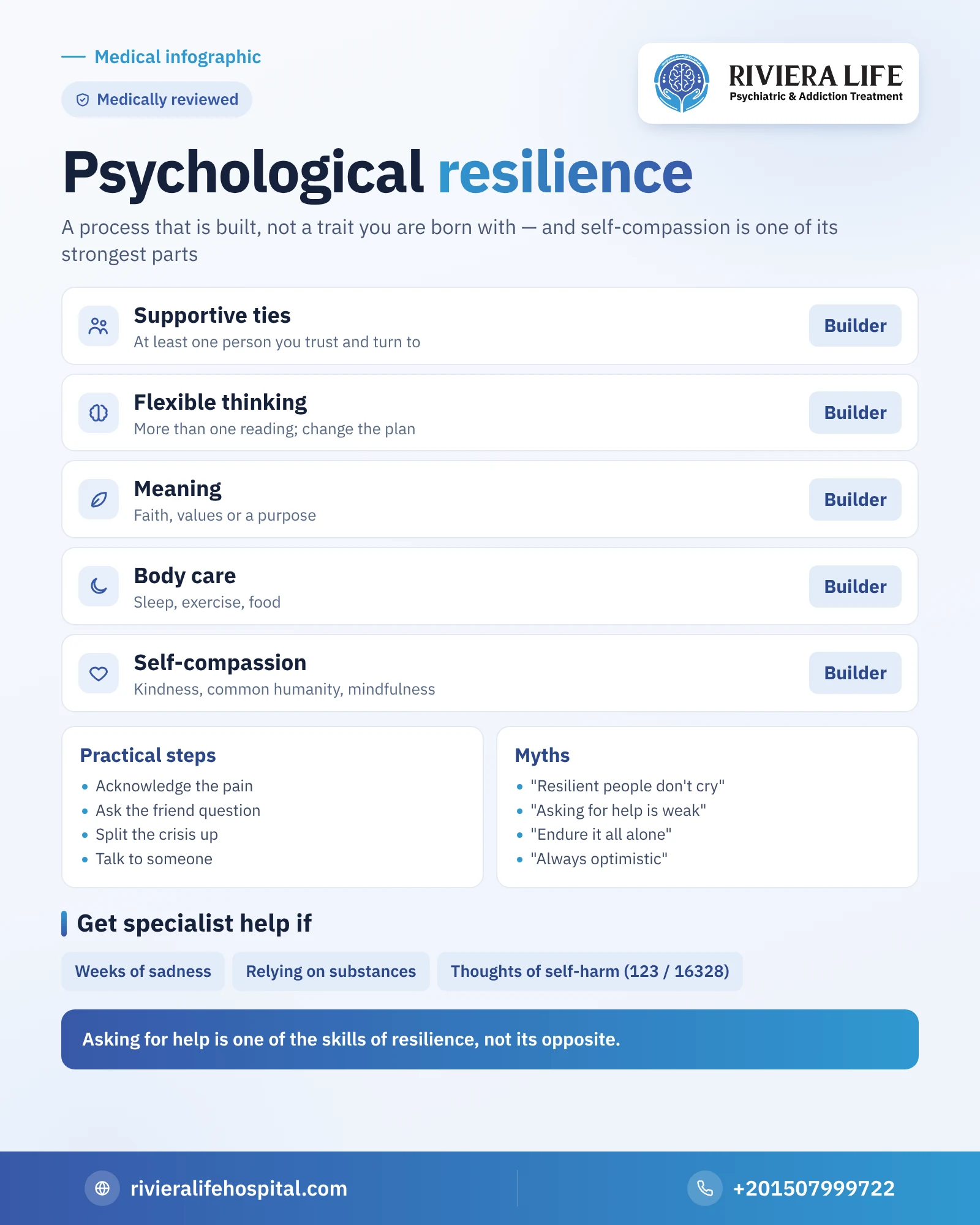
- Supportive relationships: at least one person you trust and turn to, from family, friends or work colleagues.
- Flexible thinking: the ability to see more than one explanation for a situation, and to change the plan when it doesn’t work.
- A sense of meaning: faith, values or a mission that gives pain a context and eases the feeling of futility.
- A sense of possible control: focusing on what you can do instead of what is beyond you.
- Caring for the body: sleep, exercise and food, because an exhausted body can’t bear crises.
- Problem-solving skills: dividing a big problem into small steps.
- Self-compassion: the subject of the next section.
What is self-compassion?
It is treating yourself at a time of failure or pain as you would treat a dear friend. The researcher Kristin Neff, who has studied this concept extensively, describes it with three elements:
- Kindness to oneself: instead of self-punishment, you give yourself a supportive word.
- Common humanity: you remember that mistakes and pain are part of every human’s experience, and that you aren’t the only one.
- Mindfulness: you see your pain as it is, without exaggerating it and without denying it.
It differs from self-pity, which isolates you and makes you see yourself as a lone victim, and from self-esteem, which depends on your success and people’s evaluation. According to multiple studies, self-compassion is linked to lower anxiety and depression and a better ability to try again after failure, but studies differ in their details.
Isn’t self-compassion just being lax?
This fear is common in our culture, which links seriousness with being hard on oneself. But harshness doesn’t create discipline, it creates fear, and a frightened person avoids trying. Self-compassion doesn’t cancel standards; you still want to improve, but you do so without tearing yourself down. It is the difference between a coach who says “try again and I’ll help you” and a coach who says “you’re a failure”. The first produces champions.
How to build your resilience: practical steps
- Acknowledge the pain: say to yourself “this really is hard” before saying “I have to get over it”.
- Ask yourself the friend question: what would I say to my closest friend if they went through this? Then say it to yourself.
- Split up the crisis: write down what can be controlled and what can’t, and start with the smallest step that can be carried out today.
- Keep the body’s routine: steady sleep, movement and regular food, even on the worst days. If stress is high, our article on how to lower cortisol gives practical ideas.
- Talk to someone: not necessarily to find a solution, but to lighten the load.
- Reframe the story: what did this situation teach me? What has become clearer? Without minimizing your loss.
- Make room for meaning: prayer, meditation, work that serves others, or a hobby that nourishes you.
- Practice breathing and calm: minutes of slow breathing lower emotional arousal at the moment of crisis.
- Celebrate the small things: because an exhausted mind forgets what it has achieved.
Questions to help you gauge your current resilience
This isn’t a test or a diagnosis, but a quick mirror that shows where you need support:
- Who do I call first when things go wrong? And do I have more than one person?
- How many nights did I sleep well in the last week?
- When I make a mistake, is my inner talk dominated by scolding or by learning?
- Can I bear a bad day without generalizing the judgment to my whole life?
- What gives my days meaning, even in difficult periods?
If a weak point appears to you, choose just one and start with it this week, as a small continuous change is more useful than a huge plan abandoned after two days.
Resilience in the family and at work
Children learn resilience from adults more than they learn it from words. When a son sees his father admit a mistake and fix it, and when a mother talks about her feelings without collapsing, a model forms in him. Parents don’t protect him by keeping every difficulty away from him, but by accompanying him as he deals with it. And at work, teams that allow mistakes and learning from them protect their members from exhaustion more than those built on blame. It also helps to review our article on psychological stress to know its early signs.
Resilience after trauma and in addiction recovery
Severe trauma may exceed even the strongest people’s capacity to cope, and symptoms such as nightmares, avoidance and constant fear don’t mean weakness. Here you need specialist treatment, and you will find a clearer picture in our article on post-traumatic stress disorder symptoms. In addiction recovery, resilience means dealing with a slip without it turning into a full relapse, and seeing relapse as a signal to adjust the plan, not the end of the road, as in the stages of addiction recovery.
When resilience alone isn’t enough
- Severe sadness or anxiety that continues for weeks and disrupts your life.
- Persistently disturbed sleep or appetite, or loss of interest in everything.
- Increasingly turning to alcohol, sedatives or drugs to bear the stress.
- Thoughts of self-harm or ending life, and then call an ambulance on 123 or the mental health hotline on 16328.
Asking for help is one of the skills of resilience, not its opposite. Cognitive behavioral therapy is one of the methods that most trains flexible thinking. And if medicine is needed, it is by the doctor’s decision only.
How can Riviera Life help you?
If you’ve been through a crisis that exhausted you or stresses have piled up beyond your capacity, Riviera Life hospital in Sheikh Zayed, Giza, provides a psychological assessment with consultant psychiatrists and a treatment plan in complete confidentiality, with a family program and follow-up after treatment. The first consultation is free: +201507999722.
More from our mental health guide
- Low self-confidence and a weak personality
- Burnout
- Psychological trauma
- The post-traumatic stress disorder guide
Questions many people ask
The ability to adapt well to stress, trauma and loss and return to balance; it is a process that is built, not an innate trait.
They do feel pain and grieve, but they don't stay stuck, and they benefit from others' support and healthy coping methods.
Self-esteem depends on evaluation and success, while self-compassion is treating yourself kindly even when you fail.
No, it doesn't cancel standards; it lets you try again without fear of self-punishment.
When sadness or anxiety continues for weeks, with trauma symptoms, increasing reliance on substances, or thoughts of self-harm. A specialist is needed then.